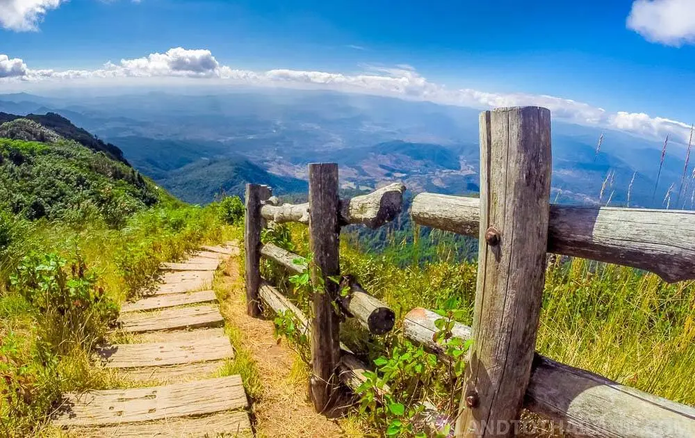

Most travellers visit Doi Inthanon for the summit sign, the twin royal pagodas, and the classic photo at Thailand’s highest point. What almost no one talks about, until they have been, is how completely different the mountain feels from the country below it. Doi Inthanon is not really a hike in the traditional sense. It is a full sensory shift — a slow reveal of a Thailand that looks, smells, sounds, and feels entirely unlike the one visitors arrive with in mind. This is a description of what a private trekking day at Doi Inthanon actually feels like, hour by hour, sense by sense.
Be Your Guides has run private trekking days at Doi Inthanon for years, and the observations below come from what travellers say afterwards about what surprised them most.
The Departure — Chiang Mai to the Mountain Foothills
A private Doi Inthanon national park tour typically begins with an early hotel pickup in Chiang Mai, somewhere between 6:30am and 7:30am. The city is already warm at this hour. Traffic thickens on the ring road, and the smell of markets opening, incense from morning temple offerings, and street food carts drifts through the vehicle windows even at low speed. This is the Chiang Mai most travellers know — busy, humid, tropical, sensory in every possible way.
Then the road climbs, slowly at first, then more steeply. Within thirty minutes of leaving Chiang Mai city, the vegetation begins to change. What comes next surprises almost every first time visitor.
The First Temperature Shift
The temperature on Doi Inthanon drops noticeably as altitude increases. A guided hike at Doi Inthanon almost always includes a moment somewhere around 1,200 metres where visitors instinctively reach for a jacket they packed on their guide’s advice without quite believing they would need it. Here is what actually happens to the senses:
- Air temperature drops from the humid low thirties down to the low twenties, then eventually into single figures near the summit
- The humidity that hangs heavily in Chiang Mai simply vanishes — the air becomes crisp and thin
- Sound changes character in cooler denser air, with bird calls and forest rustles carrying further
- The quality of the light softens as morning mist filters the sun
- The smell shifts from tropical fruit and food to damp forest, moss, and mountain earth
The Cloud Forest — A Different Thailand
Between 1,800 and 2,300 metres, Doi Inthanon enters cloud forest — a genuine ecological rarity in Thailand. This is where a private trekking tour on Doi Inthanon starts to feel like a different country entirely. Karen and Hmong hill tribe villages appear along the roadside. Coffee farms terrace the slopes. The trees are hung with mosses and lichens that only survive in the cool damp conditions found at this altitude.
The Ang Ka Nature Trail, near the summit, is where the cloud forest is most vivid. A short boardwalk winds through moss draped trees, past small mountain orchids, and around pools that reflect the canopy. Even in the middle of a Thai dry season, everything drips with moisture. Travellers who expected typical tropical Thailand often stand quietly here for several minutes, unable to reconcile the environment with the country they thought they were visiting.
The Twin Royal Pagodas — Silence and Perspective
The King and Queen pagodas, built at 2,100 metres in honour of the previous Thai monarchs, are among the most photographed spots on the mountain. But what visitors describe most often afterwards is not the architecture. It is the silence. Below the pagodas, the ground drops away into a panoramic view over layered mountains that stretch toward the horizon in soft blue gradients. On clear days you can see for tens of kilometres. On misty mornings the pagodas float above a sea of white.
A private Doi Inthanon mountain day with a private guide typically includes enough time here to actually absorb the view rather than rush through for the photograph. Group tours often allow twenty minutes. Private tours give as long as visitors want, which is usually closer to an hour once they realise what they are looking at.
The Sound of a Karen Village
Ban Mae Klang Luang is one of the Karen villages included on many private Doi Inthanon tours. The village sits in terraced valleys with coffee farms on the hillsides and small wooden houses along dirt paths. What visitors comment on most is the sound. Not silence exactly — there are children, chickens, cooking, occasional motorcycles. But the sounds are all human scale rather than urban scale. Nothing amplified. Nothing broadcast. Just a working village going about its day.
A private tour of Doi Inthanon national park usually includes time in the village for coffee at a family run stall. The coffee is roasted from beans grown on the slopes visible from the seat you drink it in. This closeness of source to cup is a genuine luxury and one of the sensory moments travellers cite most in feedback.
Wachirathan Waterfall — Water and Air
Wachirathan drops nearly eighty metres in a single powerful cascade. Standing at the viewing platform, the air is thick with spray, the sound of falling water dominates, and rainbows appear regularly in the mist. This is the most physically dramatic sensory moment on a private Doi Inthanon trekking day. The temperature drops sharply near the falls, spray coats everything within twenty metres, and the sheer volume of moving water creates a background sound that swallows conversation.
What to know for the sensory experience:
- Bring a light waterproof layer or accept that clothes will be misted
- Cameras and phones benefit from a small dry cloth for lens wiping
- The best rainbow moments appear between 10am and 12pm when the sun angles into the gorge
- The sound of the falls means you may need to raise your voice to speak to your guide
- The temperature drop of several degrees near the base of the falls is genuinely refreshing
The Descent — Returning to Chiang Mai
The drive back down Doi Inthanon in the late afternoon reverses the sensory journey of the morning. The temperature climbs. The humidity returns. The forest thins back into cultivated land, then into small towns, then into Chiang Mai suburbs, then into the city itself. By early evening you are back at your hotel with the sound of tuk tuks and market vendors outside your window. The contrast with where you were six hours earlier feels unreal.
Most travellers say afterwards that the Doi Inthanon day was among the most memorable of their Chiang Mai stay — not primarily because of any single stop, but because of the total sensory contrast with everything else the trip includes.
Who a Private Doi Inthanon Trekking Experience Suits
This kind of day works particularly well for specific traveller types:
- Travellers who have already seen the main Chiang Mai sights and want a complete change of pace
- Photographers wanting varied light, changing altitudes, and cultural stops in one day
- Nature focused travellers curious about Thailand’s cloud forest ecosystem
- Multi generation groups where the slower pace and cooler temperatures suit older travellers
- Families with children old enough to appreciate the geographic and cultural depth
- Repeat Thailand visitors looking for the parts of the country the standard itineraries skip
Combining the Mountain Day with the Wider Thailand Trip
Travellers ending a Chiang Mai stay with a mountain day often continue south to the Gulf of Thailand. A private van transfer from BKK to Pattaya a few days later, after the domestic flight back to Bangkok, keeps the transport standards consistent across the trip — private, comfortable, hotel to hotel — and provides a final geographic and sensory contrast between the northern mountains and the southern beaches.
Booking Your Private Doi Inthanon Day
Be Your Guides handles Doi Inthanon private trekking tours with the flexibility that a sensory focused day requires — early departures for the mist and light, time at each stop for the environment to reveal itself, and local Karen guides on the restricted trails. Book two to three weeks ahead for standard weeks, or a month or more for the cool season between November and February when the best guides fill quickly.
Doi Inthanon rewards travellers who slow down enough to notice what is actually happening around them. The mountain is not just a viewpoint. It is a slow sensory reveal of a Thailand that most visitors never realise exists. Given the day it deserves, it becomes one of the moments of the trip that stays vivid long after the photographs are put away.