
I chose three of my nine subjects because my friends were choosing them, and the one I dropped is the one I needed four years later. That is the whole lesson, and I could have learned it in an afternoon at fifteen if anyone had made me sit down and answer four questions honestly. Nobody did, and the choices got made in a corridor over about ten minutes. If you are about to pick, or you are a parent watching someone pick, this is what I wish I had understood before the form went in.
What actually happened
I was reasonably good at most things, which is the worst possible position to be in when choosing subjects. If you are clearly brilliant at maths and hopeless at languages, the decision makes itself. If you are fine at everything, you choose on vibes.
So I chose vibes. I took the subject my two closest friends were taking. I dropped the one whose teacher I did not like, which is a genuinely terrible reason and an extremely common one. I picked another because I had heard it was an easy A, which turned out to be untrue and also irrelevant, because I did not enjoy a single hour of it.
Four years later I applied for a course that assumed a background in the subject I had dropped. I got in, and then spent my first year quietly catching up on material everyone else had met at fifteen. It was survivable. It was also entirely avoidable.
The four questions
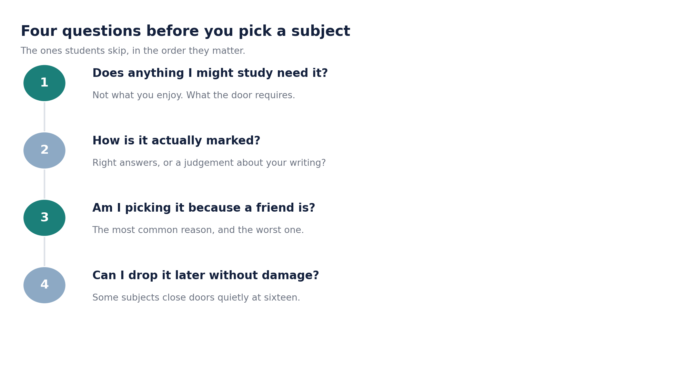
Diagram showing four questions to ask before choosing IGCSE subjects: what future study requires, how the subject is marked, whether the choice is driven by friends, and whether it can be dropped later without damage
Does anything I might study need it? Not what you enjoy. What the door requires. Look up three courses you might conceivably want at eighteen and check their stated subject requirements. This takes twenty minutes and almost nobody does it. You are not committing to anything. You are just refusing to close a door by accident.
How is it actually marked? This one nobody tells you, and the published subject curriculum sets it out plainly if you look. Some subjects are assessed on right answers, some on extended writing judged against descriptors, some on coursework built over months. These reward completely different temperaments. If you are strong under timed pressure but poor at sustained independent work, a portfolio subject will punish you regardless of talent. If the reverse is true, a subject that lives or dies on one two-hour paper will.
There is also a decent breakdown of which IGCSE subjects students find hardest that is more honest than corridor reputation, and worth ten minutes.
Am I picking it because a friend is? I was. You probably are, at least once. It is the most common reason and the worst one, because you will be in different sets within a term and different schools within three years.
Can I drop it later without damage? Some subjects build on themselves and some do not. Picking up a language at seventeen is hard. Picking up business studies is not. The subjects that compound are the ones to be careful about dropping.
What I got wrong about difficulty
I thought some subjects were easy and some were hard, and I chose accordingly.
The truth is more annoying: subjects are hard in different ways, and the published grade data makes this visible if you go looking. Some subjects require 30 percent of the marks for a grade C. Others require over 50 percent. That does not mean the first is easier. It means the paper is harder relative to the people sitting it, so the boundary drops to compensate.
Which is a long way of saying the difficulty rankings you hear in the corridor are mostly noise. What actually varies is the kind of demand. Some subjects demand precision. Some demand stamina. Some demand you carry an unresolved idea for months without panicking.
I would have been better served asking what kind of hard each subject was, and whether that matched me.
The thing about your teacher
I dropped a subject because of a teacher. I want to be direct about this because it is so common and so bad.
You will have that teacher for two years. You may have the subject for a decade. Trading a decade against two years is a poor exchange, and at fifteen it feels like the most reasonable decision in the world.
If a teacher is genuinely the problem, that is a fixable problem. Get help elsewhere, work with someone else, find a different explanation of the same material. Do not restructure your education around one person’s classroom manner.
What I would actually say
Sit down for one hour, not ten minutes in a corridor. Take the four questions in order. Write the answers down, because writing forces honesty in a way that thinking does not.
Then pick one subject purely because you want to. Not strategically. Not because it opens anything. Because you will be doing this for two years and a timetable made entirely of instrumental choices is a miserable thing to wake up to.
The one I chose that way is the one I still use. I did not plan that and I cannot take credit for it.
But I did make three choices for reasons I would be embarrassed to say out loud now, and those are the ones that cost me. Not because I ended up doing badly. Because I ended up somewhere I had to double back from, over a decision I made without thinking, in a corridor, at fifteen.
You get one afternoon to do this properly. Take the afternoon.
Rosalind Achebe writes about education, work and the decisions people make before they know enough to make them.