
Ask any shop owner what costs them the most money, and the answer usually isn’t parts or labor. It is the empty bay at 2 PM on a Tuesday that should have had a car in it.
Industry surveys consistently show no-show rates in auto repair landing between 20% and 45%, depending on the market. For a shop that books 30 appointments a day, even a 30% no-show rate means nine lost revenue opportunities every single day. Multiply that by 21 working days and you are looking at nearly 200 missed jobs a month.
The root cause is rarely lazy customers. It is a scheduling process that depends on memory, sticky notes, and manual phone calls. Fixing it does not require hiring another service advisor. It requires an appointment scheduling software for auto repair shops that treats every booking as a tracked, automated workflow from first contact to the moment the car rolls in.
Here are seven concrete ways the right system pays for itself.
1. Every Booking Lands in One Shared Calendar, Automatically
When appointments live in a paper book, a personal phone, and three different inboxes, things fall through the cracks. A customer calls, gets told “we will call you back,” and never hears from anyone.
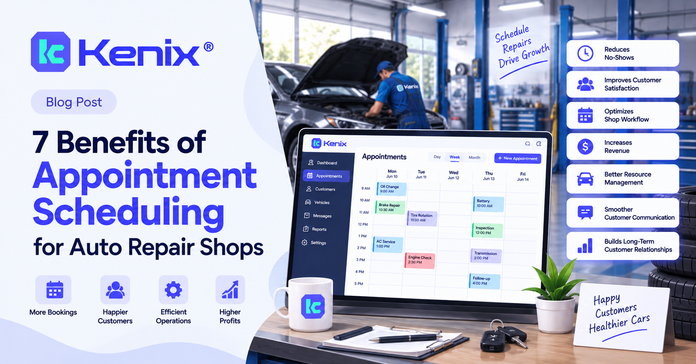
Modern scheduling tools generate appointments automatically the moment a customer books through a call, text, or web form. The whole team sees the same shared calendar, so the front desk, service advisors, and technicians are always looking at the same truth. No double bookings. No “I thought you took that call.”
If your shop is evaluating options, an auto repair appointment scheduler like Kenix builds this directly into the CRM, so the appointment and the customer record are never separated.
2. AI Matches Appointments to Actual Capacity
A slot on the calendar is not just a time. It is a promise about technician availability, bay space, and parts readiness.
This is where appointment scheduling AI earns its keep. Instead of letting a caller grab any open slot, the system weighs current workload, technician schedules, and shop hours, then suggests the slots that keep the day balanced. It can also classify incoming bookings by intent, distinguishing firm appointments from soft maybes and genuine lost opportunities, so your team spends its energy where the revenue is.
The result is a calendar that protects throughput instead of just filling squares.
3. Instant Confirmations Close the Loop Immediately
One of the biggest drivers of no-shows is ambiguity. The customer said “sounds good” on the phone, but nothing confirmed it. By Friday, they forgot.
Automatic SMS and email confirmations sent the second an appointment is booked change that dynamic. Better systems include trigger links that let the customer confirm, reschedule, or cancel in one tap. Confirming becomes a two-second action instead of a phone call they keep meaning to make.
Shops running this kind of automated confirmation flow routinely see show-up rates jump from the mid-50s to the mid-80s. That single improvement is often worth more than a new piece of equipment.
4. Timed Reminders Catch People at the Right Moments
A reminder sent three days early gets forgotten. A reminder sent while someone is driving gets ignored.
The sweet spots are 24 hours before the appointment, when people plan their next day, and 2 hours before, when the plan is still fresh. Texts at those two moments consistently outperform any other reminder timing. The best part: it is fully automatic, so your service advisors are not spending their mornings on reminder calls.
5. No-Shows Get Recovered Instead of Lost
Even with great reminders, some customers will still miss appointments. The difference between an average shop and a great one is what happens in the next hour.
A manual process means the no-show gets a call whenever someone remembers. An automated system re-enters that customer into a follow-up flow right away, sending a personalized reschedule invitation tied to their repair type. Some platforms go further and place a smart call directly to the customer, with a whisper feature that tells the service advisor who they are talking to before the line connects.
Shops using auto reschedule campaigns regularly recover 30% to 50% of no-shows within 48 hours. That is revenue a paper calendar simply cannot capture.
6. Owners Finally See the Numbers in Real Time
You cannot improve what you do not measure. Yet most shops only know their show-up rate because someone guessed at it during a slow afternoon.
A proper scheduling platform gives owners a live dashboard: total appointments, confirmed, showed up, missed, rescheduled, and show-up rate trend. Multi-location operators get the same view filtered by store, which makes it obvious which branch is overbooked and which one has unused capacity.
End-of-day reports land in the owner’s inbox automatically, summarizing attendance and flagging outstanding no-shows. That visibility changes how shops staff, schedule, and plan cash flow.
7. The Calendar Learns From Your Data
Over weeks and months, your appointment history becomes a decision-making asset. Appointment scheduling AI can surface patterns like:
- Which days and time slots convert best, so you prioritize booking calls during peak intent windows
- Which slots carry the highest no-show risk, so you run proactive confirmation campaigns before the problem happens
- Which advisors or service types drive the most reliable attendance
This is the shift from managing a calendar to managing a system. The calendar stops being an administrative burden and becomes a revenue tool.
What to Look For Before You Buy
Not every scheduling tool fits a repair shop. Generic tools built for salons or clinics miss the operational reality of bays, technicians, and parts. When you evaluate options, insist on:
- Automatic appointment creation from calls, texts, and automations
- AI-assisted scheduling that respects workload and technician availability
- SMS and email confirmations with one-tap trigger links
- 24-hour and 2-hour reminder automation
- Automatic no-show recovery and reschedule campaigns
- Real-time KPI dashboard with multi-location filters
- Native integration with your CRM and phone system
If the tool requires double entry or lives outside your existing workflow, your team will quietly stop using it.
The Bottom Line
Empty bays are not a customer problem. They are a process problem. Shops that move to a dedicated appointment scheduling software for auto repair typically see show-up rates climb from the mid-50s into the mid-80s, recover a large share of no-shows automatically, and give owners real visibility into daily performance without adding staff.
The best way to know whether it works in your shop is to run it during real operating hours and watch the numbers. Several platforms, including Kenix, offer pilot programs with no upfront cost, so you only commit once the results are proven. Book a walkthrough, connect your calendar for two weeks, and let your show-up rate make the case.