
Texas hospital administrators are investing in acoustic upgrades to protect Medicare and Medicaid reimbursements tied to HCAHPS quietness scores, meet HIPAA speech privacy requirements, reduce nurse burnout driven by alarm fatigue, and accelerate patient recovery. With over 630 licensed hospitals and a $1.5 billion state behavioral health construction program already underway, acoustic performance has become a non-negotiable clinical, legal, and financial priority across Texas.
The World Health Organization recommends hospital wards stay below 30 decibels at night. Most Texas hospitals operate between 60 and 70 decibels – more than twice that safe threshold. That gap has measurable financial consequences under CMS reimbursement rules, real legal exposure under HIPAA, and direct clinical consequences measured in extended patient stays, higher nurse turnover, and increased medical errors.
This is not a comfort decision. It is a compliance, safety, and financial performance decision that Texas administrators can no longer defer.
Texas sits at the intersection of every pressure driving this investment. With over 630 licensed hospitals – the second-largest hospital network in the country – and a construction boom that has pushed healthcare build costs up 30 to 40 percent in recent years, acoustic performance has moved from afterthought to strategic priority. Whether your facility is building new or retrofitting an existing unit, working with experienced acoustic and soundproofing specialists in Texas who understand clinical environments makes the difference between a surface-level fix and a lasting, code-compliant solution.
The Scale of Texas’s Hospital Noise Problem
Texas is not just any state when it comes to hospital noise control challenges. It operates more freestanding emergency departments than any other state – 338 were counted in 2023 alone. These facilities carry the same HIPAA speech privacy requirements and HCAHPS reporting obligations as full hospitals, often with significantly less acoustic infrastructure.
The state’s rural hospitals face a compounding risk. In small-market Texas facilities, reduced staffing means each noise-related incident carries proportionally higher clinical risk. A missed alarm in a 12-bed critical access hospital has far more immediate consequences than the same missed alarm in a 500-bed urban system with layered backup coverage.
Texas Hospital Noise: Key Statistics
- 630+ licensed hospitals in Texas – second most in the United States.
- Texas had 338 freestanding emergency departments in 2023 – more than any other state.
- RN vacancy rate in Texas hospitals rose from 5.9% in 2019 to 17.6% in 2022 (Texas Center for Nursing Workforce Studies).
- A projected nurse deficit of 57,012 nurses is expected by 2032, with noise-driven burnout cited as a primary contributing factor.
- $1.5 billion in state funding was signed into law in 2023 to expand, renovate, and build new behavioral health facilities across Texas.
- Seven new state psychiatric hospital projects were announced by Governor Abbott in June 2024 under that legislation.
How Hospital Noise Directly Affects Patient Recovery and HCAHPS Scores
When patients cannot sleep, they cannot heal. Noise above 45 decibels triggers the release of cortisol – the body’s primary stress hormone – which suppresses immune function and slows tissue repair. A study published in Critical Care found that over 58 percent of hospitalized patients identified noise as the primary cause of their sleep disturbance, with downstream effects on healing time, pain perception, and overall satisfaction.
For premature infants in neonatal intensive care units (NICUs), the threshold is even lower. Consistent noise above 50 decibels is linked to measurable neurological development deficits. Texas Children’s Hospital and UT Southwestern operate among the largest NICU programs in the country – facilities where acoustic performance is a direct clinical outcome variable, not a design preference.
Post-surgical patients also respond measurably to quieter environments. Research shows that reduced noise levels lower the perception of pain, which translates to reduced opioid demand – a meaningful outcome in a state still managing the long-term effects of opioid dependency patterns.
Clinical Effects of Noise on Texas Hospital Patients
- Cortisol response above 45 dB – suppresses immune response and extends recovery time.
- ICU delirium risk – disrupted sleep in intensive care settings is linked to up to three times higher delirium incidence.
- NICU neurological impact – noise above 50 dB causes measurable developmental deficits in premature infants.
- Post-surgical pain – quieter recovery environments reduce pain perception and lower opioid demand.
- Readmission risk – poor nighttime sleep quality is associated with higher unplanned readmission rates among older patients.
The HCAHPS Reimbursement Link
The HCAHPS survey asks patients directly whether the area around their room was kept quiet at night. National data shows that quietness consistently ranks among the lowest-scoring HCAHPS domains, with only around 60 percent of patients reporting satisfaction. Under the CMS Hospital Value-Based Purchasing program, consistently low quietness scores put performance-based Medicare and Medicaid reimbursements at direct risk.
Texas administrators seeking a structured starting point for improvement should consult professional acoustic treatment services for healthcare facilities in Texas. A properly scoped clinical acoustic assessment identifies exactly which zones are costing your facility HCAHPS points and driving HIPAA exposure – before regulators or surveyors identify them first.
HIPAA Acoustic Compliance – The Legal Pressure Texas Facilities Cannot Ignore
HIPAA’s Physical Safeguard provisions require healthcare providers to implement reasonable safeguards to prevent incidental disclosure of Protected Health Information (PHI) – and that requirement applies explicitly to spoken conversations, not just electronic records. Open nurse stations, shared patient rooms, waiting areas, and telehealth consultation spaces are all zones where PHI gets spoken aloud daily.
The standard used to measure acoustic privacy is the Articulation Index (AI). An AI score of 0.2 or below is considered appropriate for medical speech privacy. Without proper acoustic treatment, most open clinical environments exceed this threshold – meaning overheard conversations can be clearly understood by unauthorized individuals, which qualifies as incidental PHI disclosure under HIPAA.
Highest-Risk HIPAA Acoustic Zones in Texas Hospitals
- Open nurse stations – staff discuss patient status, medications, and diagnoses in open-plan spaces audible to visitors and other patients.
- Shared patient rooms – conversations between clinicians and patients in multi-bed rooms carry to neighboring beds.
- Waiting areas and reception – patients verbally confirm personal health information, insurance details, and appointment reasons within earshot of others.
- Telehealth consultation booths – remote patient conversations in insufficiently isolated spaces create digital and physical acoustic overlap.
- Multi-tenant medical office buildings – a unique Texas exposure where patient conversations can travel between separate clinical suites sharing common HVAC systems.
HIPAA-Compliant Acoustic Solutions
The following acoustic interventions are explicitly recognized under HIPAA compliance frameworks:
- Sound masking systems – engineered background sound calibrated to the speech frequency range reduces intelligibility in open clinical areas. Particularly effective in nurse stations, waiting rooms, and open corridors.
- Acoustic door seal kits – reduce sound transmission through door gaps without requiring wall construction.
- Fabric-wrapped wall panels – absorb ambient sound and reduce reverberation in clinical spaces where conversation density is high.
- Acoustic ceiling tiles – specialized tiles reduce speech transmission between adjacent spaces and lower overall room reverberation.
A simple compliance check requires no equipment: stand 6 to 10 feet from any clinical conversation and determine whether key phrases are clearly understandable. If they are, that space carries documented HIPAA exposure and needs intervention.
Alarm Fatigue and Staff Burnout – The Hidden Operational Cost of Noise
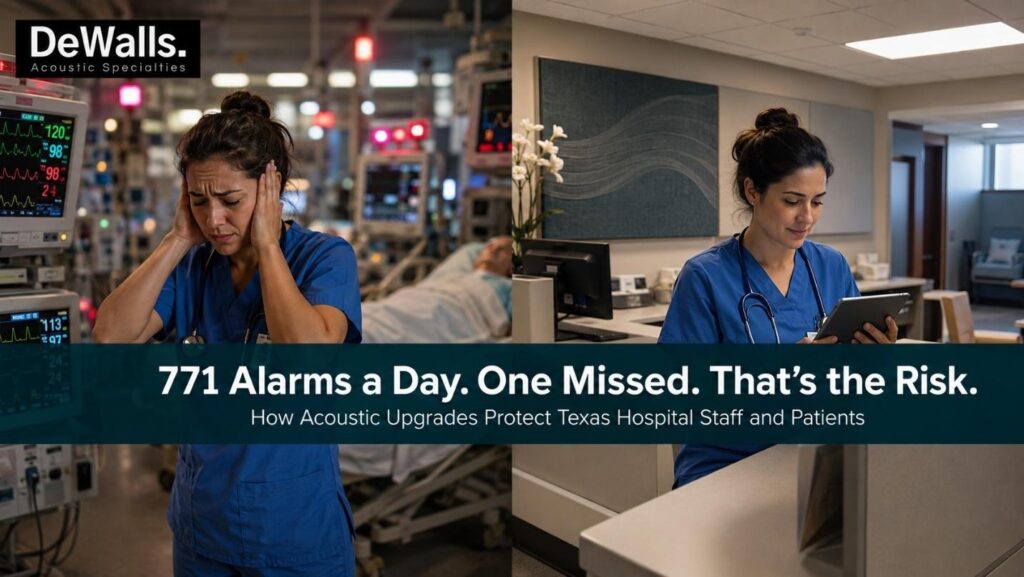
ICU nurses in Texas hospitals deal with an average of 771 alerts per bed per day. Between 85 and 99 percent of those alarms are false positives or clinically insignificant. A peer-reviewed study published in Nursing Outlook in October 2024 confirmed that alarm burden is significantly and independently associated with high nurse burnout – identifying it as a direct threat to nurse job outcomes beyond the general pressure of understaffing.
In Texas, the staffing math is already severe. The Texas Center for Nursing Workforce Studies documented that the RN vacancy rate jumped from 5.9% to 17.6% between 2019 and 2022. Nurse turnover in Texas hospitals reached 28.3% in 2022. Replacing a single registered nurse costs between $40,000 and $60,000 when recruitment, onboarding, and productivity loss during ramp-up are factored in. For a 200-bed facility turning over even 10 nurses annually due to noise-driven burnout, that is a direct $400,000 to $600,000 operating cost.
How Excessive Noise Degrades Clinical Performance
- Cognitive load – sustained noise above 65 decibels measurably impairs clinical decision-making speed and accuracy.
- Alarm desensitization – nurses exposed to constant non-actionable alarms become conditioned to delay or suppress their response – including to critical alerts.
- Verbal order errors – mishearing medication doses, patient names, or procedure instructions in noisy surgical suites and ICUs creates direct patient safety liability.
- Staff satisfaction and retention – noise consistently ranks in the top three stated reasons nurses cite for leaving their current employer in Texas workforce surveys.
Texas’s Behavioral Health Boom Demands a Specialized Acoustic Standard
Texas ranks among the lowest states in the country for mental health resources per capita. The $1.5 billion behavioral health construction program signed into law in 2023, followed by seven new state hospital project announcements in June 2024, represents the largest single investment in psychiatric infrastructure in Texas history. Every one of those facilities requires acoustic design that fundamentally differs from standard medical-surgical construction.
Standard hospital acoustic panels are not built for behavioral health environments. Psychiatric and crisis stabilization units require wall and ceiling systems that are simultaneously tamper-resistant, ligature-safe, impact-resistant, and acoustically effective. A panel that performs excellently in a medical-surgical ward will not meet the safety and durability requirements of an inpatient psychiatric unit.
What Makes Behavioral Health Acoustic Design Different
- Dual-function panels – must meet both safety code requirements (ligature-safe, impact-resistant) and acoustic performance standards simultaneously.
- Sound masking as a therapeutic tool – consistent background sound in crisis stabilization units reduces the startle response to sudden noise peaks, actively supporting de-escalation protocols.
- Unpredictable noise peaks – unlike general wards, behavioral health spaces experience sudden sound events that can escalate agitated patients; masking and absorption work together to buffer these peaks.
- Tamper-proof installation – all acoustic elements must be secured against removal or damage by patients in varying states of distress.
Acoustic Upgrade Solutions for Texas Hospital Environments
Room-by-room acoustic prioritization is the most cost-effective approach for Texas administrators working within capital budget cycles. Not every zone carries equal risk, and phased investment – targeting the highest HCAHPS and HIPAA exposure areas first – produces the fastest measurable return.
| Hospital Zone | Primary Problem | Recommended Solution | Priority Level |
|---|---|---|---|
| ICU | Alarm noise, patient delirium | High-NRC ceiling panels + sound masking | Critical |
| Patient Rooms (Night) | Sleep disruption, HCAHPS scores | Acoustic ceiling + door perimeter seals | High |
| NICU | Neurological development risk | Low-NRC ceiling + soft absorption | Critical |
| Behavioral Health Unit | Safety + patient agitation | Impact-resistant, ligature-safe wall panels + masking | Critical |
| Nurse Stations (Open) | HIPAA exposure + staff focus | Sound masking system + partial enclosure | High |
| Waiting Areas | HIPAA speech privacy + anxiety | Acoustic ceiling + soft furnishings | Medium |
| Consultation Rooms | Speech privacy compliance | STC-rated door seals + wall panels | High |
| OR / Procedure Rooms | Communication error risk | Acoustic ceiling + vibration isolation pads | High |
Passive Acoustic Treatments
- Acoustic ceiling panels (NRC 0.70–0.95) – cleanroom-compatible options available for ORs; antimicrobial-coated versions for infection-sensitive zones.
- Impact-resistant wall panels – fabric-wrapped systems for general clinical use; solid-core panels for behavioral health.
- Door perimeter seal kits – reduce sound bleed through door gaps without requiring structural modification.
- Rubber flooring underlayment – reduces cart and equipment roll noise by 8 to 12 decibels, one of the most overlooked noise sources in older Texas facilities.
- HVAC duct lining – fiberglass or foam lining inside existing ductwork addresses the single largest overlooked noise transmission path in hospital retrofits.
Active and Smart Acoustic Systems
- Sound masking systems – ceiling plenum-installed emitters tuned to speech frequencies; the primary HIPAA compliance intervention for open clinical spaces.
- Vibration isolation mounts – pad systems for compressors, generators, and imaging machines that transmit low-frequency vibration through building structures.
- Real-time decibel monitoring sensors – dashboard alerts to charge nurses when a zone exceeds pre-set thresholds, enabling immediate behavioral intervention before acoustic treatment is needed.
The ROI Framework: Building the Business Case for Texas Hospital Boards
Acoustic investment competes for budget against infrastructure projects that have more visible deliverables. The administrators who win board approval make the case in financial terms. There are five calculable ROI levers for a Texas hospital acoustic upgrade:
- HCAHPS reimbursement recovery – Under the CMS Value-Based Purchasing program, improvement in the HCAHPS quietness domain directly increases performance-based Medicare and Medicaid reimbursement rates. Every point gained is money recovered that would otherwise be withheld.
- Nurse retention savings – Reducing noise-driven turnover by retaining even 10 nurses annually avoids $400,000 to $600,000 in replacement costs, based on the $40,000–$60,000 per-RN replacement cost benchmark.
- Length-of-stay reduction – Better patient sleep shortens average recovery time. Each 0.5-day reduction in average LOS improves bed availability, throughput, and revenue per admission.
- HIPAA fine avoidance – HIPAA penalties for privacy violations range from $100 to $50,000 per violation, with repeat violations attracting maximum penalties. Acoustic HIPAA exposure is a repeat-violation risk by nature.
- Malpractice liability reduction – Noise-linked communication errors in surgical and ICU settings generate patient safety incidents with direct malpractice exposure. Acoustic treatment measurably reduces that risk category.
Illustrative ROI Scenario – 200-Bed Texas Community Hospital: Acoustic investment (priority zones): $1.2 million HCHPS reimbursement improvement: +$380,000/year Nurse turnover reduction (10 RNs retained): +$500,000 one-time LOS reduction revenue gain: +$210,000/year Estimated break-even: 14 to 18 months.
How to Start Your Texas Hospital Acoustic Upgrade Without Disrupting Patient Care
The administrators who make the most progress do not start with a full facility overhaul. They start with data they already hold and use it to prioritize a phased intervention that keeps units operational throughout. Here is the proven sequencing approach:
- Pull HCAHPS quietness domain scores by unit for the past four quarters. The lowest-scoring units have the highest reimbursement risk and the clearest mandate for intervention.
- Run a staff noise survey targeting charge nurses and ICU staff. Identify the zones generating the most alarm fatigue complaints and communication difficulty.
- Conduct a HIPAA intelligibility spot check – stand 6 to 10 feet from active clinical conversations in nurse stations, waiting rooms, and consultation areas. Any clearly audible exchange is a documented compliance gap.
- Engage a certified acoustic consultant (INCE Board Certified or LEED acoustic specialist) for formal RT60 reverberation and decibel measurement across priority zones.
- Build a prioritized treatment plan aligned to the current capital budget cycle. Sequence: behavioral health units first, then ICU, patient floors, outpatient consultation areas, and finally administrative zones.
- Implement in phases using ICRA infection control protocols for any demolition-adjacent work. Acoustic ceiling tile replacement, door seal installation, and sound masking deployment can each be completed unit-by-unit without census disruption.
- Validate and track – measure post-installation decibel levels and RT60, then monitor the next HCAHPS quietness cycle to quantify the reimbursement improvement for the board report.
Frequently Asked Questions
Why is noise a problem in hospitals?
Hospitals generate continuous noise from medical alarms, wheeled equipment, staff conversations, and HVAC systems. Peak ICU noise levels have been measured at 103 decibels – comparable to a chainsaw. This far exceeds the WHO-recommended maximum of 30 decibels at night and directly impacts patient sleep, recovery speed, and staff cognitive performance.
How does hospital noise affect patient recovery?
Noise above 45 decibels triggers cortisol release, which suppresses immune function and slows healing. Sleep disruption extends length of stay, elevates ICU delirium risk, and increases unplanned readmission rates. In NICUs, sustained noise above 50 decibels causes measurable neurological development deficits in premature infants.
What are the HIPAA requirements for acoustic privacy in hospitals?
HIPAA’s Physical Safeguard provisions require healthcare facilities to implement reasonable safeguards against incidental disclosure of PHI – including spoken conversations. An Articulation Index score of 0.2 or below is the recognized target for medical speech privacy. Open nurse stations, shared rooms, and waiting areas frequently fail this threshold without acoustic treatment.
Do poor HCAHPS quietness scores result in financial penalties?
Yes. Under the CMS Hospital Value-Based Purchasing program, hospitals with consistently low patient satisfaction scores – including the quietness domain – face direct reductions in their performance-based Medicare and Medicaid reimbursements. The quietness domain consistently ranks among the lowest-scoring categories nationally, making it one of the highest-leverage areas for reimbursement recovery.
What is alarm fatigue and how does acoustic treatment help?
Alarm fatigue occurs when clinical staff become desensitized to frequent, mostly non-actionable alarms – and begin to delay or suppress their response, including to critical alerts. With an average of 771 alerts per bed per day in ICUs (85 to 99 percent of which are false positives), noise-driven desensitization is a documented patient safety risk. Acoustic treatment reduces ambient noise levels, improving the signal-to-noise contrast so that critical alarms remain distinctive and staff response times improve.
What is the typical cost of a hospital acoustic upgrade in Texas?
Costs vary significantly by zone and solution type. Acoustic ceiling panel retrofits range from $6 to $35 per square foot depending on clinical requirements. Sound masking system installation typically runs $8 to $15 per square foot for nurse stations and open clinical areas. Behavioral health panel systems with tamper-resistant and ligature-safe specifications range from $25 to $45 per square foot. A full priority-zone retrofit for a 200-bed Texas community hospital typically falls in the $1.0 to $1.5 million range with a 14 to 18-month break-even projection.
Can a hospital retrofit acoustics without closing units?
Yes, through phased implementation under ICRA infection control protocols. Acoustic ceiling tile replacement, door seal installation, and sound masking system deployment can all be executed unit-by-unit during periods of reduced census or scheduled maintenance windows. Structural work requires infection control containment but most acoustic improvements involve additive installation rather than demolition.
Conclusion: Texas Hospitals That Act Now Have the Competitive Advantage
Texas hospital administrators are investing in acoustic upgrades for healthcare facilities because the cost of inaction has become quantifiable and unavoidable. Poor acoustic performance drains HCAHPS reimbursements, creates HIPAA exposure, accelerates nurse turnover, slows patient recovery, and introduces clinical error risk. Each of those costs is measurable. Each of them is reducible through targeted acoustic investment.
Texas’s specific conditions – rapid population growth, aging hospital infrastructure, and the most significant behavioral health construction program in the state’s history – have compressed the timeline for action. Administrators who address acoustic performance proactively will capture reimbursement recovery, retention savings, and compliance protection that facilities waiting for the next survey cycle will miss entirely.
The starting point is already in your data. Your HCAHPS quietness scores are telling you exactly where the financial exposure is. Start there, build the phased case for your board, and work with experienced acoustic professionals who understand the intersection of clinical performance, HIPAA compliance, and Texas hospital construction – because that intersection is where acoustic investment pays the highest return.