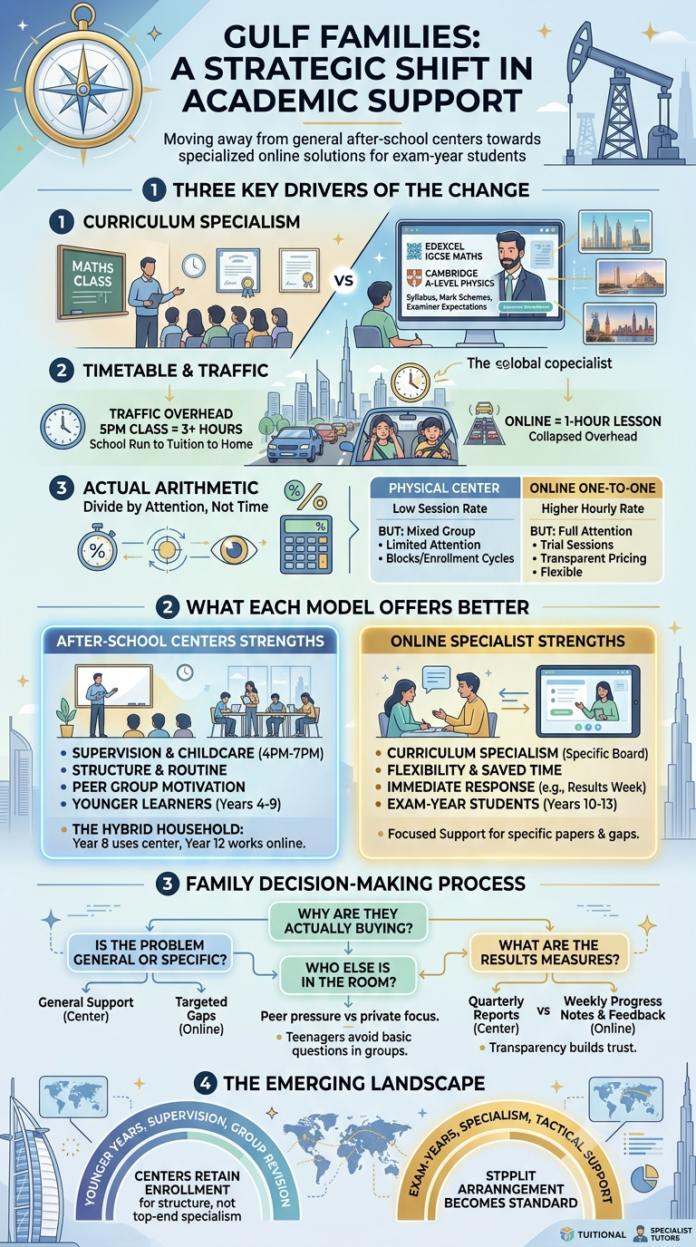

Something has shifted in how Gulf families buy academic support, and it happened without much of an announcement.
Ten years ago the answer to a struggling Year 11 student was simple. You found a tuition centre near home, enrolled your child in a group class two evenings a week, and hoped the grades moved.
Those centres are still there. Increasingly, they are not the first call.
1. Curriculum Specialism: The Challenge for Group Tuition
The first driver is the one centres find hardest to answer: curriculum specialism.
A British-curriculum student in the Gulf is not simply studying “maths”. They are studying Edexcel International A-Level Pure Mathematics, or Cambridge IGCSE Additional Mathematics, or AQA GCSE Higher Tier.
Those are different syllabuses. Different assessment objectives, different command words, different mark schemes, different examiner expectations.
A centre running a mixed group of fourteen students cannot teach all of them properly. It teaches the average. Parents have worked this out.
Online providers changed the arithmetic by removing geography from the matching problem. A student in Sharjah taking OCR A-Level Physics can now work with someone who has taught that exact specification for a decade, a tutor who might be in Manchester, Muscat or Nairobi. Providers such as Tuitional have built their model around that match, assigning tutors by examination board and syllabus rather than by subject alone.
That is a structural advantage rather than a marketing one. No single physical centre can hold a bench deep enough to cover every board across every subject.
2. The Timetable Deficit: Traffic, Overhead, and Reclaimed Hours
The second driver is duller, and arguably more decisive. Traffic.
A 5pm class in a city like Dubai or Riyadh does not cost an hour. Between the school run, the drive out and the drive back, it costs closer to three, and it costs a parent, not just a student.
For a family with two children in different year groups, that is most of a working week gone.
Online sessions collapse that overhead to the length of the lesson itself. For exam-year students juggling coursework deadlines and mock timetables, the recovered hours matter more than the fee difference.
3. Economic Realities: Reframing Cost-per-Hour vs. Cost-per-Attention
Cost comparisons in this sector are often presented badly, because the two models are not measured the same way.
A group class advertises a low per-session rate, but the student may receive only a few minutes of individual attention. A one-to-one session costs more per hour and delivers the full hour.
Parents have started dividing by attention rather than by time. Once you do that, the gap narrows sharply, and in many cases it closes entirely.
There is also a transparency effect. Online providers tend to publish their pricing openly, offer trial sessions, and allow families to leave without a term’s notice. Centres more often work on enrolment cycles and upfront blocks.
When one model lets you test before committing and the other does not, the risk sits in an obvious place.
4. The High-Stakes Pressure Test: What Results Week Exposes
Nothing concentrates a parent’s mind like the August results window.
Cambridge releases AS and A Level results before IGCSE results each summer, so that university admissions can be processed first. Both dates and the process for reviewing results are published openly by Cambridge International, and every year a predictable wave of families discovers them at short notice.
That week is when the weakness of the group model shows. A student who has missed a university offer by one grade does not need a class. They need a specialist in that specific paper, available within days, working on that specific gap.
Physical centres are closed for the summer or running general revision blocks. Online providers can match a tutor the same week.
5. Retaining Value: Core Strengths of Physical Tuition Centres
It would be wrong to write the sector off, and most families do not.
Younger students often work better in a room with a teacher and a whiteboard. Primary and lower-secondary learners in particular benefit from the structure and the supervision, and screen-based learning suits them less well.
Centres also provide something online providers are still working out how to replicate: a peer group. For some teenagers, seeing other students working is the thing that makes them work.
And for families where both parents work long hours, a supervised physical space between 4pm and 7pm solves a childcare problem as much as an academic one.
The shift is not universal. It is concentrated almost entirely in Years 10 to 13, where the stakes are highest and the specialism requirement is sharpest.
6. Parent Decision Dynamics: Evaluating Academic Support Options
Talk to enough parents and a consistent decision process emerges, though almost nobody describes it in these terms.
The first question is whether the problem is general or specific. A child who is broadly struggling across a subject needs sustained teaching. A child who is losing marks on one paper type needs something much narrower, and much shorter.
Families increasingly recognise that these are different purchases. Centres are built around the first. Online specialists are built around the second.
The second question is who else is in the room. For a subject where a student needs to be pushed, a group can help. For a subject where they are embarrassed to ask basic questions, a group is actively counterproductive.
Parents rarely articulate this, but it drives a great many decisions. Teenagers will not admit confusion in front of classmates, and a full term can pass before anyone notices.
The third question is measurement. Centres traditionally report progress at the end of a term, if at all. Online providers have moved to weekly session notes and monthly summaries, largely because a parent who cannot see the room demands to see the record.
That transparency has had an unexpected competitive effect. Once a family becomes accustomed to weekly written feedback, going back to a model without it feels like a downgrade regardless of teaching quality.
7. Emerging Household Behaviors: The Unplanned Hybrid Model
What is emerging in practice is not a clean switch but a split arrangement within the same household.
A Year 8 child attends a local centre for general support and structure. Their Year 12 sibling works online with a specialist in one subject. The family uses both models simultaneously, for different reasons.
Providers on both sides find this uncomfortable, because each would prefer to be the whole answer. Parents find it entirely logical.
It also explains why centre enrolment figures have held up better than the shift in exam-year behaviour would suggest. The volume has not left the sector. It has redistributed within it, and the redistribution is happening at the top end where margins are highest.
8. Market Equilibrium: Future Outlook for GCC Tutoring
The likely outcome is not the disappearance of the tuition centre but a split in what each model is for.
Centres will keep the younger years, the supervision function and the group-revision market. Online providers will keep exam-year subject specialism, where matching a student to the right examiner-trained tutor matters more than anything else.
The centres that struggle will be the ones in the middle, offering general subject teaching to exam-year students without board-level specialism, at a price point that assumes geography still limits a parent’s options.
It does not, and it has not for several years.
The families making this switch are not chasing a trend. They are doing something more ordinary, and more difficult to argue with: they have worked out what they are actually buying, and they have started buying it directly.