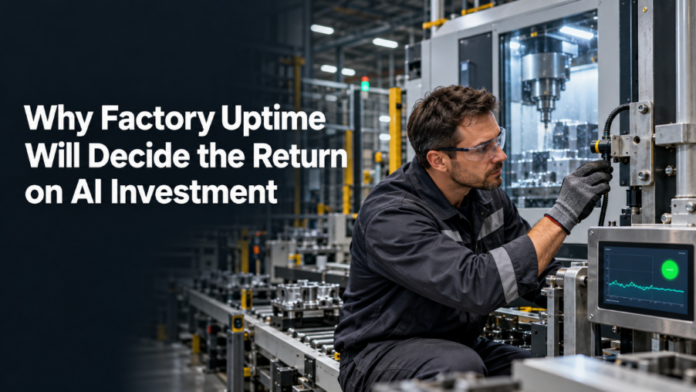

Industrial AI investments often fail to deliver positive financial returns because software monitors secondary machines while critical bottlenecks fail, or substandard sensors trigger false alarms. Predictive maintenance pays off only when it targets costly bottleneck failures and drives immediate, coordinated physical repairs.
The Cost of Factory Downtime
Before deploying predictive models, plant leadership must accurately quantify downtime by separating genuine financial loss from operational noise.
Differentiating Bottlenecks from Buffered Lines
Downtime cost depends entirely on machine location. Halting an upstream machine with buffer inventory rarely impacts finished output. Halting a bottleneck immediately deletes shippable production. Plant teams must tie downtime losses directly to lost customer shipments.
Preventing Duplicated Cost Allocations
Financial models frequently overstate downtime damage by counting a single event across multiple cost buckets, including revenue loss, scrap materials, and overtime. If operators recover lost volume within normal shifts without missing deliveries, no revenue was lost. Real financial losses consist strictly of forfeited profit margins, scrapped materials, and emergency labor rates.
Building an Objective Failure Baseline
Track downtime strictly by asset tag, root cause, duration, and actual net volume impact. Machine learning algorithms cannot resolve component delivery delays or scheduling gaps; their value lies solely in preventing physical machine breakdowns.
Calculating AI Payback
Determining project payback requires measuring verifiable net cash savings against the complete cost of ownership rather than relying on theoretical availability gains.
Revenue Gains Tied to Market Demand
Extra uptime creates cash only when market demand absorbs the additional production. Generating surplus inventory when downstream cells or warehouses are full merely ties up working capital.
Prioritizing Direct Cash Over Soft Efficiency
True savings come from eliminating direct emergency expenses: weekend callouts, air freight surcharges, and scrapped batches. Reassigning internal mechanics improves efficiency, but it delivers cash savings only if external contractor expenses decrease.
The Real Cost of False Alarms
Net savings equal gross downtime reductions minus the direct labor and scrap costs created by investigating false alarms. Late warnings fail to prevent breakdowns, while false alerts disrupt production and waste parts.
Total Project and Hardware Costs
Upfront capital goes primarily toward sensor installation, conduit wiring, and PLC integration rather than software licenses. When sourcing industrial limit switches for position feedback, cutting corners leads to dust and coolant penetration, creating electrical noise that algorithms mistake for impending machine failure.
Ongoing Operational Overhead
Deduct recurring cloud compute fees, edge licensing, vendor support, and mechanic validation hours from gross savings. Project payback must be evaluated across cumulative cash flows over multiple years under conservative failure reduction scenarios.
Keeping Machines Running
Software insights yield zero financial return unless predictive alerts trigger disciplined, coordinated mechanical action on the factory floor.
Standardizing Alert Response Protocols
Early detection is useless without an actionable response protocol. Condition alerts must explicitly define who inspects the asset, what diagnostic tools confirm the fault, and when repairs take place.
Physical Diagnostics Before Equipment Teardown
Always verify physical components before disassembling complex machinery. Indexing errors typically stem from loose mounting bolts, bent actuator arms, or oxidized contacts rather than internal gearbox failure. Software cannot fix mechanical misalignment.
Automated Work Orders and Hardware Retrofits
Link alerts directly to automated work orders and stocked spare parts. When retrofitting legacy machinery with specialized feedback hardware, controls teams should consult XURUI engineers to verify stroke tolerances, electrical ratings, and enclosure protection for harsh industrial environments.
Testing Before Expansion
A disciplined pilot strategy protects capital by proving algorithm reliability under actual plant conditions before approving an enterprise rollout.
Piloting on an Isolated Bottleneck
Isolate one critical bottleneck asset with an expensive failure history. Run the algorithm in shadow mode on live production data to let technicians benchmark predictions against manual inspections before automating maintenance actions.
Validating Under Real Plant Extremes
Evaluate algorithms under operational stress, including cold morning startups, tooling changeovers, and diverse product recipes. Measure pilot success through warning lead times, false alarm rates, and missed breakdowns rather than abstract statistical accuracy.
Strict Operational Milestones for Expansion
Scale only when verified alerts demonstrably prevent breakdowns and protect production quotas. Terminate projects if target failure modes lack detectable precursors, happen once a decade, or resolve through simple visual operator checks.
Conclusion
Factory uptime dictates industrial AI returns. Achieving rapid breakeven requires actionable alerts, swift execution on the factory floor, and market demand for recovered output. Plant leadership should approve enterprise rollouts only after isolated pilots demonstrate repeatable net cash gains over total hardware and operational costs.