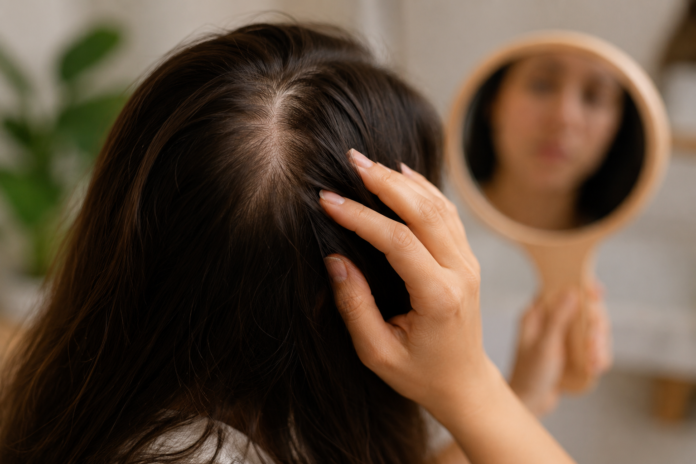

Hair thinning tends to follow a particular pattern in how people respond to it. They notice something, tell themselves it is probably nothing, and wait. Weeks pass, then months. The shedding continues. The part gets a little wider. The ponytail sits a little thinner. By the time most people take actual steps, the problem has been visible for a year or more, and a significant amount of follicular activity has already been lost. That delay is not just psychologically understandable. It has real clinical consequences.
The biology of hair loss is time-sensitive in a way that is not intuitive until you understand what is happening beneath the scalp. The window for effective intervention is genuinely wider early than it is late, and that is not a marketing message. It is how hair follicles actually work.
What Is Happening Beneath the Surface
Hair loss, in the most common forms affecting both men and women, is driven by the gradual miniaturisation of hair follicles. In androgenetic alopecia, which accounts for the majority of patterned hair loss, a hormone called dihydrotestosterone (DHT) binds to susceptible follicles and progressively shrinks them over time. Each hair growth cycle produces a finer, shorter strand than the one before, until eventually the follicle stops producing visible hair at all.
This process is not sudden. It builds across years, and each cycle of follicle miniaturisation is incremental. The clinical significance of this is that follicles that are miniaturised but still active respond to treatment. Follicles that have been dormant for a long time, or where the structural tissue has been replaced by scar tissue, do not respond to the same interventions. Early action catches follicles while they are still in the treatable phase.
Accessing personalised hair loss treatment through InstantScripts connects you with registered doctors who can assess your specific pattern and history and recommend a treatment protocol tailored to where you actually are in the process. That personalisation matters because hair loss is not homogeneous. Male pattern, female pattern, stress-related shedding (telogen effluvium), nutritional deficiency-driven loss, and autoimmune-related loss all have different causes and different optimal treatment approaches. Getting a clinical assessment rather than a guess determines whether you are addressing the actual mechanism or just hoping for the right one.
Why Delay Has a Compounding Cost
The frustrating thing about acting late on hair loss is not just that treatments become less effective. It is that the treatments that do work need more time to show results when the starting baseline is worse. Minoxidil, one of the most evidence-supported topical treatments for both sexes, works by prolonging the growth phase of the hair cycle and increasing blood flow to the follicle. It is significantly more effective when follicles are still actively producing hair than when they have been miniaturised for years.
Finasteride, the oral DHT-blocking medication prescribed for male pattern hair loss, similarly performs better when begun early. Studies consistently show greater hair retention and regrowth when treatment starts before significant density loss has occurred. This is not because the medication changes: it is because the follicles it is working to protect have not yet experienced prolonged DHT exposure and the structural damage that comes with it.
The practical upshot is this: the same treatment, the same cost, the same daily habit, produces meaningfully better outcomes at the first sign of thinning than it does two years later. The delay costs nothing in the moment and is paid for over the years that follow.
What Early Action Actually Looks Like
Acting early does not require certainty. You do not need to wait until you are sure the thinning is real, or until a friend mentions something, or until a photograph makes it impossible to ignore. Noticing more hair than usual in the shower drain, a change in the texture or density of your part, or a shift in how your hairline sits are all sufficient reasons to have a conversation with a doctor.
A clinical assessment at this stage involves a review of your history, a look at the pattern and distribution of any thinning, and potentially a blood panel to rule out contributing factors like thyroid dysfunction, iron deficiency, or hormonal imbalance. This is not an overreaction to a minor concern. It is information gathering while the information is still actionable.
For women especially, hair thinning often goes unaddressed for longer than it does for men because the social expectation around female hair loss is less acknowledged. Diffuse thinning across the crown, a widening part, or increased scalp visibility are symptoms that deserve the same clinical attention as any other health change, and accessing that attention should not require significant effort or barriers. Online consultation platforms make this straightforward: you can have a medical conversation, receive an assessment, and get a treatment recommendation without adding another in-person appointment to a schedule that is already full.
The Habits That Support Any Treatment Plan
Treatment works best when it sits within a broader approach to scalp and hair health. A few consistent habits that support whatever clinical intervention you are pursuing:
- Avoid chronic high-heat styling where possible, as repeated thermal stress degrades the hair shaft and can exacerbate the visible appearance of thinning even when follicular health is being addressed
- Prioritise protein intake at meals, since hair is predominantly keratin and amino acid availability directly influences the growth cycle
- Manage chronic stress through whatever method reliably works for you, since elevated cortisol is one of the more significant contributors to telogen effluvium, the stress-triggered shedding pattern that can be mistaken for androgenetic loss
- Consider scalp massage for a few minutes daily, which has some emerging evidence for modestly improving hair thickness over time through increased blood circulation
The connection between general health habits and hair health is well established. As discussed in the guide to beauty treatments that highlight natural features, approaches that support underlying biological function tend to produce more durable results than surface-only interventions. Hair is no exception: what is happening inside the follicle and in the broader physiological environment around it matters as much as what is applied topically.
Reading the Early Signs Correctly
One of the reasons early action is hard to take is that the early signs of hair thinning are genuinely ambiguous. Most people shed between fifty and one hundred hairs a day as part of the normal growth cycle. Seasonal shedding in autumn is also well documented. The difference between normal shedding and the beginning of a thinning process is not always obvious without knowing your own baseline.
What warrants attention is a change from your personal normal rather than comparison against a general standard. If you are consistently seeing more shedding than you typically have, if your scalp is more visible than it used to be in specific areas, or if the texture of your hair has changed without any obvious lifestyle cause, these are the signals worth investigating.
Personal style is partly about how you feel in your own skin, and for many people, their hair is a significant part of that. Protecting it while the options are strongest is not vanity. It is the same logic behind any preventive health decision: act while the outcome can still be shaped, rather than waiting until the only options left are more difficult and less effective. Understanding your own presentation choices, whether it is your hairstyle, your chain style for different occasions, or the way your overall look comes together, starts with feeling confident in what you have got, and that confidence is worth protecting.