
“Call and negotiate” is advice, not a plan. Here is who can actually change the number, and what each of them will ask you for.
Last checked September 2026. Legal points are quoted from irs.gov, ecfr.gov and cms.gov; service details from each organization’s own pages.
The bill is $9,400. You call the number on it, wait eleven minutes, and a polite person offers you $391 a month for two years. That is not a reduction. That is the same number, sliced.
Somewhere in that system is a person who could change the amount, and it is not the one who answered. Billing reps take payments. Financial counselors screen for assistance. Coders correct codes. An outside advocate can argue. A federal reviewer can rule. Different jobs, different powers, and “call and negotiate” stops at the first one.
What follows is seven routes that exist in the United States right now, in no particular order. Some are free, one costs $25, one bills Medicare, one you pay yourself. Every one has a condition attached, and the conditions are where people get stuck, so each entry names them. Legal points come from the IRS, the Electronic Code of Federal Regulations and CMS.
What “getting a bill reduced” actually means
Reduction happens through one of a few mechanisms, and knowing which you are aiming at tells you who to call.
- Charity care. The hospital forgives all or part of the bill based on household income.
- Billing error. A duplicate line, an upcoded visit, an unbundled service, a supply on the bill but not in the chart.
- Insurance appeal. The bill is yours only because a claim was denied or processed wrong.
- Formal dispute. A reviewer outside the hospital decides whether the charge holds.
- Relief after the fact. Someone else extinguishes the balance. You rarely control this one.
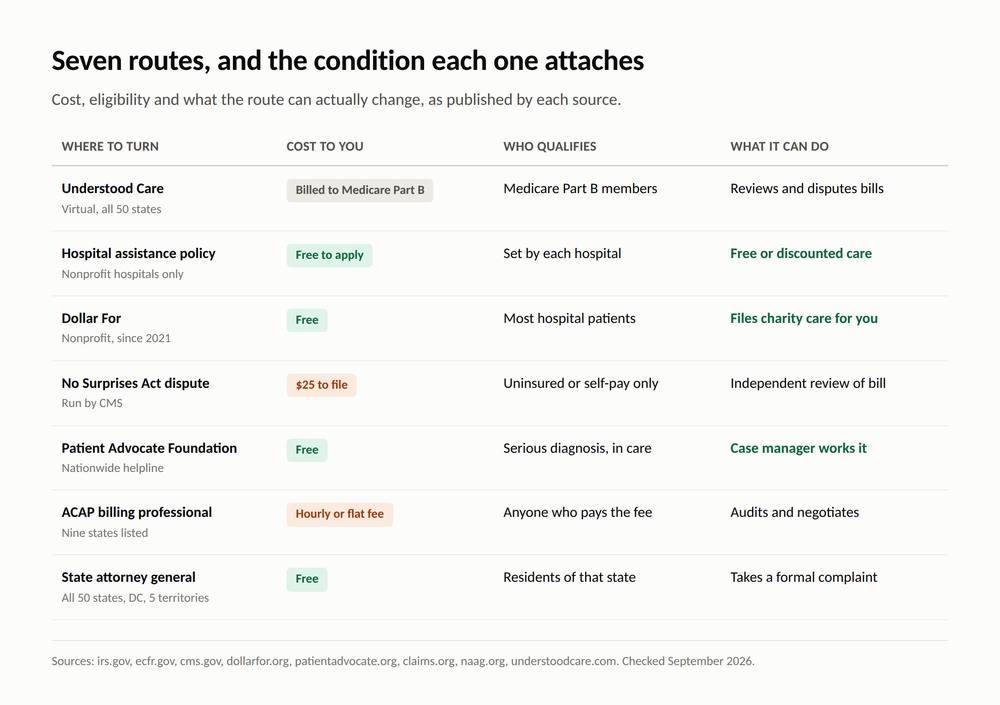
Seven routes, and the condition each one attaches
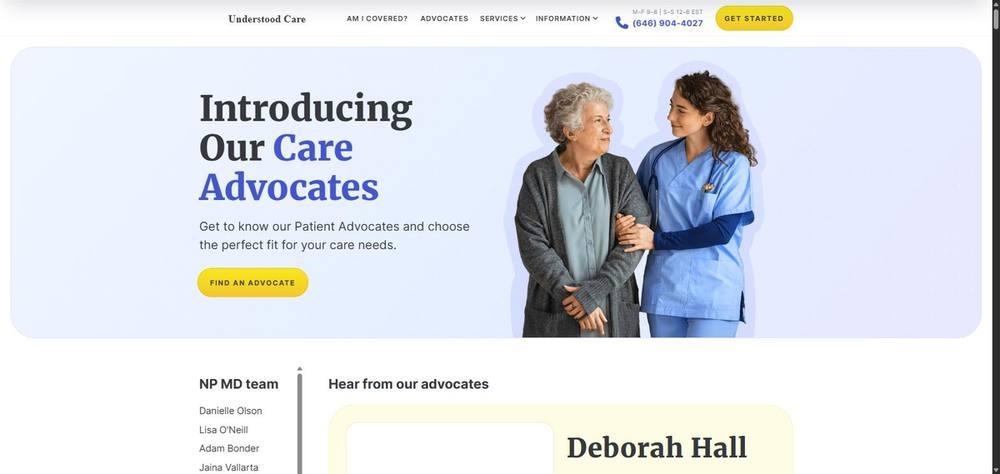
Understood Care
A virtual advocacy service staffed by what the company calls “seasoned doctors, nurses, pharmacists, and other healthcare experts.” Members get one dedicated advocate rather than a queue, summed up on its Medicare Advantage guide as “No call center, no starting over.”
The bill work is specific: request the itemized bill, pull the Medicare Summary Notice, match each line item by date of service and procedure code, then check flagged codes against the record. It targets duplicate charges, upcoded visits, unbundled services and uncharted supplies. You can connect with a patient advocate through the state-by-state roster on its site or by calling (646) 396-0527.
Key strengths
- Billed to Medicare Part B for most patients, under the Community Health Integration and Principal Illness Navigation services CMS began paying for in CY 2024.
- One named advocate for the case, with clinicians doing the review.
- Published turnaround of two to four hours for a single-visit review.
Best for
Medicare beneficiaries holding a bill that does not match their Medicare Summary Notice.
Worth asking about
Coverage is narrow. The pricing page says it is “not yet covered by Medicaid” and “not yet covered by commercial insurance,” and that Part B coverage applies “if you have Original Medicare and a supplemental plan and have paid your deductible.” Under 65 with employer coverage, this is not your route.
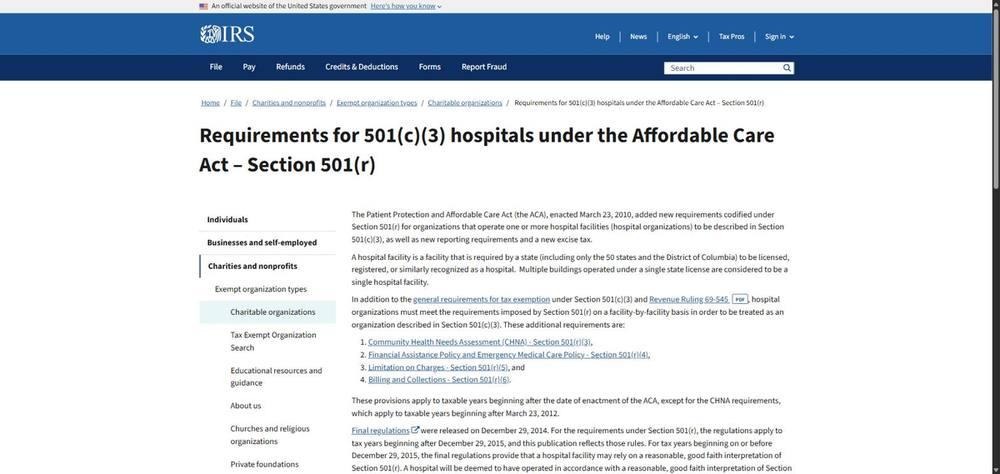
Your hospital’s own financial assistance policy
The route with the most legal weight behind it, and the one people skip. Section 501(r) applies to 501(c)(3) organizations operating state-licensed hospital facilities. Under 26 CFR 1.501(r)-4, such a facility must have a written, widely publicized financial assistance policy stating the eligibility criteria, whether the help is free or discounted, the basis for amounts charged, how to apply, and what happens on nonpayment.
Two rules follow. Under 1.501(r)-5, a hospital may not charge an eligible individual more than the amounts generally billed to insured patients for emergency or medically necessary care. Under 1.501(r)-6, it must refrain from extraordinary collection actions, including credit reporting, suits and wage garnishment, for at least 120 days from the first post-discharge billing statement.
Key strengths
- The policy must be written and published, so you can read the thresholds first.
- The cap in 1.501(r)-5 means an approved applicant cannot be billed gross chargemaster rates.
- The application window closes no earlier than 240 days after that first statement.
Best for
Anyone treated at a nonprofit hospital whose income is near its thresholds.
Worth asking about
501(r) sets process, not a national discount. Each hospital writes its own criteria, so identical incomes can qualify at one and not the one across town. It reaches only 501(c)(3) hospital facilities: for-profit hospitals, physician groups billing separately and ambulance companies sit outside.
Dollar For
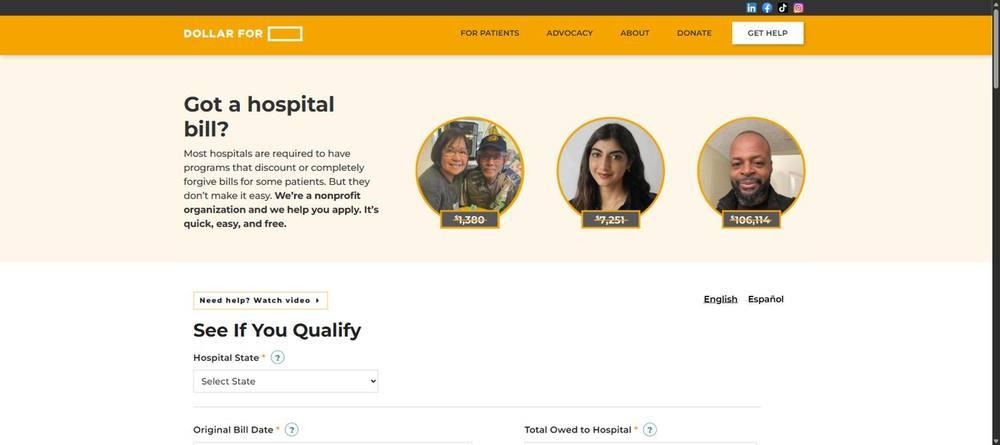
A 501(c)(3) nonprofit, EIN 46-0889864, founded by Jared Walker, that does the charity care paperwork for you. Its pitch is blunt: “We educate people about charity care, even if hospitals don’t.” It is free, and runs on a database of hospital policies, an eligibility screener and automated form completion.
Its figures, covering work since 2021, are that it has “helped 16,110 patients apply for charity care” and “secured $55,306,002 in medical debt relief.” It says a family of four earning under $100,000 qualifies on average, and that nationally households under 212% of the federal poverty level tend to qualify for free care and families under 311% for discounted care. Insured patients sometimes qualify too: “many hospitals, but not all, will waive copays and deductibles.”
Key strengths
- Free, with no fee and no cut of whatever gets written off.
- It already holds the policy for your hospital, the hardest part.
- The screener gives you a yes or no before you fill out anything.
Best for
Someone with a hospital bill and a household income in that range.
Worth asking about
Dollar For can only work inside rules the hospital already wrote. If the policy cuts off below your income, help with the form changes nothing. It publishes totals but no approval rate.
The No Surprises Act patient-provider dispute process
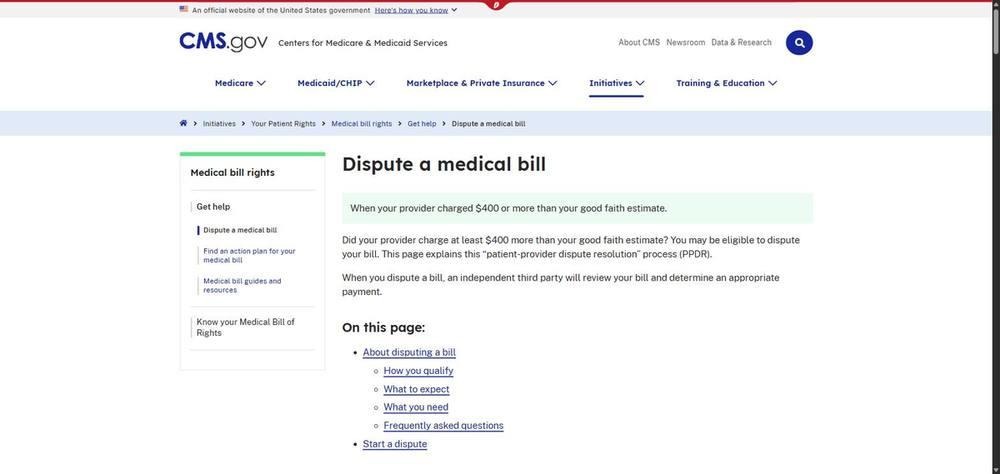
The one route where someone outside the hospital rules on your bill, and almost nobody uses it because the conditions are strict. CMS lists six, all of which must be true: you did not have or use insurance for the care; you told the provider beforehand; the care was on or after January 1, 2022; you have a good faith estimate from three days before the appointment; your initial bill is under 120 calendar days old; and one provider charged $400 or more above that estimate.
Meet all six and you file with CMS. There is a $25 non-refundable fee: “the dispute process doesn’t start until the $25 fee is paid,” though if the dispute goes your way it comes off what you owe. An independent reviewer then decides whether the charges exceeded what could reasonably have been expected.
Key strengths
- The decision comes from outside the hospital.
- $25 is the entire cost, and it is credited against the bill if you win.
- The estimate is a written baseline the provider produced themselves.
Best for
Self-pay patients who said up front they were paying cash and kept the estimate.
Worth asking about
The estimate is the gate. If you used insurance, never said you were self-pay, or never got an estimate, you are not eligible however wrong the bill looks. The clock runs from the date on the bill, not from when you opened it. Help desk: 1-800-985-3059.
Patient Advocate Foundation
A national nonprofit offering “free help for eligible patients and families living with a serious or chronic health condition.” Case management runs on three fronts: appealing insurance denials, securing discounts and payment plans, and applying for programs covering food, rent, utilities and medicine. It says that in 2025 it served patients with over 750 distinct diagnoses.
Eligibility is a checklist, and all of it must be true: a confirmed diagnosis of a serious health condition, active treatment or treatment starting within 60 days, US citizenship or permanent residence, and treatment in the United States or a US territory. The line is 800-532-5274, weekdays 8:30 AM to 5:00 PM Eastern.
Key strengths
- Free, and the case manager takes on the work rather than coaching you.
- Handles the insurance appeal and the bill together, usually one problem.
- Nationwide, with published hours and a direct line.
Best for
Patients in treatment for cancer or another serious condition.
Worth asking about
The diagnosis and active treatment requirements are the whole gate. One expensive emergency room visit, or a condition you finished treating last year, will not.
Alliance of Claims Assistance Professionals
When nothing free applies, the paid option is a claims assistance professional, and ACAP lists them. It calls itself “a nationally recognized association of independent Claims Assistance Professionals (CAP)” whose members “provide medical claims assistance and patient advocacy” on a fee basis.
The association’s value is the vetting. ACAP says members “undergo a rigorous application and vetting process and provide multiple professional references in order to be invited to join,” and “work solely for their clients’ interests.” Its Find a CAP directory is free.
Key strengths
- Members are vetted and must supply references. A web search gives you neither.
- No gate on income, diagnosis, insurance status or hospital type.
- The referral itself costs nothing.
Best for
Large bills where the amount at stake comfortably exceeds a professional fee.
Worth asking about
Coverage is thin: the directory lists members in nine states, California, Colorado, Connecticut, Florida, Maine, Missouri, New Jersey, New York and Oregon, though members may work remotely. ACAP publishes no rates, so ask whether each professional charges hourly, a flat fee or a percentage of savings. Its disclaimer is that member practices “are solely responsible for the quality of their work.”
Your state attorney general’s consumer office
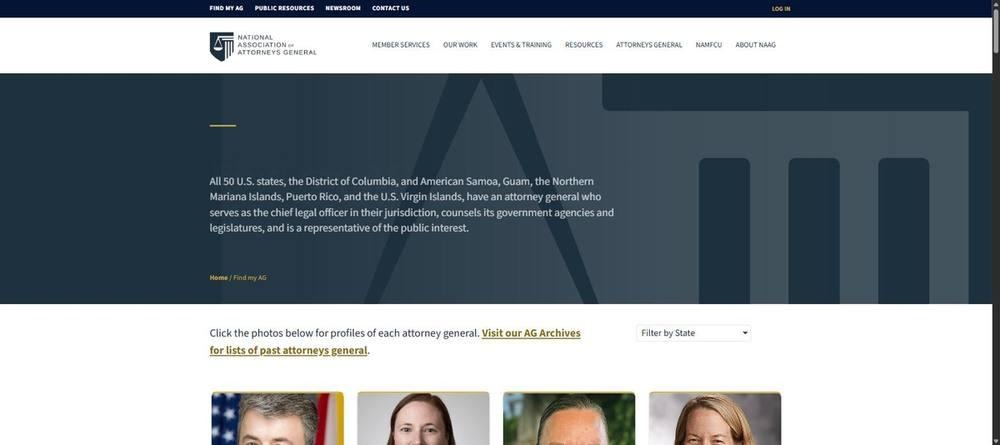
Every state has one, and people reach for it last when it sometimes belongs first. The National Association of Attorneys General, “the nonpartisan national forum for America’s state and territory attorneys general,” maintains a directory covering all 50 states, DC and five territories. A complaint is free and creates a record a billing office must answer.
What the office does varies by state, and that is the honest caveat. Some have a health care unit: the New York Attorney General’s Health Care Bureau says it “assists patients who have problems accessing health care or getting insurance coverage” and runs a helpline handling “over 4,000 requests for assistance each year.” Others route billing complaints through general consumer protection.
Key strengths
- Free, and available in every state and territory.
- A complaint on file changes the tone of a billing conversation.
- Some states enforce their own hospital assistance laws, reaching further than 501(r).
Best for
Aggressive collection on a disputed balance, or a hospital ignoring its own published policy.
Worth asking about
An attorney general represents the state, not you, and generally will not act as your lawyer or promise an outcome. NAAG publishes the directory but no uniform description of what each office handles.
Why the same bill gets different answers
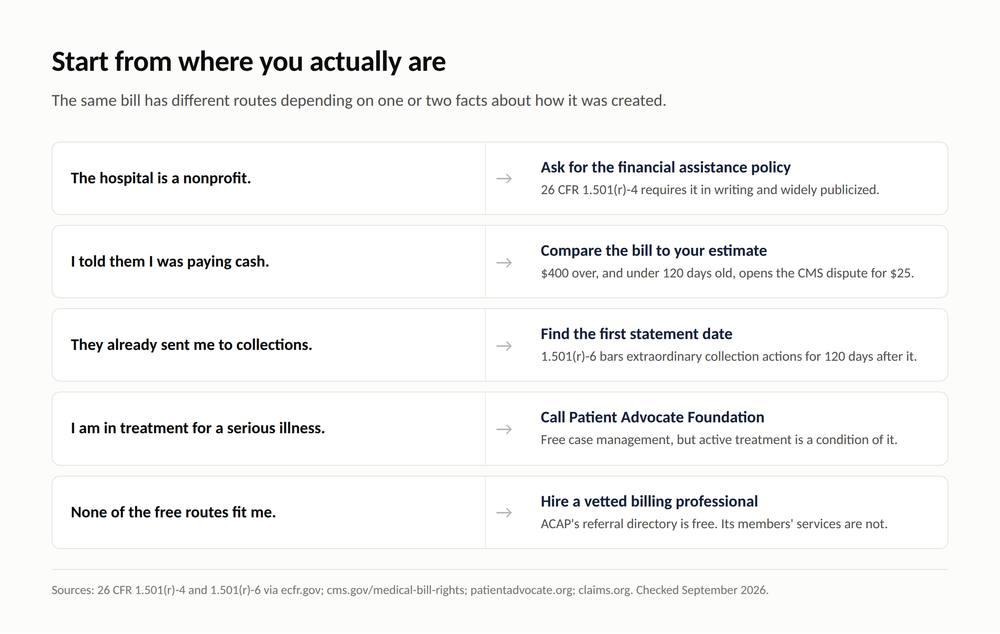
Read the seven together and a pattern shows up. The free routes are gated by who you are: income, diagnosis, insurance status, state. The paid route is gated by what you can spend. The federal dispute is gated by paperwork you either have or do not. None of it is gated by how well you argue on the phone.
So order matters more than effort. Apply for assistance before you agree to a payment plan, since agreeing can be read as accepting the balance. Get the itemized bill before you dispute anything, because a summary hides the lines where errors live. And check your dates: two of these die on a 120-day clock.
Start from where you actually are
The one you cannot apply to. People find Undue Medical Debt, formerly RIP Medical Debt, and assume it is a route. Its own FAQ says plainly that “Undue Medical Debt cannot relieve debt by individual request,” because “we acquire large, bundled portfolios of debt to help thousands of people at once and we can only erase debts that providers like hospitals and physicians are willing to sell to us.” If a letter arrives saying your debt was abolished, that is real. Waiting for one is not a plan.
Questions to ask before you commit to a route
- Is this hospital a 501(c)(3) facility? If so, ask for the written financial assistance policy, the plain-language summary, and the list of non-hospital providers it covers.
- What is the date on my first post-discharge billing statement? It starts the 120-day window under 1.501(r)-6.
- Did I tell them before the care that I was not using insurance, and do I still have the good faith estimate? Without both, the CMS dispute is closed.
- If I am paying someone, how do they charge: hourly, flat fee, or a percentage of savings? Get it in writing first.
- Am I about to sign a payment plan? Ask whether signing affects a pending assistance application, and ask the person who administers the policy, not the one taking the payment.
Where to start
Start with two documents and one date. Request the itemized bill in writing, pull the matching insurance statement, a Medicare Summary Notice or an explanation of benefits, and note the date of your first billing statement. Every route above turns on those three, and gathering them costs nothing.
Then pick by eligibility, not by hope. Nonprofit hospital and a modest income, go to the hospital’s policy or to Dollar For. Serious diagnosis in active treatment, call Patient Advocate Foundation. Uninsured and holding an estimate the bill blew past, file with CMS. On Medicare with a bill that does not match the summary notice, an advocacy service that works the line items is shorter. No free route open, pay a vetted professional. These are doors into one building, and most people only try the one marked “billing.”
Sources: irs.gov and ecfr.gov for Section 501(r) and 26 CFR 1.501(r)-4, -5 and -6; cms.gov for the dispute conditions, the $400 threshold, the 120-day window, the $25 fee and the CY 2024 Physician Fee Schedule; and the published pages of Understood Care, Dollar For, Patient Advocate Foundation, ACAP, NAAG, the New York Attorney General and Undue Medical Debt. All checked September 2026. Fees, thresholds and eligibility rules change, and each hospital writes its own policy, so confirm current terms first.