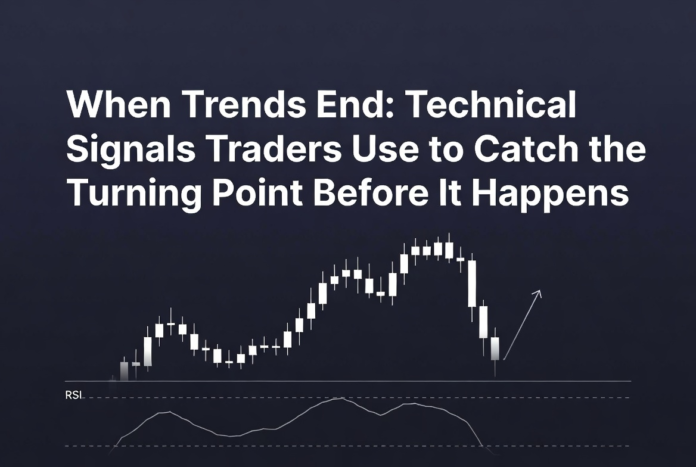

Catching a trend reversal before the crowd is one of the hardest things in trading and one of the most rewarding. Most traders see the turn only in hindsight, after a series of lower highs has already formed and the move they wanted to catch is half over. The ones who act earlier are reading specific technical signals that appear before price confirms the change in direction.
These signals are not magic. They are structural patterns in price and momentum that reflect shifts in the balance between buyers and sellers. Understanding best reversal indicators for forex starts with the same principle that governs any market: trends follow cycles, and cycles produce identifiable turning points.
Why Reversals Are Hard to Catch and What Makes Them Visible
Trends persist longer than most traders expect. Every pullback inside an uptrend looks like a potential reversal until it isn’t. Traders who try to fade strength too early get stopped out repeatedly before the actual top forms. The reason is that trending markets print higher highs and higher lows in an uptrend, and lower lows and lower highs in a downtrend. Until that sequence breaks, the trend is intact regardless of how extended it looks.
What makes reversals visible before they are confirmed is divergence: a situation where price continues making new extremes but the momentum behind those extremes is weakening. When price prints a higher high but the RSI prints a lower high at the same time, buying pressure is diminishing even as the price level advances. That divergence does not guarantee a reversal, but it reduces the probability that the trend will extend much further without a significant correction.
Volume tells a related story. A trend running out of fuel typically shows declining volume on each successive new extreme. When the final push to a new high comes on noticeably lighter volume than the previous swing, the market is running on momentum rather than fresh conviction.
The Indicators That Signal Reversals Before Price Confirms
Several technical tools generate reversal signals with enough lead time to be actionable. No single indicator works reliably in isolation, but in combination they produce a consistently recognizable pattern.
RSI divergence is the most widely used reversal signal. Standard settings are 14 periods. A bearish divergence forms when price makes a higher high while RSI makes a lower high. A bullish divergence forms when price makes a lower low while RSI makes a higher low. The signal is stronger when the RSI reading at the second peak or trough sits in overbought territory (above 70) or oversold territory (below 30).
The MACD histogram gives a related signal. When histogram bars are shrinking while price is still advancing, momentum is fading. A cross of the MACD line below the signal line after a period of divergence often marks the beginning of the reversal move.
| Signal | What It Shows | Reliability Notes |
| RSI bearish divergence | Momentum weakening at new price high | Stronger in overbought zone, on daily or weekly chart |
| MACD histogram contraction | Fading buying pressure before peak | Confirm with price structure, not alone |
| Volume decline at new extreme | Reduced conviction behind the move | Most useful in equity and futures markets |
| Engulfing candle at resistance | Sharp rejection at a key level | Needs confirmation from next candle |
| Break of swing low/high | Trend structure officially broken | Lagging but highest reliability |
Candlestick patterns at key levels add a timing dimension. A bearish engulfing candle appearing at a major resistance level after a prolonged uptrend reflects a session where sellers overwhelmed buyers decisively. The pattern carries more weight on higher time frames and when it appears at a level where price has previously reversed.
How to Structure a Reversal Trade
The entry logic for a reversal trade differs from a trend-following entry. In trend following, you enter on a pullback in the direction of the trend. In reversal trading, you are entering against the prevailing trend, which means timing and risk structure have to be precise.
The standard approach is to wait for two conditions to align: a technical signal (divergence, declining volume, rejection candle) at a structural level (prior swing high, round number, Fibonacci retracement of the larger move). When both align, the entry is taken with a stop above the most recent high for a short, or below the most recent low for a long.
Position sizing matters more in reversal trades than in trend trades. The failure rate is higher because the trade works against the prevailing direction, and multiple attempts may be needed before the reversal confirms. Many traders use smaller initial position sizes on reversal setups, then add once price breaks the first swing structure that confirms the change in direction.
Timeframe Alignment and Where Reversals Actually Form
Reversals on lower time frames are noise. A 15-minute chart shows dozens of apparent reversal signals each day, most of which are intraday fluctuations inside a larger trend. The reversals that matter form on daily or weekly charts and are confirmed by alignment across multiple time frames.
The process runs from higher to lower: identify the trend on the weekly chart, look for divergence and structural weakness on the daily chart, use the four-hour chart to time the entry. A reversal setup showing RSI divergence on the daily chart, confirmed by a rejection at a key weekly level, with an engulfing candle on the four-hour chart carries substantially higher probability than any single-time-frame signal.
Markets in distribution tend to show the same pattern: choppy price action at a high, multiple tests of the same resistance without a clean breakout, declining volume, and repeated RSI divergences. The distribution phase can last weeks. The reversal move, when it comes, is often fast and driven by stops being triggered below the range low.
Conclusion
Reversal signals are not predictions. They are probability shifts. When momentum diverges from price, volume thins at new extremes, and price forms a rejection pattern at a key structural level, the probability that the trend will continue with the same force declines materially. That shift in probability is the tradeable edge.
Catching reversals consistently requires patience over aggression. The trader who waits for two or three aligned signals before entering, sizes the position to survive an initial false move, and adds on structural confirmation will outperform the one who fights every trend in anticipation of a top. The signals are there in every market. Reading them correctly is a discipline built over screen time, not a technique mastered in an afternoon.