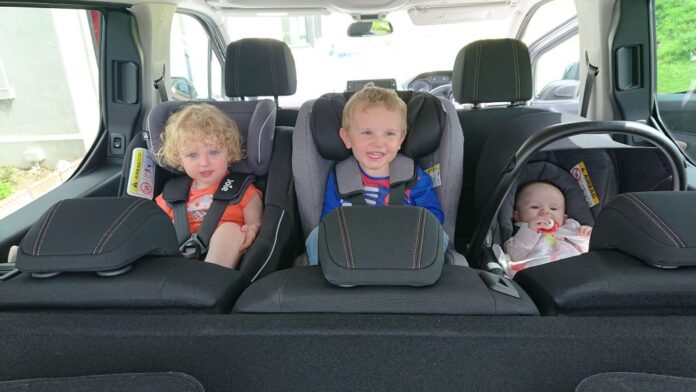

Shopping for a family vehicle gets more complicated once you have three or more children. A vehicle can technically have seven seats and still be frustrating to use every morning if car seats block third-row access, the cargo area disappears when every seat is occupied, or older kids have to climb awkwardly past younger siblings.
That is why passenger capacity should be only the starting point. The better question is whether the vehicle works with your children’s ages, car seats, daily routines, and everything your family regularly carries.
Before buying, test the vehicle as if you already own it. Bring the car seats, load the stroller, put the kids where they would normally sit, and see how the setup actually works.
Start With Your Real Seating Arrangement
A vehicle advertised as a seven- or eight-passenger model does not necessarily give every family the same amount of usable space.
First, decide where each child would sit. A family with an infant, a preschooler in a forward-facing seat, and an older child in a booster has different needs from a family with three teenagers.
Think a few years ahead as well. Car seats become boosters, children get taller, and a third row that feels adequate for a small child today may become less practical later.
If you regularly drive grandparents, friends, or other relatives, include those passengers in the calculation. Filling every seat with your immediate family leaves no spare capacity for anyone else.
Check Car Seat Compatibility, Not Just Seat Count
For families still using child restraints, car seat fit should be tested before purchasing the vehicle.
The National Highway Traffic Safety Administration advises parents to choose a restraint appropriate for the child’s age and size and make sure it fits the specific vehicle. Its car seat safety guidance also recommends reading both the child restraint instructions and the vehicle owner’s manual for installation details.
Do not assume every rear seating position has the same hardware. Lower-anchor and tether locations vary by vehicle, and a car seat can also be installed with a seat belt when permitted by the applicable instructions. NHTSA notes that lower anchors are found in a minimum of two rear seating positions, so having a wide second-row bench does not automatically mean there are lower anchors for three car seats.
Bring your actual restraints to the dealership if possible. Check whether they install securely in the positions you intend to use and whether neighboring seats and buckles remain accessible.
Decide Between a Bench Seat and Captain’s Chairs
For three or more children, the second-row configuration can change how the entire vehicle functions.
A bench seat may allow three children to sit in the second row if the vehicle, restraint combination, and seating positions accommodate them correctly. It can also preserve the third row for additional passengers or cargo.
Captain’s chairs create a different advantage: easier separation between children and, in some vehicles, a clearer path toward the third row.
Neither arrangement is automatically better.
Imagine a family with two children in large car seats and one older child who needs the third row. If folding the second-row seat is impossible while a child restraint is installed, accessing that third row may become inconvenient. A center aisle could make the same routine much easier.
Test both configurations with your family’s actual seating needs rather than choosing based on appearance.
Make Sure the Third Row Is Truly Usable
Third-row seating can vary considerably between vehicles.
Sit in it yourself. Check headroom, legroom, foot space, ventilation, cup holders, charging access, and how easy it is to get in and out.
Then consider who will actually sit there.
If a child restraint will be installed in the third row, verify the appropriate seat belt and tether arrangements in the owner’s manual. For a forward-facing car seat, NHTSA advises using a tether when one is available and following the vehicle and car-seat manufacturers’ installation instructions.
Also test what happens when the third row is occupied. Some vehicles provide generous passenger capacity but leave relatively little room behind the final row for everyday cargo.
Test Third-Row Access With Car Seats Installed
This is one of the easiest problems to miss during a quick test drive.
A second-row seat may slide or fold beautifully in an empty showroom vehicle. Once a bulky child restraint is installed, however, that movement may be restricted or the process may become impractical for daily use.
Try your intended configuration before buying.
Can an older child reach the third row independently? Can you help them buckle if necessary? Would you need to remove a car seat whenever someone gets into the back?
Picture the routine in less-than-ideal conditions: school drop-off in the rain, a sleeping toddler, grocery bags in the cargo area, and everyone trying to get out at once.
Convenience that seems minor during a dealership visit can matter considerably when you repeat the same task every day.
Measure Cargo Space With Every Needed Seat in Use
Families rarely travel with passengers alone.
There may be a stroller, diaper bag, backpacks, sports equipment, groceries, scooters, or luggage. If you need the third row regularly, cargo capacity behind that row matters more than the maximum cargo figure advertised with seats folded.
Bring your largest everyday item when you shop. A stroller is particularly useful because it quickly reveals whether the remaining cargo area works for your family.
Think about ordinary errands as well as road trips. If the stroller takes up nearly all the available space, where will a week’s groceries go?
For families comparing larger three-row SUVs, someone researching a Grand Wagoneer in San Antonio can use the same approach: evaluate the specific vehicle and configuration against the number of passengers, child restraints, and amount of cargo the family actually needs rather than relying on vehicle class alone.
Pay Attention to Doors and Loading Height
Getting several children in and out changes which design details matter.
Wide-opening rear doors can make it easier to reach child restraints, while sliding doors on some vehicles can be particularly convenient in tight parking spaces. With conventional doors, consider how much room you need beside the vehicle to buckle a child.
Vehicle height matters too.
A tall SUV may provide useful ground clearance, but repeatedly lifting a toddler into a high seat can become tiring. Very young children may also need more help climbing in.
Open every door and practice the movements you would make on a normal day. Ease of entry deserves more weight than it may receive on a specification sheet.
Look for Storage Where Families Actually Need It
Cargo volume is only part of family storage.
Small-item storage helps control the things that accumulate inside a vehicle: water bottles, wipes, snacks, toys, charging cables, sunglasses, and school supplies.
Look for practical door pockets, cup holders, center-console space, seatback storage, and accessible compartments.
Placement matters. A storage bin that can only be reached from the front seat does little for a child in the third row.
Also consider how easy the interior is to clean. Removable floor mats, accessible seat gaps, and durable surfaces can make routine cleanup less frustrating.
Check Climate Control Throughout the Cabin
A large cabin needs effective airflow beyond the front seats.
When comparing vehicles, look at the placement of vents and whether rear passengers have appropriate climate controls for the vehicle’s design. Sit in the second and third rows with the system operating.
This becomes especially noticeable when children spend significant time in the rear seats during very hot or cold weather.
Sun exposure can also vary by seating position. Window shades, tinted glass where permitted, and effective rear ventilation may contribute to passenger comfort, but features differ by model and trim.
Verify the equipment on the exact vehicle you are considering rather than assuming every version includes it.
Consider Visibility and Driver-Assistance Features
A larger family vehicle can take time to adjust to, particularly if you are moving from a sedan or smaller crossover.
During the test drive, evaluate visibility when changing lanes, reversing, parking, and navigating narrow areas. Pay attention to how much of the surrounding area you can see naturally and what assistance the vehicle provides.
Backup cameras are required on new passenger vehicles sold in the United States, but additional driver-assistance features vary. Depending on the model and trim, available technology may include blind-spot monitoring, parking sensors, surround-view cameras, or other systems.
Treat these features as assistance rather than substitutes for attentive driving.
More technology is not necessarily better if the controls are distracting or difficult to understand. Test the systems and decide whether they genuinely make the vehicle easier for you to operate.
Think About Everyday Running Costs
Larger vehicles can carry more people and cargo, but capacity has financial tradeoffs.
Compare fuel or energy consumption, insurance, tires, routine maintenance, financing, and expected depreciation alongside the purchase price. A vehicle that stretches the monthly budget may not be the most practical family choice even if the interior works perfectly.
Driving patterns matter too.
A family traveling 20,000 miles per year will experience fuel-cost differences more strongly than one driving 6,000 miles. If two vehicles differ by $60 per month in fuel under your actual driving pattern, that becomes $720 per year.
Use your own mileage and local prices rather than relying on a generic estimate.
Test the Vehicle With the Whole Family
A solo test drive cannot tell you how well a vehicle works with three children.
If practical, bring the family for a second visit after narrowing your choices. Install the child restraints, let older children enter the third row, load your normal gear, and drive on roads similar to those you use regularly.
Pay attention to small inconveniences.
Can everyone reach a cup holder? Can the driver hear a child in the third row? Does someone have to move every time another passenger gets out? Can you reach a younger child when parked without climbing awkwardly through the cabin?
A vehicle that works smoothly during this test is much more likely to work during an ordinary Tuesday morning.
FAQs
Is a three-row SUV necessary for a family with three kids?
Not always. Some two-row vehicles may accommodate three children depending on passenger size, child restraints, and the vehicle’s seating configuration. A third row can provide additional flexibility, especially if you regularly carry other passengers or cannot comfortably fit the required child restraints across one row.
Can three car seats fit across one vehicle row?
Sometimes, but compatibility depends on the vehicle, seating positions, and the specific child restraints. Seat width alone does not determine whether an installation is appropriate. Test the actual seats and follow both the vehicle and car-seat manufacturers’ instructions.
Is a bench seat or captain’s chairs better with three children?
A bench can provide an additional second-row seating position, while captain’s chairs may make third-row access easier in some vehicles. The better option depends on where your children will sit, whether they use child restraints, and how frequently you need the third row.
How much cargo space does a family of five need?
There is no single ideal number because families carry different gear. Instead of choosing by cargo-volume specifications alone, test whether the space behind the seats you will actually use can hold your stroller, groceries, sports equipment, luggage, or other regular items.
For a family with three or more children, the most useful vehicle is not necessarily the one with the most seats or the biggest exterior.
It is the one that makes the repeated parts of family life easier: installing the restraints correctly, getting everyone in and out, carrying the gear you actually use, and keeping passengers comfortable without stretching the household budget.
Bring your real-life setup to the dealership and test it. Ten minutes spent loading car seats and a stroller can reveal more about a family vehicle than a long list of specifications.