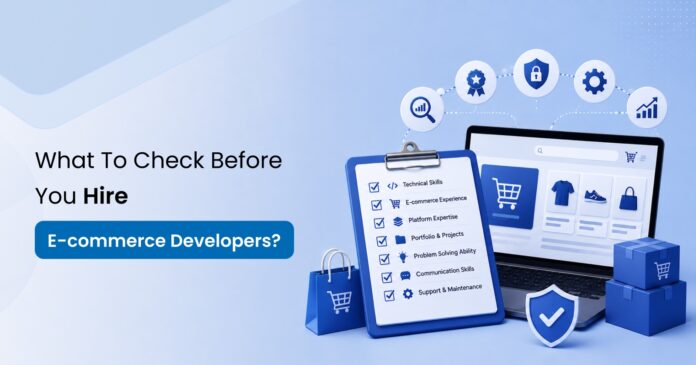

Ecommerce development is in a constant boom and is surpassing the benchmark we expected. One such innovation is the use of AI in e-commerce development services. With the rise in development and expansion, there is a high demand for hiring ecommerce developers in the market. However, the task is not just about hiring but about hiring the right talent for your business to help you achieve the desired results. In this blog, we will discuss key pointers to keep in mind when hiring the right talent.
Understand What Your Store Actually Needs
Every eCommerce store is unique and distinct from another. Therefore, you must understand what your business needs most, whether you want scalability, profitability or to focus on reducing abandoned cart rates in the beginning. If you know your needs and requirements, you can clearly communicate your expectations when hiring e-commerce developers.
Always source candidates with comprehensive knowledge of the eCommerce ecosystem and experience with platforms such as Shopify, BigCommerce, or Magento (Adobe Commerce).
Look at Their Past Work and Experience
Past work and experience speak a lot about the candidate profile. Having prior experience developing online eCommerce platforms will help you determine whether the developer knows the ins and outs. Obviously, you cannot rely on a profile that says, “I know how things work but have never worked on the same,” because that’s a complete bluff and a blunder for your organization.
To save yourself, ask questions like, “During an eCommerce store’s development and deployment, what challenges did you face, and what are the types of eCommerce platforms and their pros and cons? These questions will help you select the right candidate as per your business needs.
Technical Skills That Really Matter
Ecommerce developer roles and the relevant tech stack go hand in hand. For your reference, we have provided a table below which will help you source the right candidate from an eCommerce development company based on your project’s technical needs.
| Role | Key Technologies and Skills | Relevance |
| Frontend | HTML, CSS, JavaScript, React, Redux, SaaS, jQuery, Vue.js, Angular | Relevant for UI, speed, and customer experience. |
| Backend | JS/TS (Node.js, NestJS) or PHP, PostgreSQL, MySQL, MongoDB, Redis, REST, GraphQL, Webhooks, Docker, AWS, GCP, Azure | Responsible for handling business logic, performance, integrations, and scalability |
| Full-Stack | Combination of both frontend and backend technologies | Suitable for startups or projects with smaller teams |
| Platform-Oriented | Magento, Shopify, BigCommerce, WooCommerce, Salesforce Commerce Cloud, and SAP Commerce | Becomes essential if you have deep knowledge of the eCommerce platform |
This table can be a complete game-changer for you. After analyzing the table, you can evaluate what you need and what capabilities to look for in a potential candidate.
Communication and Support After Launch
Post-launch support and communication make sure ensure long-term product success by tracking user engagement, resolving bugs, and maintaining clear touchpoints. It involves establishing a dedicated ticketing system, building a comprehensive knowledge base and using targeted communication formats, such as quick Slack updates or short demo videos, to drive adoption.
From feedback loops and omnichannel support to self-service resources, you will need numerous interconnected elements to maintain product health and user satisfaction.
For stores with complex inventory operations, integrating a Shopify WMS can also help developers connect warehouse processes with the broader e-commerce system.
Understanding Pricing and Getting Value for Money
There are different pricing models for each ecommerce platform. From free versions to basic, and then to premium versions, the right developer will always be aware of the pricing currently charged by these platforms. The benefit you will get from it is that it will help you select the right channel that matches your current business requirements.
Apart from that, you will have to conduct the right analysis based on the features you receive. To simplify this for you, here is a table to help you differentiate between platforms and select the best value-for-money option.
| Feature | Shopify | WooCommerce | BigCommerce | Magento |
| Suitable Platform | Hosted on a SaaS platform | Self-hosted plugin | Hosted on a SaaS platform | Self-hosted plugin |
| Best Suited For | Ideal for beginners, D2C brands and quick launches | Suitable for WordPress users and content-heavy stores | Best for scaling brands that require built-in tools | Feasible for enterprise, B2B and high-volume stores |
| Setup Functionalities | Easy to set up. Drag and drop | Complex and requires technical setup | Moderate and comes with built-in features | Hard to set up and requires a dedicated developer |
| Security and Hosting | Managed by Shopify | Self-managed | Handled by BigCommerce | Self-managed |
| Primary Cost | It depends on the subscription plans you purchased | Free plugin. You only need to pay for hosting and domain charges | Differs. It is completely based on subscription tiers | Magento Open Source is free to use. However, Adobe Commerce is its paid version |
| Customization Levels | Depends mostly on apps or themes | Customization levels are limitless | Offers great flexibility within SaaS bounds | Infinite customization is available |
| SEO Potential | SEO control is good, but limited to URL tweaking | Exceptional SEO potential, as it runs on WordPress | Very strong native tools | SEO potential is on an advanced level, but it requires a strong technical setup |
Common Mistakes to Avoid While Hiring
Watch out for these common pitfalls to avoid before you hire or interview the e-commerce developer.
Mistake 1: Slow-Loading Websites
A slow-loading website will impact user retention and increase your website’s bounce rate. If it takes more than 5 seconds to load, it means you will have 7% fewer sales. The reasons why it happens are:
- Poor image optimization
- Junk codes
- Poor hosting mediums
- Inaccurate databases
The right developer will resolve the issue even before it occurs. By using content delivery networks, compressing everything, and cleaning up messy code before the problem arises or someone reminds them, your issue will be resolved promptly, and your website will not struggle with slow loading times.
Mistake 2: Mobile Responsiveness
Nowadays, everyone prefers using smartphones to desktops, and most orders are placed on phones. This is where the loop happens. Businesses tend to optimize websites and pay less attention to improving mobile responsiveness. The right developer will ensure that does not happen to you and will ensure:
- Websites fit on mobile screens and are designed well
- Have a clear button for making a purchase
- Respond quickly on cellular connections
- Designed and works exactly like native applications
These pointers will help you select the best candidate to ensure that no mobile customers are lost and to improve the brand image.
To Wrap Up
Now that you know what to check before hiring eCommerce developers, invest your time and energy in sourcing the right candidate who matches your needs and is an asset to the organization. Furthermore, gain a better sense of whether they are willing to serve a long-term commitment with your organization or not. Also identify whether you need to hire a dedicated developer, an agency, or a freelancer for your business, because that’s going to make the entire difference in how you approach the hiring process. In this blog, we have outlined the non-negotiable basics.
FAQ
If I have an e-Commerce website, what security standards do I need to follow?
Ans: Your eCommerce website must comply with the PCI DSS standard and require TLS/SSL encryption for all data transfers.
Name the third-party integrations that are critical for e-Commerce platforms.
- Payments: Stripe, PayPal, and Authorize.Net
- Logistics: FedEx, UPS, and DHL
- Marketing: Klaviyo, Mailchimp, and Google Analytics 4 (GA4)
- Operations: Inventory management (ERP) and customer systems (CRM)