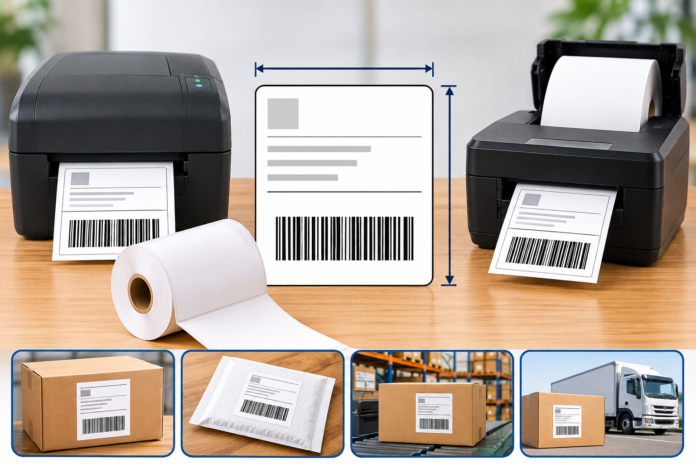

The most common parcel shipping label is 4 × 6 inches, approximately 102 × 152 millimeters. This format is widely used by major carriers, ecommerce platforms, warehouses, and four-inch thermal printers because it provides enough room for addresses, service information, routing marks, and scannable barcodes.
It is not the only valid size. International documents, carrier doc tabs, postal letters, freight shipments, return labels, and platform-specific formats may use different dimensions. Always select the format generated for the service and match the printer page definition to the physical media.
Why Is 4 × 6 So Common?
A four-inch print width accommodates standard parcel information while keeping the label compact enough for cartons and mailers. Many desktop thermal printers are built around this width, and shipping software commonly offers a true 4 × 6 PDF, PNG, ZPL, or other printer-ready output.
The format also supports high-volume handling. Operators can apply one self-adhesive label without cutting a sheet, and automatic scanners can find familiar barcode locations. Standardization reduces setup time, but it does not remove the need to verify the carrier file and barcode quality.
Are All 4 × 6 Labels Exactly the Same?
Physical media sold as 4 × 6 may vary slightly by metric conversion, gap, corner radius, liner width, adhesive, coating, and manufacturing tolerance. A driver may call the same rectangle 4 × 6, 100 × 150 mm, or 102 × 152 mm even though these are not identical.
Measure the actual label and use the supplier’s specification. The source document, driver stock, and media must agree. A small mismatch can accumulate into vertical drift, clipping, or an unexpected gap after repeated labels.
What Other Shipping Label Sizes Are Used?
UPS workflows can use 4 × 6 or slightly longer standard labels and extended formats such as 4 × 8 for document or reference areas. FedEx systems support several thermal stock sizes with or without document tabs. USPS online labels are generally intended to print at approximately 4 × 6, while some letter and customs workflows differ.
Office printing often uses Letter or A4 sheets containing one or more labels. Narrow internet-postage formats and freight labels also exist. Never resize an extended or multi-page carrier document until it merely fits one 4 × 6 label.
How Do You Check the Source File Size?
Open the PDF properties or inspect the print preview. A true 4 × 6 page should show one complete shipping label filling the page without large Letter-size margins. If the label occupies one corner of an 8.5 × 11 page, fitting that entire page will make the barcode too small.
Choose the thermal format in the shipping platform before purchasing or downloading when possible. Use the original carrier-generated file rather than a screenshot. Screenshots may reduce resolution, add margins, or change proportions.
Which Printer Is Needed for a 4 × 6 Label?
Use a printer with a supported media width of at least four inches plus the liner allowance specified by the manufacturer. Confirm whether the printer loads the roll internally, feeds fanfold media from the rear, or requires an external holder. Check maximum outside diameter and core size.
Load compatible shipping labels, adjust the guides, and calibrate the sensor. A printer that can physically accept a four-inch web may still require the correct gap, black mark, thickness, and driver definition.
Which Print Settings Preserve the Size?
Set the page to the exact media dimensions and print at Actual Size, 100%, or no scaling. Disable Fit, Shrink, multiple pages per sheet, browser headers, and automatic margin changes. Choose orientation by the preview.
If the label is clipped, correct page dimensions or printer offsets rather than reducing scale. If it is small with wide blank space, check whether the source is an office-paper format. Save a named preset only after a test label measures correctly.
How Much of the Label Can Be Used?
Carrier-generated files already reserve areas for barcodes, human-readable information, and required clear space. Do not add logos, borders, notes, or tape over these areas. Thermal printers also have a printable width that may be slightly narrower than the full liner.
For custom logistics labels, leave adequate quiet zones around barcodes and keep critical information away from die-cut edges. Test the longest address and densest barcode rather than approving a short sample.
Does Label Adhesive Affect the Standard Size?
Size and adhesive solve different problems. A standard 4 × 6 face still needs an adhesive suitable for corrugated board, recycled cartons, plastic mailers, cold packages, or rough surfaces. The label should lie flat without edge lift or wrinkles.
Apply samples to filled packages at the actual temperature. Smooth from the center outward and scan after application. A perfectly sized barcode may fail if a flexible mailer folds or the label detaches during transport.
How Should a Shipping Label Be Positioned?
Use the largest flat face of the package. Keep the barcode away from seams, corners, closure tape, strapping, and folds. Do not wrap a label over an edge. Remove or fully cover obsolete carrier labels and tracking codes from reused cartons.
International shipments may require customs documents in a pouch or additional labels. Follow the carrier instructions for those documents instead of attempting to combine everything onto the standard parcel label.
What Should Buyers Specify When Ordering?
- Exact face and liner dimensions.
- Roll or fanfold format, core, outside diameter, and winding direction.
- Gap, black mark, perforation, and labels per roll.
- Direct thermal grade, topcoat, adhesive, and service environment.
- Printer models, carrier formats, and acceptance tests.
Give the label maker representative carrier files and package samples. Use 4 × 6 as the default for common parcel shipping, but confirm every platform, service, printer, and document type. The standard is valuable only when the digital page, physical label, and operational requirement truly match.
What Information Should Be Confirmed Before Ordering?
Confirm the carrier format, printer model, maximum print width, face dimensions, liner width, gap, core, outside diameter, winding direction, adhesive, and carton surface. A label described only as 4 x 6 may still be mechanically incompatible with a particular holder or sensor.
Test one roll through receiving, packing, application, scanning, and transport. Approval should cover both printer feeding and real carton adhesion rather than dimensions alone.