
Let’s be honest for a second. Running a medical practice or a hospital right now is kind of a nightmare. Staff shortages, burned-out nurses, patients who only show up when things are already bad, and constant pressure to see more people in less time. Something has to give.
For a lot of providers, that “something” has turned out to be remote patient monitoring, or RPM. More specifically, hiring a company to run it for you instead of trying to build the whole thing in-house.
I’ve been watching this shift for a while now, and I think it’s one of the few genuinely good things that’s happened in healthcare tech in the last few years. Here’s why it’s worth paying attention to.
What is remote patient monitoring?
Remote patient monitoring is exactly what it sounds like. Your patient uses a small device at home. It could be a blood pressure cuff, a glucose meter, a pulse oximeter, or a wearable that tracks heart rhythm. The device sends readings to your practice throughout the day. If something looks off, someone reaches out to the patient before it turns into a hospital visit.
Easy concept. Running it effectively is the difficult part. Remote patient monitoring services can help with it. They take care of the software, equipment, shipment, 24-hour monitoring, patient onboarding, and frequently the billing paperwork as well. Clinical summaries and alarms are sent to your team. You don’t need to transform your clinic into an IT business or add five more employees.
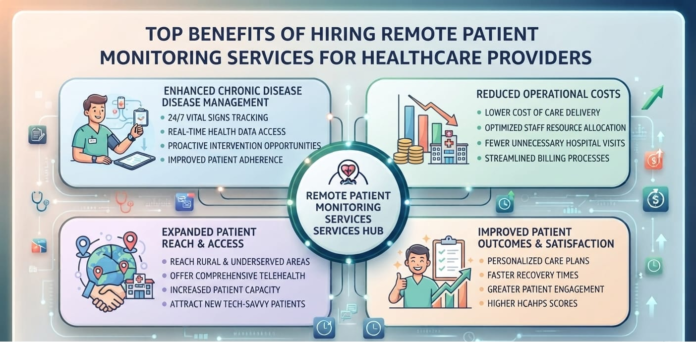
The top benefits of hiring remote patient monitoring services for healthcare providers
Catch problems weeks before they become emergencies
This is the one that actually matters. When you’re only seeing a patient every three months, a lot can go sideways in between visits. Blood pressure creeps up. Weight jumps five pounds in a week (a big deal for heart failure patients). Blood sugar swings all over the place.
With RPM in place, you see those changes as they happen. A nurse can call the patient the same day, adjust medication, or bring them in early. That one phone call can prevent an ER trip that would have cost the patient thousands and stressed everyone out.
Take pressure off your staff instead of adding to it
I know what a lot of doctors are thinking here. “Great, another thing for my already exhausted team to babysit.” Fair.
However, it is the entire purpose of using a service rather than creating it yourself. A reputable RPM firm employs healthcare personnel to handle alarms around-the-clock. Only those who genuinely require your attention are escalated. Blood pressure readings at two in the morning don’t swamp your MAs and nurses. Every day, they receive a brief synopsis and are alerted when a professional clinician’s opinion is needed.
This is the difference between RPM being beneficial for many practices and being an additional load that no one has time for.
It actually pays for itself (and then some)
Remote monitoring is reimbursed by Medicare and the majority of commercial payers. Device setup, monthly monitoring, and clinical time spent on the patient are covered by CPT codes such as 99453, 99454, 99457, and 99458. When reimbursement is multiplied by several hundred chronic care patients, it becomes substantial money even though it doesn’t change the lives of individual patients.
A good RPM service will often take care of the billing aspect as well, or at the very least provide you with clear paperwork that your billers may use. For the majority of practices, the math usually works out in the first few months.
Patients stay engaged (and they actually like it)
Here’s something I didn’t expect when I first started looking into this. Patients tend to love it.
Most people with a chronic condition feel forgotten between appointments. They’re managing their diabetes or hypertension alone at home, guessing whether they’re doing okay. When someone from your team checks in, they feel seen. When they see their own numbers on an app, they start noticing patterns and taking their meds more consistently.
Higher engagement means better outcomes. Better outcomes mean fewer readmissions, better quality scores, and patients who stick with your practice instead of shopping around.
Reach patients who can’t easily come to you
If you serve rural areas, elderly patients, or anyone with mobility issues, you already know how much care falls through the cracks because getting to the office is a hassle. RPM closes some of that gap. A retired farmer sixty miles out can still get regular check-ins on his heart failure without driving in every month.
For providers trying to expand access without opening new locations, this is one of the few tools that actually works.
What to look for in remote patient monitoring services
Not all RPM services are equal. A few things worth asking before you sign anything.
First, ask who’s actually on the other end of the alerts. Is it US-based clinical staff? What are their credentials? How fast do they respond?
Second, look at the devices. Are they cellular-enabled so patients don’t need Wi-Fi at home? A lot of older patients don’t have reliable internet, and that alone can kill a program.
Third, check how their platform talks to your EHR. If your nurses have to log into a separate system every day, adoption will die within a month.
Fourth, ask about billing support. This isn’t a small detail. It’s often the difference between the program being profitable or a headache.
So is hiring an RPM service actually worth it?
For most practices dealing with chronic conditions, yeah. The upfront work of picking a partner and enrolling patients is real, but once the flywheel is going, RPM tends to make the practice calmer, not busier. Patients get better care between visits, your staff stops feeling like they’re always behind, and there’s a new revenue stream you weren’t tapping before.
You don’t have to go all in. Start with a hundred patients, pick a reliable remote patient monitoring service, like Tellihealth, that doesn’t lock you into some five-year contract, and see what the data tells you after six months. That’s how most of the providers I’ve seen do this successfully.