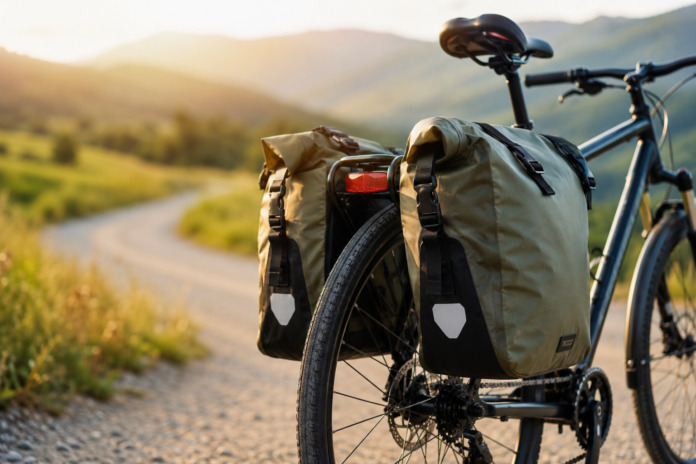

What is a Bike Pannier?
A bike pannier is a bag or container attached to the rack of the bicycle. It is used as a storage box for storing things, such as food, water, clothing, books, laptops, and other things you want to carry with you while travelling or touring.
These bags are available in various shapes, sizes, and designs. These are lightweight, durable, and can be easily removed when they are of no use. They are waterproof and are a convenient way to transport essentials with you while commuting.
History of Bike Panniers
Hundreds of years ago, pannier bags were used to carry essential things on animals like horses or donkeys. At first, they were made from leather. But along with advancements, pannier bags were updated to be used on bicycles. They were lightweight, made from canvas and cotton.
The word pannier is a French word that typically means bread basket. Modern panniers are more durable and waterproof, using materials such as PVC- or TPU-coated fabrics. They are available in different sizes according to the requirements and are used on bicycles and motorcycles as well for travelling or commuting. Similarly, small saddle bags are also used to carry small items such as tools.
Types of Bike Panniers
Bike panniers are divided into four types based on their capacity to store and carry things.
Commuter Panniers
Commuter panniers are spacious and are best for carrying clothes and laptops because they have extra sleeves or outer pockets, which means they have enough capacity to store a large number of things.
Convertible panniers
Convertible panniers are more convenient and can be converted into a backpack. They are best for commuting and grocery shopping. You can easily fix them on the rack of the bike without carrying the load on your back.
Front Panniers
Front panniers are small and usually mounted at the front of the bicycle. They keep the gravitational force low when handling the bicycle. Front panniers contain at least 10 L of capacity and are suitable for lighter gear or supplies.
Rear Panniers
Rear panniers are spacious in capacity and are mounted on the back rack of the bicycle. They are usually available with a 20 L capacity. They are best suited for heavy loads. They are lightweight and more stable.
Things to Consider Before Buying a New Bike Pannier
Whether you are going on a tour, commuting, or travelling to some nearby areas, it is important to choose a suitable bike pannier. Here are some essential things to consider before choosing or buying a new bike pannier.
Design and Capacity
Consider the load you have to carry with you and select the capacity of the bag accordingly. If you are travelling, then more capacity is required as compared to simple grocery shopping.
Usage Purpose
You must know for which purpose you are going to use the bike pannier, such as for touring or commuting. Pannier bags can wear out more while trying to cover long distances in less time.
Durability and Materials
Pannier bags are usually made from polyester or nylon material and PVC- or TPU-coated fabrics for waterproofing. Choose a pannier bag with reliable or durable material.
Attachment System
Consider pannier features for attaching to the rack of the bicycle to adjust it properly. Some panniers are easily adjustable while others may be limited to one hook, or have no adjustment.
Repairing Services
Warranty and repair services are important things to consider and to discuss properly for their long-term functionality.
Conclusion
Bike panniers play an important role in carrying loads from one place to another. They are available in different sizes, shapes, and designs. Modern designs are more lightweight, durable, and convenient to use for touring or commuting.
Pannier bags have been used for hundreds of years, but they were updated or modernised a few years back in the 19th or 20th century for bicycles. There are different types of bike panniers, including commuter, front, rear, and convertible panniers. Keep in mind their design, durability, attachment system, purpose of use, and repair services before buying a new pannier bag.