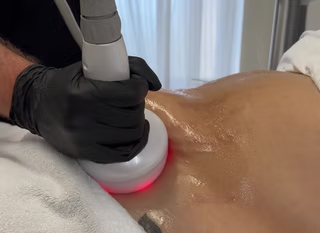

If you are looking into non-invasive ways to reshape your body, you have almost certainly bumped into the letters RF.
Radio Frequency (RF) is the absolute backbone of modern aesthetic medicine. If you look at the top-performing treatment packages in any high-end medical spa, you will find RF tucked inside them somewhere. It is the component that bridges the gap between simply shrinking a localized fat deposit and achieving a genuinely sleek, firm silhouette.
But what is it actually doing under the skin? Is it melting fat, tightening skin, or is it just an expensive massage?
The Core Physics: What is Radio Frequency?
To understand RF, you have to realize that it isn’t an exotic laser or a localized cold treatment. Radio frequency relies on alternating electrical currents that sit on the electromagnetic spectrum, the exact same spectrum that includes radio waves, Wi-Fi signals, and microwaves.
When an RF device passes over your skin, it releases these currents into your tissue. Your skin layers are not perfect conductors; they have natural electrical resistance (impedance).
As the RF current pushes through this resistance, it generates deep, localized heat. The magic of RF technology is that it bypasses the outer layer of your skin (the epidermis) entirely without burning it, focusing its thermal energy directly into the deeper layers: the dermis (where collagen lives) and the subcutaneous fat layer.
The Dual Action: What RF Does for Body Sculpting
Radio frequency is highly valued by professionals because it performs two distinct jobs simultaneously. Most body sculpting technologies are one-trick ponies, they either target fat or they tighten skin. RF addresses both.
Thermal Lipolysis (Shrinking and Disrupting Fat)
When the alternating RF waves reach the subcutaneous fat layer, they cause the water molecules within the fat tissue to vibrate rapidly. This friction generates structural heat, raising the internal temperature of the fat layer to roughly 43°C to 45°C.
Fat cells are highly sensitive to temperature changes. This sustained heat triggers two responses:
- Accelerated Metabolism: The heat forces the fat cells to release their stored fatty acids (triglycerides) into the lymphatic system, causing the cells to physically shrink.
- Apoptosis (Cell Death): If the practitioner maintains that specific target temperature for a set time, a percentage of those heated fat cells will suffer structural damage and break down permanently over the following weeks.
Immediate & Long-Term Skin Tightening
This is where RF stands out compared to other fat-reduction methods. When you heat the dermis to about 42°C, it forces the existing, loose collagen fibers to immediately contract and shorten. Think of it like throwing a wool sweater into a hot dryer, the loose fibers tighten instantly.
More importantly, this thermal energy acts as a controlled micro-injury. Your body recognizes the heat as a sign to kickstart its healing response, stimulating fibroblasts to build entirely new networks of collagen and elastin over the next 2 to 6 months.
Monopolar vs Bipolar vs Multipolar RF
If you look closely at device specifications, you will notice that radio frequency comes in different configurations. The configuration determines how deep the energy travels and how it reshapes the tissue.
- Monopolar RF: This uses a single active electrode tip on the handpiece and a grounding pad placed somewhere else on your body. The energy has to travel all the way through your tissue to get to the pad, allowing it to penetrate incredibly deep, straight into the dense subcutaneous fat layer. This is your heavy-hitter for fat reduction.
- Bipolar RF: The current travels between two closely spaced poles on the same handpiece. Because the distance is short, the energy loops back up quickly, staying within the upper dermal layers. This configuration is brilliant for surface skin tightening, wrinkles, and delicate areas like the neck or face.
- Multipolar/Polypolar RF: This configuration combines multiple positive and negative poles on a single handpiece. It creates a complex, woven matrix of electrical currents that allows the practitioner to heat both the deep fat layers and the superficial skin layers uniformly at the exact same time.
Why RF is the Perfect “Partner Technology”
While radio frequency can be a standalone treatment for mild skin tightening, its true power is realized when it is paired with other modalities.
If you use a technology like Ultrasonic Cavitation or Cryolipolysis, you are actively destroying fat cells. However, when you rapidly empty out the fat volume beneath the skin, you can occasionally leave behind a deflated appearance if the skin lacks elasticity.
The RF energy tightens the structural skin matrix as the fat diminishes, ensuring the treated area recovers with a smooth, contoured surface rather than loose or uneven skin tissue.
What a Session Actually Feels Like
For most clients, an RF body sculpting session feels surprisingly comfortable. Practitioners typically apply a glycerin-based conductive gel to your skin to help the handpiece glide smoothly.
As they move the handpiece in steady, circular patterns, you will experience a deep, warming sensation, very similar to a hot stone massage. The technician will constantly monitor your skin temperature with an infrared thermometer to ensure the tissue stays within the therapeutic window (40°C–45°C) without crossing into discomfort.
Sessions generally take 20 to 40 minutes per targeted zone. Aside from a bit of temporary redness (erythema) that fades within an hour or two, there is absolutely zero downtime. You can head straight back to work or go hit the gym.
The Long Game: What to Expect for Results
Because RF relies heavily on your body’s natural collagen manufacturing plant, patience is a necessity.
While you might notice a slight “snap” and tightening immediately after your first session due to initial collagen contraction, the real transformational work happens beneath the surface over time. A standard professional protocol typically recommends a series of 6 to 8 sessions, spaced roughly one week apart.
Your definitive results will steadily reveal themselves over the course of 3 to 6 months as those new collagen matrices mature and the lymphatic system completes its filtration process. It is a subtle, steady transformation, but when performed correctly by a skilled practitioner, it offers an exceptionally smooth, natural-looking contour that holds its shape beautifully.
Wrapping Up
If you are looking to invest in non-invasive treatments, remember that the best outcomes happen when you address both layers of the equation. Finding an experienced professional who understands how to leverage radio frequency alongside fat reduction will ensure you don’t just lose the volume, but get the sleek, tight silhouette you are actually looking for.