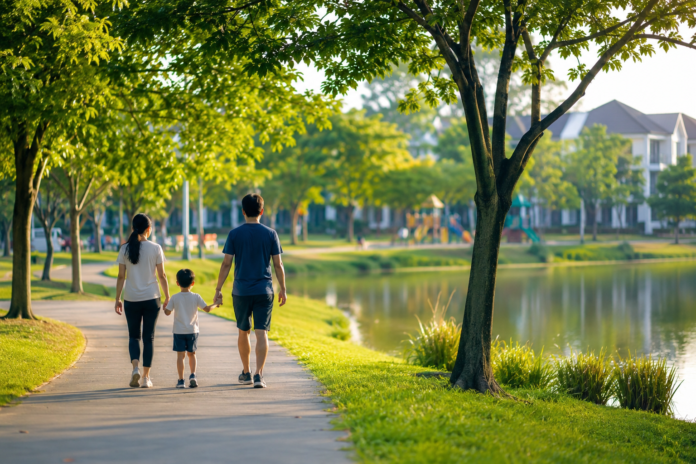

When people hunt for a property, the usual checklist tends to be practical enough. Number of bedrooms, parking spaces, school distance, whether the kitchen is big enough for that second fridge the family swears they need. Fair enough. But there is one thing that often slips under the radar until much later, and that is what lies just outside the gate. A patch of green. A jogging path. A lake. A place where the evening feels a little softer.
In Malaysia, where life can move quickly and the weather has its own ideas, living near green spaces has a way of changing the mood of a neighbourhood. It is not only about looks, though a row of trees does beat concrete walls any day of the week. It is about the small moments that start to build up. A morning walk before the heat kicks in. Children cycling without being boxed in by traffic. An older couple taking their slow evening stroll after dinner. Nothing dramatic, just a calmer rhythm.
That calm matters more than people sometimes admit. After a long day in the office, a messy commute, or one of those never-ending Klang Valley traffic crawls that feels like the road has personally offended you, having a nearby park or recreational area can feel like a small mercy. You step out, the air shifts a little, and suddenly the day does not feel so heavy.
Green spaces change the way a neighbourhood feels
A good park does not sit there looking pretty and doing nothing. It draws people out of their homes in a way that feels natural. Parents bring toddlers to the playground. Joggers appear early in the morning, often looking far more committed than the rest of us. Teenagers gather on benches pretending they are not socialising. The place becomes part of daily life, not just a weekend stop.
That is one of the nicest things about homes near recreational amenities. The surroundings help create a sense of community without forcing it. In Malaysia, where neighbourhood life still matters quite a bit, that can be a real bonus. People notice one another. Neighbours wave. There is more life on the streets, but in a comfortable sort of way, not the chaotic type.
Families with young children tend to appreciate this most. A nearby field or park means fewer excuses for everyone to stay indoors glued to screens. It is easy for kids to burn off energy, which is a blessing for parents who know the difference between a sleepy child and a hyper child after sunset. Anyone who has tried to manage a bored child indoors on a rainy day will understand the appeal very quickly.
Better for health, easier on the mind
There is a reason people feel better after a walk in a garden or by a lake. Fresh air, natural light, and open space do something that four walls simply cannot manage. It is not mystical. It is just human. We seem to function better when our eyes have somewhere soft to rest.
Living near green areas encourages more movement too. When a jogging track is five minutes away, it feels less like a chore and more like a reasonable idea. When there is a park nearby, evening exercise becomes part of the routine instead of a grand plan that gets postponed until next month. That helps adults, sure, but also children and older residents who need safe and pleasant places to stay active.
There is mental relief in it as well. A park can act like a pressure valve. Some people need the gym. Others need trees. Sometimes all it takes is sitting on a bench and watching the clouds drift by, preferably while the phone stays in the bag for once. In a country where urban living often means noise, heat and schedules that are far too packed, access to greenery feels like a genuine advantage rather than a decorative extra.
More than scenery, it adds daily convenience
Recreational amenities are not just for leisure. In many Malaysian townships and new developments, they also serve as practical spaces. Walking paths become shortcuts. Playgrounds become after-school meeting points. Community gardens give residents something to look after together. Even a simple open field can turn into a place for futsal, badminton, family picnics or a quick weekend event.
That mix of use is part of the charm. A home close to these spaces often makes family routines smoother. Need a place for the children to blow off steam? Sorted. Want to take the dog out without driving somewhere first? Easier. Looking for a spot to chat with friends without booking a café table? There it is.
Developments with thoughtful landscaping and recreational features also tend to feel more settled. They are not just rows of units stacked for convenience. They offer breathing space, which makes a big difference when people spend most of their week moving between work, home and traffic lights. Even a brief stroll around the neighbourhood can become a little ritual, and honestly, those small rituals help keep life from turning into one giant spreadsheet.
Why Malaysian buyers pay attention to this
In Malaysia, buyers often look beyond the unit itself. A condo or landed home might tick the basic boxes, but the surrounding environment can tip the scale. Proximity to parks, lakes, clubhouses and recreation areas is often seen as a sign of a better long-term living experience. It can even influence resale appeal, since many buyers now value liveability just as much as size.
This is especially true for younger families and working professionals who want balance. They may not have time for long weekend drives every time they want fresh air. If a decent park is nearby, the whole lifestyle feels easier. Less planning. Less faff. More actual living.
There is also the climate to think about. Malaysia’s heat can be relentless in the middle of the day, so tree shade and open-air recreation are not small details. They are a welcome relief. A well-planned green area gives residents somewhere pleasant to be without needing to escape the city altogether.
Homes near amenities often feel more complete
Some developments manage to get the balance right. They are close to everyday essentials, yet still offer space to slow down. That combination is attractive because it feels complete. You are not just buying a roof and walls. You are buying a daily experience.
For example, a neighbourhood with walking trails, a lake, landscaped gardens and family-friendly common areas can change how people use their home. Weekends feel more relaxed. Even weekdays become a little gentler. The home itself becomes part of a wider lifestyle, not just a place to sleep and stash groceries.
That is why listings in thoughtfully planned areas often draw attention from buyers who are thinking ahead. A nice layout is useful, no doubt, but a pleasant setting can be the thing people remember after seeing ten similar properties. When a home sits near good recreational spaces, it tends to leave a better impression. Quietly, steadily, without making a song and dance about it.
Finding the right fit in a green neighbourhood
If a buyer is weighing up where to settle, it helps to look at how the surrounding area fits the family’s actual habits. Do the children need a playground nearby? Is jogging part of the routine? Would an evening walk be more realistic than a long drive to a park on weekends? These are simple questions, but they reveal a lot.
Some developments make the case rather well by blending homes with landscaped surroundings and recreational access. A good example is Hana Eco Ardence for sale, where the setting adds another layer to daily living. It is the sort of place that appeals to buyers who want their home to feel a bit more grounded, a bit more relaxed, and less boxed in by the rush of city life.
At the end of the day, a house near green spaces offers more than a pleasing view. It can support better routines, lighter moods and a stronger sense of connection to the neighbourhood. For many Malaysians, that is worth a great deal. After all, a home is not only about what happens indoors. Sometimes, the nicest part begins just beyond the front door.