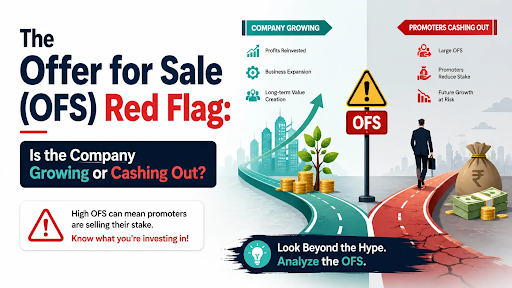

The Hidden Details Behind the IPO Hype
Whenever a highly anticipated upcoming IPO hits the Indian Share market, the retail investing community immediately goes into a frenzy. Social media timelines flood with speculation, and everyone scrambles to check the unofficial IPO GMP (Grey Market Premium) and the listing gains calculator to count profits.
But amidst all this noise, a critical piece of information is almost always ignored. People get so blinded by the shiny branding of the company and the inflated premium numbers that they forget to ask the most fundamental question in finance: Where exactly is my money going?
When you hit the “Apply” button and block ₹15,000 in your bank account, you naturally assume that your money is going to the company to help it build new factories, hire better talent, or expand its business. But in the modern primary market, that is often not the case at all. To figure out the truth, you must look closely at a small section in the company’s official prospectus called the “Object of the Issue.”
This section will clearly state whether the IPO is a Fresh Issue or an Offer for Sale (OFS). Understanding the difference between these two terms is the ultimate shield against losing your capital to overhyped corporate exits.
The Green Flag: What is a Fresh Issue?
A Fresh Issue is exactly what an IPO was originally designed to be. In a Fresh Issue, the company is creating brand new shares and selling them directly to the public.
Every single rupee you invest goes straight into the company’s official bank account. The management then uses your capital to fuel future growth. They might use it to:
- Set up a new manufacturing plant.
- Expand their retail stores into new states or countries.
- Fund crucial Research & Development (R&D) for new technology.
- Pay off high-interest corporate bank loans, which instantly boosts their profit margins.
When you invest in a Fresh Issue, your goals and the management’s goals are perfectly aligned. You are giving them the fuel they need to grow the business, and as the business grows, your share price goes up.
The Red Flag: What is an Offer for Sale (OFS)?
An Offer for Sale (OFS) is a completely different mechanism. In an OFS, the company is not creating any new shares, and more importantly, the company itself is not receiving a single rupee of your money.
Instead, the existing shareholders—usually the original founders, early angel investors, and massive Private Equity (PE) or Venture Capital (VC) firms—are simply selling their personal shares to you.
When you apply for a 100% OFS issue, your hard-earned money bypasses the company entirely and goes straight into the personal bank accounts of those early investors. They get to cash out at a massive profit, buy luxury real estate, and exit the risk, while you are left holding shares in a company that hasn’t received a single dime of fresh capital to grow its business.
Why a 100% OFS is a Massive Warning Sign
If a highly hyped upcoming IPO is entirely an Offer for Sale, you need to step back and ask a very cynical, logical question:
If this business is so fantastic, and the future is so incredibly bright, why are the original founders and professional investors so desperate to sell their shares to the public?
Venture capitalists and institutional investors are not charities; they are ruthlessly smart financial players. They employ teams of analysts to value businesses. If they are choosing this exact moment to sell their massive stake to retail investors, it usually means one of two things:
- Peak Valuation: They believe the company has already reached its maximum possible valuation, and the growth is about to slow down drastically. They are cashing out at the absolute top before the public realizes the growth is over.
- The GMP Illusion: They are using a heavily manipulated IPO GMP to create retail FOMO (Fear Of Missing Out). They hype up the grey market so retail investors oversubscribe the issue, ensuring the early investors get a smooth, highly profitable exit strategy at your expense.
Is Every OFS a Bad Investment?
It is important to note that an OFS is not illegal, and it is not always a complete disaster. Many great, fundamentally strong companies enter the market with a mix of both.
A partial OFS is very common and generally acceptable. For example, if an IPO raises ₹2,000 Crores, where ₹1,500 Crores is a Fresh Issue to build a new factory, and ₹500 Crores is an OFS to let early investors take some well-deserved profit after waiting ten years, that is a perfectly healthy balance.
The major red flag is the 100% OFS. If a company is coming to the market solely to let private equity funds exit, you are no longer investing in the company’s future growth; you are simply providing liquidity for the rich to get richer.
Conclusion
The primary market is not a guaranteed wealth-creation machine; it is a highly calculated transfer of risk. Before you let the excitement of an upcoming IPO or a sky-high GMP dictate your financial decisions, always open the company’s DRHP (Draft Red Herring Prospectus) and read the “Object of the Issue.”
If the management is raising fresh capital to aggressively grow the business, it might be a journey worth taking. But if the entire issue is just a coordinated exit plan for early venture capitalists, it is usually best to keep your money safely in your pocket and wait for a better opportunity.
Frequently Asked Questions (FAQs)
Where can I find out if an IPO is a Fresh Issue or an OFS?
You can find this information on the official website of the NSE or BSE by looking at the company’s Red Herring Prospectus (RHP). Alternatively, almost all reliable Share market news apps and brokerage platforms clearly break down the IPO size into “Fresh Issue” and “OFS” on their summary pages.
Does a 100% OFS mean the stock price will crash on listing day?
Not necessarily. A 100% OFS can still list at a premium if the broader S market is in a massive bull run and the public demand is irrationally high. However, once the initial listing day hype fades, these stocks often struggle to deliver long-term returns because the company did not receive any new capital to fund future expansion.
Why does SEBI allow 100% OFS IPOs?
SEBI’s role is to ensure transparency, not to judge the quality of an investment. Providing an exit route for early investors is a standard part of the global financial ecosystem. It encourages venture capitalists to fund start-ups early on, knowing they can eventually exit through an OFS. SEBI simply mandates that the company clearly discloses this to you so you can make an informed choice.