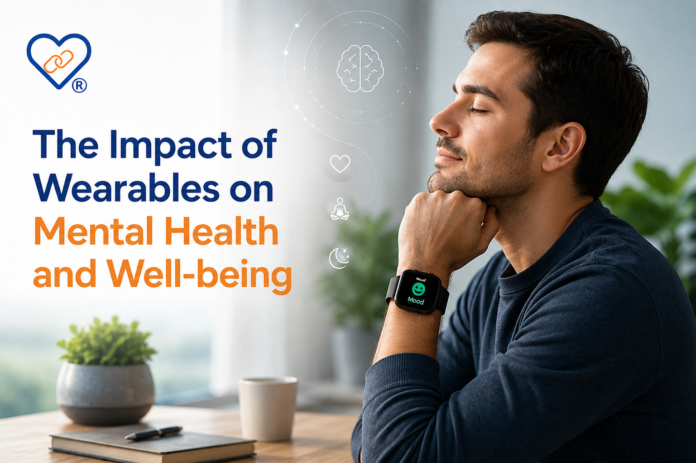

A decade ago, wearables answered one question: how much did you move today? Steps, calories, maybe a heart rate graph. Useful for physical health, silent on everything else. That’s changed. Sleep data started getting linked to mood. Heart rate variability started showing up as a stress indicator. The industry realized physical metrics were only half the picture, and emotional well-being was the half nobody was measuring.
What Is Emotional Well-Being, and Why Are Wearables Getting Involved?
Emotional well-being is your ongoing capacity to manage mood, stress, and motivation day to day. Wearables got involved because the same sensors already tracking your body happened to capture signals connected to emotional state too.
Heart rate variability, sleep quality, and activity patterns all correlate with stress and mood, even though none of them were originally designed to measure emotion. Manufacturers noticed the overlap and started building features around it instead of ignoring the data.
A real example from the category: a user’s sleep tracker flags three consecutive nights of poor sleep. That same pattern, on a wellness-focused wearable, now triggers a check-in prompt instead of just a chart nobody looks at twice. That shift, from passive chart to active nudge, is the entire story of where this category is headed.
How Do Smart Wearables Actually Detect Emotional Shifts?
Smart wearables detect emotional shifts indirectly by tracking physical signals that correlate with mood and stress, not by reading emotions directly. Heart rate variability is the most common signal used.
When HRV drops and stays low, it often lines up with elevated stress, even before someone consciously feels stressed. Combine that with a drop in sleep quality or a change in activity level, and a device can flag a pattern worth addressing.
None of this is mind reading. It’s pattern matching across a handful of physical signals, refined over time as the device learns what’s normal for a specific person versus what’s a genuine shift.
What Do Wearable Sensors Track That Actually Matters?
The wearable sensors that matter most for emotional well-being are heart rate variability, sleep stages, and activity consistency, not step count alone.
A quick breakdown of what each sensor actually tells you:
- Heart rate variability: Higher variability generally signals better stress resilience. Sustained low variability is a useful early flag.
- Sleep stage tracking: Deep and REM sleep affect next-day focus and mood more than total hours alone.
- Activity consistency: Irregular activity patterns, not low activity itself, correlate more strongly with mood dips.
- Skin temperature and motion patterns: Increasingly used to detect restlessness or irregular rest, which often precedes a stress spike.
None of these sensors work in isolation. The value comes from combining them and watching for pattern changes over time, not from any single reading.
What Real Impact Are Wearables Having on Mental Health?
Wearables are shortening the gap between a stress signal and a response, which is the actual mechanism behind their impact on mental health. Data that used to sit unused in an app now triggers something a user can act on immediately.
That’s a meaningful shift, but it comes with a limit. Sensor data on its own hasn’t been shown to improve well-being. It’s the pairing of data with action, a reminder, a breathing prompt, or a visualization cue, that produces actual behavior change.
This is also where many devices fall short. They collect detailed data and hand the user a dashboard, then stop. A dashboard doesn’t change behavior. A well-timed nudge does.
What Should You Look for in a Wearable?
Look for a wearable that pairs its sensor data with a clear action, not just a report. Data without a next step is the most common gap in this category.
Before choosing a device, ask:
- Does the device turn sensor data into a specific prompt or just another chart?
- Is there a goal or purpose tracked alongside the physical signals?
- Does it include a community or accountability layer?
- Is onboarding guided, or are you left to interpret the data alone?
Conclusion
Wearable sensors already track more about your emotional state than most people realize. The gap has never been the data. It’s what happens after the data shows up. By combining sensor insights with reminders, visualization, and meaningful daily actions, platforms like Dirac Links demonstrate how wearable technology can support long-term emotional wellness rather than simply reporting numbers.