
By a roofing industry contributor.
A full roof replacement is a big investment in your home. The first price you see can be a shock, but the real money problems come from mistakes made when you’re rushed. A bad roof job doesn’t just fail to protect your home. It can cause new problems, like leaks, mold in your attic, and huge energy bills. These extra costs are often much bigger than the money you thought you saved with the cheapest offer.
It’s easy to see why people want to cut corners, especially on labor costs. But skilled workers are a big and necessary cost. According to the U.S. Bureau of Labor Statistics, the median pay for roofers was $55,440 per year in May 2025. The Bureau also expects the need for these workers to grow 5% by 2035. This means good crews are in high demand. When you search for a contractor, you might look for a full-service team like Reliable Roofing & Restoration Denver that handles everything from inspection to insurance claims. The key is to know the difference between a good investment and a future problem.
Even construction laborers and helpers earned a median of $46,680 a year in the same period, says the Bureau of Labor Statistics. This shows a simple truth: good work requires skilled people who are paid fairly. Picking a contractor just because their price is very low often means you’re giving up the skill, insurance, or good materials needed to do the job right.
Quick answer: The most expensive roofing mistakes are not about choosing the wrong shingle color. They are mistakes in the process: not understanding your insurance, bad ventilation, hiring a contractor you haven’t checked out, and only looking at the shingles while ignoring the important layers underneath.
What’s inside
· How Can Misunderstanding My Insurance Policy Cost Me?
· What Separates a Professional Contractor from a Risky Bet?
· Why Is a Colorado Roof Different from One in a Milder Climate?
· Frequently Asked Questions About Roofing
How Can Misunderstanding My Insurance Policy Cost Me?
If you misunderstand your policy, you might pay for a new roof yourself when you were actually covered. Or, you might take a small payment from the insurance company that doesn’t cover the full cost of a good repair. The words in these papers are very specific and often help the insurance company. Your first job is to learn the difference between “functional” and “cosmetic” damage before you talk to an insurance adjuster.
Functional damage is anything that stops the roof from shedding water and protecting your home. This includes hail hits that damage the shingle’s core or knock off a lot of the small surface pebbles. When those pebbles are gone, the sun’s rays can break down the shingle. Insurance companies might call this “cosmetic” damage so they don’t have to pay for a new roof. Getting a review from your own contractor is the best way to fight a low offer from the insurance company.
An insurance offer that is too low to pay for good workers is another big warning sign. Good roofing is a skilled job, and a real contractor has high labor costs. According to the U.S. Bureau of Labor Statistics, the median pay for roofers was $55,440 per year in May 2025. Construction laborers and helpers earned a median of $46,680 a year in the same period. An insurance offer that can’t cover these wages is pushing you to hire a bad crew. This can lead to mistakes that cancel your shingle warranty.
❝ A key detail is if your policy has Replacement Cost Value (RCV) or Actual Cash Value (ACV). ACV pays for the value of your old roof, which is worth less over time. RCV pays for a brand new roof. With an RCV policy, you usually get a first check for the ACV amount. You get the rest of the money only after you show the work is done by giving them the final bill.
In the end, it’s up to you to prove your case. You have to file claims and give them paperwork by certain deadlines. Keep a record of every talk you have with your insurer. Take lots of photos of the damage before any work starts. Ask a contractor if they will meet the insurance adjuster at your house. A good roofer can point out damage that an adjuster might miss.
What Separates a Professional Contractor from a Risky Bet?
A pro will show you proof of their license, insurance, and safety rules. A risky contractor will just offer a low price and try to pressure you. You should look at their papers, not just listen to their promises. First, ask for a certificate of insurance (COI). This paper should list two things: general liability to protect your property and worker’s compensation insurance. If a worker gets hurt on your property and the contractor has no insurance, you could be forced to pay.
Next, check their qualifications. Ask for their license number and check it with your city or state. Also look for special training certificates from shingle makers. For example, a GAF Master Elite certificate means the contractor was trained by one of the biggest shingle companies. This isn’t just for show. It often lets them offer better warranties that other installers can’t.
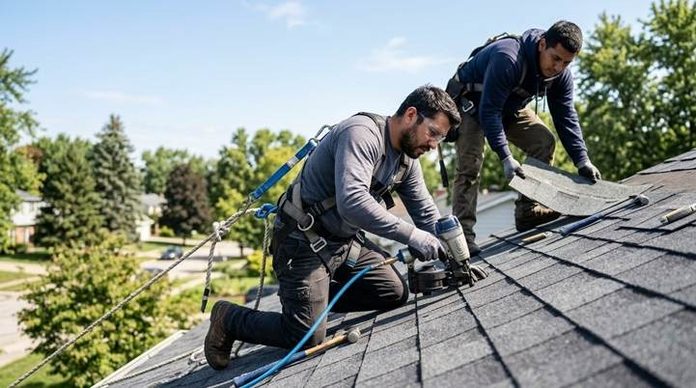
Safety is another sign of a true pro that you can’t ignore. A good company spends money on equipment and training to keep its crew safe. The Occupational Safety and Health Administration (OSHA) says employers must give workers fall protection for any job six feet or higher. If a crew works on your roof without safety gear like harnesses, it’s a big warning sign. It shows the contractor doesn’t care about their workers’ safety.
❝ Never pay a big deposit before the work starts. A common way to pay is in three parts: one-third to order materials, one-third when the roof is installed, and the final third after the final check and cleanup. A contractor who wants 50% or more before any materials show up is a big financial risk.
Use this checklist to compare potential contractors:
| Evaluation Area | Green Flag (Look for This) | Red Flag (Avoid This) |
| Insurance | Shows you a current insurance certificate for liability and worker’s comp. | Won’t show proof or says your homeowner’s policy covers them. |
| Licensing | Gives you a local license number you can check yourself. | Has no license, uses another’s license, or says you don’t need a permit. |
| Estimate | Gives a detailed estimate listing costs for labor, materials, and trash removal. | Gives a vague, single price and pressures you to sign right away. |
| Safety Plan | Explains their safety rules and uses safety gear on the job. | The crew has no safety harnesses, and the job site is a mess. |
Why Is a Colorado Roof Different from One in a Milder Climate?
A Colorado roof has to deal with strong sun, quick temperature changes, and bad hail. Roofs in other places don’t face this. These things don’t just wear out a roof faster. They cause unique problems that require special installation methods for this area. A contractor who installs every roof the same way is setting your roof up to fail early.
The most overlooked problem is the strong ultraviolet (UV) light. At Denver’s high altitude, the air is thinner and blocks less UV light. This sunlight breaks down the asphalt in shingles faster. It makes them brittle and causes the small protective pebbles on top to fall off. Losing these pebbles isn’t just about looks. It’s like the roof’s shield wearing away, leaving the shingle’s core open to damage.
Next are the big temperature swings. The Front Range often has days where the temperature changes by 40 degrees or more. This makes all the roofing materials expand and shrink over and over. Shingles, the layer underneath, and the wood deck all change size at different speeds. This puts a lot of stress on nails and seals. Over time, this can pull nails out and break the seals around vents and chimneys, letting water get in.
❝ Ask a contractor how they handle Colorado’s freeze-thaw cycles when they install flashing and valleys. A good local roofer will probably use a stronger ice and water shield in key spots. They might even run it higher up the roof than the rules require. Their answer will show if they understand local weather.
Finally, hail on the Front Range isn’t a rare threat. It happens again and again. Hail hits cause two kinds of damage. The first is easy to see: lost pebbles. The second is harder to spot: “bruising.” A big hailstone can crush the inside of the shingle without breaking the top layer. This hidden damage weakens the shingle and creates a spot that will later crack and leak. A normal roof inspection might miss this bruising, but it’s a major reason for valid insurance claims in this region.
Frequently Asked Questions About Roofing
What is the “25% rule” for roofing? The 25% rule is a provision in some building codes stating that if more than 25% of a roof covering needs to be repaired or replaced within a 12-month period, the entire roof must be brought up to the current code. This often means a full replacement is required instead of a large patch. However, this is code-dependent, so you must verify the specific regulations for your municipality.
Should I replace my 20-year-old roof? While many asphalt shingle roofs have a lifespan of 20 to 30 years, age is just one factor. A professional inspection is the only way to know for sure. An inspector will look for signs of systemic failure like widespread cracking, shingles that are curling at the edges, or extensive bald spots from granule loss, which indicate the roof is at the end of its useful life.
What factors determine the cost of a new roof? The final price is driven by several key variables, not just square footage. The most significant factors include the material you choose (e.g., standard architectural shingles vs. impact-resistant or metal), the steepness or “pitch” of your roof, and its complexity, such as the number of valleys, dormers, and skylights that require custom flashing work.
What is the difference between a material and a workmanship warranty? A material warranty is provided by the shingle manufacturer and covers defects in the product itself. A workmanship warranty is provided by your contractor and covers errors made during installation. A perfectly good shingle can fail if installed improperly, which is why a contractor’s warranty is just as critical as the manufacturer’s.
How long does a typical roof replacement take? For an average-sized residential home, the on-site work of tearing off the old roof and installing the new one usually takes one to three days. This timeline can be extended by factors like inclement weather, the complexity of the roof structure, or delays in passing municipal inspections between phases of the project.
The Bottom Line on Protecting Your Investment
The most expensive roofing mistake is not choosing the wrong shingle color; it is misunderstanding what you are actually buying. You are not just purchasing materials and labor. You are buying a complex system designed to protect your largest asset from very specific, local threats. A low bid often seems attractive, but it can hide enormous risks, from an uninsured crew working on your property to installation methods that will fail under the stress of high-altitude UV and rapid freeze-thaw cycles.
The central tradeoff is never just about price. It is about the total cost of ownership over the next twenty years. A roof that fails prematurely due to improper flashing or an installer’s ignorance of local conditions is infinitely more expensive than one done correctly from the start. The initial estimate is only a small part of the long-term financial equation.
Ultimately, your goal should shift from finding the lowest price to finding the lowest risk. This requires you to become an investigator, not just a buyer. Ask for verifiable proof: a current insurance certificate, a valid local license, and a clear explanation of how the installation will account for our region’s unique climate challenges. When you prioritize documented professionalism over a simple handshake and a low number, the right choice often becomes clear.
About the author
Reliable Roofing & Restoration is a family-owned, locally operated contractor specializing in storm damage restoration for Colorado properties since 1997. The firm assists both residential and commercial property owners with inspections, repairs, and navigating the insurance claims process. As a GAF Master Elite Contractor, a credential held by a small percentage of roofers nationally, the company focuses on projects along the Colorado Front Range, from Fort Collins to Colorado Springs, addressing the region’s unique climate challenges.