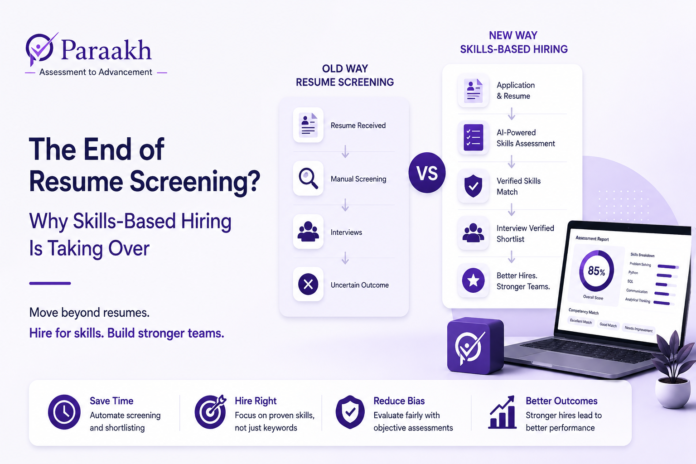

Resume screening was never meant to be a quality filter. It was meant to be a volume filter a fast way to cut five hundred applications down to fifty. Somewhere along the way, HR teams started treating it as a proxy for capability, and that’s the part now breaking under its own weight.
The Resume Screening Problem, in Numbers HR Teams Already Feel
Every recruiter has lived some version of this: a candidate’s resume matches 90% of the job description, they sail through screening, and forty minutes into the technical interview it’s clear they can’t do the core part of the job. Meanwhile, a candidate whose resume didn’t use the “right” keywords but who could actually do the work never made it past the ATS filter.
That’s not a hiring failure. It’s a measurement failure. Resumes measure how well someone can describe experience. They don’t measure whether that experience produced real capability.
The knock-on costs show up everywhere in the funnel:
- Time-to-hire stretches because interview panels are re-screening candidates who never should have reached them.
- Interview hours get wasted re-confirming basic competency instead of evaluating judgment and fit.
- Strong candidates get filtered out early for cosmetic resume reasons nonstandard job titles, employment gaps, unconventional formatting despite being fully qualified.
- Hiring managers stop trusting HR’s shortlist, which quietly erodes the entire recruiting function’s credibility.
What “Skills-Based Hiring” Actually Replaces
It’s worth being precise here, because the phrase gets used loosely. Skills-based hiring doesn’t mean ignoring resumes or experience. It means resumes and experience become inputs to a verification step, rather than the final word.
The shift is from:
Resume claims → keyword match → interview → decision
to:
Resume claims → skills assessment → verified shortlist → interview (focused on fit and judgment) → decision
The assessment step doesn’t replace the interview. It changes what the interview is for. Instead of spending the first half of a conversation establishing whether a candidate actually knows what their resume says they know, the interviewer starts from a confirmed baseline.
Did you know? Studies on structured, skills-based evaluation consistently find it to be a stronger predictor of on-the-job performance than years-of-experience or education filters alone which is part of why LinkedIn, SHRM, and other major HR bodies have been actively promoting skills-based hiring frameworks over the last several hiring cycles.
Why This Shift Is Happening Now
Three forces are converging at once:
- AI-generated resumes have made keyword matching nearly useless. When every candidate can optimize their resume against a job description in seconds, resume-to-JD matching stops being a meaningful filter.
- Hiring volumes recovered faster than recruiter headcount. Teams are screening more applications with the same or fewer people, and manual resume review doesn’t scale.
- Assessment technology got personalized enough to be trustworthy. Older assessment platforms gave every candidate the same generic test, which recruiters (correctly) treated with some skepticism. Assessments generated from the actual job description and candidate profile are a different, more credible signal.
From Application to Verified Shortlist: What the New Workflow Looks Like
A skills-based hiring workflow, in practice, looks like this:
- Candidate applies and resume is parsed and matched against the JD.
- Basic knockout requirements are checked automatically.
- A role-specific assessment is generated based on the JD and the candidate’s profile.
- Claimed skills are compared against demonstrated performance.
- Qualified candidates move into a verified shortlist, ranked by fit and confirmed skill.
- Interviewers receive a candidate brief with focus areas, not just a resume.
- Results stay attached to the candidate record for future reference.
This is the workflow behind what Paraakh describes as connecting application to verified shortlist the point being that assessment isn’t a bolt-on step at the end of screening, it’s woven into the pipeline from the first application onward.
Pro tip: If your ATS and assessment platform operate as two disconnected systems, you’ll lose most of the time-saving benefit. The value comes from assessment results flowing directly into the candidate record the interviewer already sees not a separate report someone has to go find.
What Recruiters Gain
- Fewer resumes to manually pre-screen, since knockout and matching happen automatically
- A defensible reason for every candidate on the shortlist a verified score, not a gut call
- Less time spent re-explaining to hiring managers why a candidate was passed forward
- A record that survives recruiter turnover, since assessment data stays attached to the candidate
What Hiring Managers Gain
- A confirmed baseline before the interview even starts
- Specific focus areas to probe, rather than generic competency questions
- Less time spent discovering basic skill gaps that should have surfaced earlier
- Comparable data across candidates, instead of comparing resumes written in wildly different styles
Is Resume Screening Actually Going Away?
Not entirely, and it shouldn’t. Resumes still carry useful context career trajectory, domain background, the kind of narrative signal an assessment can’t capture. What’s changing is resumes’ role as the primary filter. They’re becoming an input to a verification process rather than the process itself.
The more accurate framing isn’t “resumes are dead.” It’s that resumes alone were never enough, and the tools to close that gap at scale finally exist.
How to Start Shifting Toward Skills-Based Hiring
- Pick one high-volume role to pilot first skills-based hiring shows its value fastest where screening volume is highest.
- Define what “verified” means for that role before choosing an assessment approach technical accuracy, scenario judgment, or both.
- Make sure assessment results reach the interviewer, not just HR the time savings depend on that handoff.
- Track time-to-hire and interview-to-offer conversion before and after, so the shift is measured, not assumed.
FAQ
Does skills-based hiring mean removing resumes from the process entirely? No. Resumes still provide context on career trajectory and domain background. Skills-based hiring adds a verification step so resumes aren’t the sole basis for advancing candidates.
What roles benefit most from skills-based hiring? High-volume technical and operational roles see the fastest ROI, since screening time savings compound with applicant volume. It’s also valuable for any role where resume claims are hard to verify manually most technical and specialist positions.
How is this different from a standard pre-employment test? Standard tests are usually generic and identical for every applicant. Skills-based hiring, as implemented through AI assessment, generates a test tied to the specific job description and the individual candidate’s profile and experience level.
Does this slow down the candidate experience? It shouldn’t, if the assessment is scoped and personalized correctly. Overly long, irrelevant assessments are what drive candidate drop-off not assessment itself.
Can skills-based hiring reduce bias in screening? It can reduce certain forms of bias tied to resume formatting, keyword luck, and unconscious pattern-matching, but only if the assessment content itself is reviewed for fairness and consistently applied across candidates.
What’s the first metric to track when piloting this approach? Interview-to-offer conversion is usually the clearest early signal if verified candidates convert at a higher rate than resume-screened candidates did previously, the assessment step is doing its job.