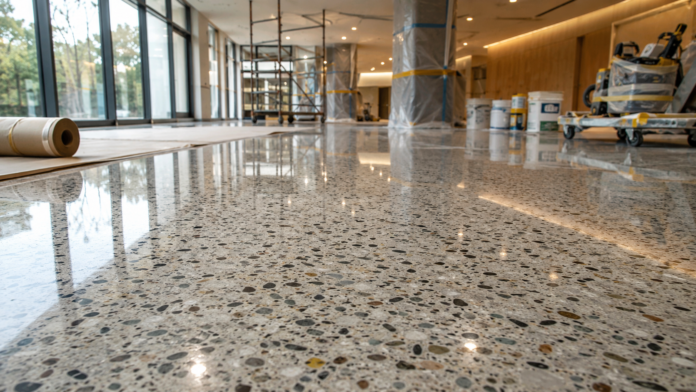

Most flooring arrives as a set of discrete units. Planks, tiles, boards, rolls. If one section gets damaged, the repair conversation starts with a reassuring question: do we have any of the original material left over? For terrazzo, that question has no useful answer, because there is no original material sitting in a box. The floor was created in place, and its surface is a single continuous plane with no seams to hide a repair behind.
That single property shapes almost every decision made around terrazzo on an active site.
A Surface That Is Manufactured On Site
Terrazzo is formed by setting chips of marble, granite, glass, or similar aggregate into a binder, typically cement-based or epoxy, and then grinding the cured surface flat and polishing it to the specified sheen. The pattern visible in the finished floor is a cross-section, revealed by grinding rather than printed or applied.
This means the finish and the structure are the same material. There is no wear layer sitting on top of a substrate, no veneer bonded to a core. Depth of color and pattern continue downward through the slab, which is part of why terrazzo lasts for decades in heavily trafficked buildings.
It also means damage does not stay superficial in the way it does on layered flooring. A deep scratch or chemical stain is not sitting on a sacrificial coating that can be stripped and reapplied. It is in the floor.
Why Repairs Rarely Disappear
Patching terrazzo is possible. Making a patch invisible is considerably harder.
Aggregate comes from natural stone quarried in batches, and color varies between batches in ways that are subtle in a sample chip and obvious across a floor. Binder color, mixing ratios, and curing conditions all contribute to the finished appearance. A patch mixed months after the original pour, cured under different site conditions, and ground by a different operator will rarely read as identical under the raking light that terrazzo floors so often sit beneath.
Because the surface is seamless, there is no natural boundary to end a repair against. On tile, a damaged unit is removed and replaced within its own grout lines, and the eye accepts the edge. On terrazzo, the repair boundary falls in the middle of an uninterrupted field, where any difference in tone or aggregate density becomes a visible line.
The Exposure Window Is Unusually Long
Terrazzo is typically poured relatively early in the finishing sequence, since it requires curing time and generates significant dust and slurry during grinding. Work that follows, including painting, fixture installation, millwork, and equipment delivery, all happens on top of a surface that is already final.
That sequence is difficult to reverse. Grinding after adjacent finishes are complete would coat everything nearby in slurry, so the floor goes down first and then waits. In larger commercial projects, that wait can stretch across months of continued trade activity.
Protecting terrazzo during this interval addresses several distinct threats at once. Grit tracked across a polished surface abrades it under foot traffic and wheel loads. Dropped tools chip aggregate. Spilled solvents, adhesives, and acidic products can etch or stain a cement-based binder within minutes. Selecting a terrazzo floor mat or covering system appropriate to the specific binder chemistry matters here, since a material safe on epoxy terrazzo may behave differently against a cementitious surface still completing its cure.
Curing Adds a Second Constraint
Cement-based terrazzo continues gaining strength and releasing moisture well after it appears finished. Sealing that moisture beneath an impermeable covering too early can affect the cure and, in some cases, contribute to discoloration that only becomes visible after the covering comes up.
This creates a timing question with no universal answer, since cure behavior depends on mix design, slab thickness, ambient temperature, and humidity. What it does establish is that protection for terrazzo is not simply a matter of covering the floor as quickly as possible. The material’s moisture behavior has to be accounted for alongside its vulnerability to physical damage.
What the Absence of Spare Parts Actually Costs
The financial consequence of terrazzo damage compounds differently than it does for modular flooring. There is no material cost for a replacement unit, because there are no units. Instead there is mobilization of a specialized crew, containment of grinding dust in what may be a nearly complete space, a fresh pour, a full cure period, and re-grinding of an area large enough to blend, which is frequently far larger than the damage itself.
Each of those steps consumes schedule at the point in a project where schedule is least available. A floor that cannot be patched quietly is a floor whose protection plan carries more weight than its material cost alone would suggest.