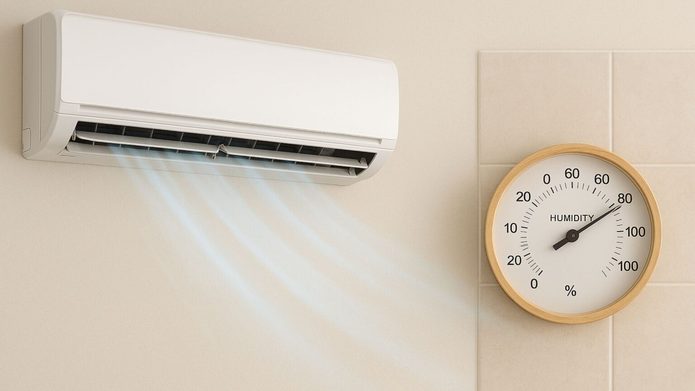

Central Florida summers bring long cooling seasons and high dew points, so some Lakeland homes feel “cool but clammy.” Air conditioning does more than drop the temperature. It must also remove moisture by moving warm, humid air across a cold evaporator coil where water condenses and drains away. When sizing, airflow, and ductwork are mismatched, the system sheds sensible heat but leaves too much latent moisture behind. The result is sticky indoor air, musty odors, and uneven comfort. This article explains the specific causes and fixes that help homeowners eliminate that clammy feel without guesswork.
- Oversized Cooling Creates “Cool but Sticky” Rooms
One of the fastest ways to get a clammy house is to install an air conditioner that is larger than the home’s actual load. Oversized systems short-cycle: the thermostat is satisfied in a few minutes, but the evaporator coil does not stay cold long enough to wring out moisture. A proper Manual J load calculation accounts for attic insulation, window area and orientation, infiltration, and shading. Skipping that step and replacing “4 tons with 4 tons” because that is what was there before often leads to elevated indoor humidity, even when the thermostat reads 72 degrees.
If you are planning a replacement, work with an HVAC contractor serving in Lakeland homeowners who will verify the load and discuss cycle length and humidity targets, not just temperature. Consider this common scenario: after new windows and air sealing, a home’s cooling load drops, but the replacement AC matches the old tonnage. The unit now hits setpoint quickly, shuts off, and leaves moisture in the air. A right-sized system runs longer at lower capacity, improving dehumidification and comfort.
- Right Sizing and Airflow Targets That Pull Moisture Out
Latent removal improves when equipment capacity and airflow match the home’s load. After a Manual J, a Manual S selection helps match capacity to actual conditions. Many pros target around 350 to 400 CFM per ton in humid climates, which keeps the evaporator coil cold enough to condense water efficiently. Variable speed compressors and ECM air handlers extend run time at lower output, stretching cycles so the coil stays wet and productive. The trade-off ee longer runtimes on muggy days, but indoor relative humidity drops and comfort rises, which can reduce the urge to overcool.
Verifying airflow and charge matters as much as the nameplate SEER2. A quick check of total external static pressure with a manometer can reveal if the blower is fighting undersized ducts or a restrictive filter. Technicians may adjust blower speed taps or the ECM profile to hit the target CFM, then fine-tune refrigerant charge using superheat and subcooling measurements. A dirty evaporator coil or clogged condensate drain also undermines moisture removal, so coil cleaning and drain maintenance are part of controlling humidity.
- Duct Leaks and Undersized Returns Starve the Coil
Ductwork often decides whether your AC can dehumidify effectively. Leaky supply ducts in a hot attic dump conditioned air outside the envelope and pull in unfiltered, moist attic air through gaps. Undersized return ducts and a small return plenum raise static pressure and reduce CFM across the coil, warming the coil surface and cutting latent capacity. Sealing ducts with mastic, adding return grilles, or installing jumper ducts between closed rooms helps the blower breathe. In one realistic example, a main suite with the door closed and no dedicated return can see pressure imbalances that backfeed humid air from the attic or garage, leaving the suite muggy.
Room-to-room balance also matters. Closing supply registers to “push more air” to preferred rooms increases duct static pressure, reduces overall airflow, and can cause coil ffreeze-upsthat further reduce dehumidification. A better strategy is to evaluate branch runs with the highest resistance, correct crushed flex duct, and add balancing dampers in accessible trunks. Even small fixes, like properly supporting flex duct to maintain its round shape and reducing sharp turns, can recover the CFM the coil needs to condense moisture.
- Thermostat Placement and Fan Settings That Affect Humidity
Where the thermostat lives and how the fan is set can undo good equipment choices. A thermostat mounted near a supply register, on an exterior wall, or in a hallway that cools quickly will cause premature cycle shutdowns. Remote room sensors or relocating the thermostat to a representative interior wall can extend cycles. Fan mode matters, too. Leaving the blower set to ON after a cooling call ends can re-evaporate water from the coil and pan back into the ducts, raising indoor humidity. In humid climates, use Auto, or a dehumidify mode that slows the blower during cooling calls to improve latent removal.
Filtersalso affect airflow and humidity control. High MERV media can improve air quality, but jumping to a very dense filter without adding return capacity or upsizing the filter cabinet can spike static pressure and starve the coil. Many homes do well with MERV 8 to 11, paired with a larger filter rack and adequate returns. The key is measuring rather than guessing: a static pressure reading and a quick duct inspection tell you what your system can handle without sacrificing moisture control.
When Supplemental Dehumidification Makes Sense
Some Lakeland homes see humidity problems even when the AC is right-sized, especially during shoulder seasons or at night when sensible loads are low, and the system barely runs. In these cases, awhole-housee dehumidifier tied into the return duct can maintain target relative humidity independently of cooling calls. Look for models that integrate with an air handler, have dedicated condensate drains, and include thermostat control options. This approach can be more effective than oversized cooling, avoids overcooling the house, and reduces the risk of microbial growth on surfaces.
Supplemental steps work well alongside fundamentals. Confirm insulation levels and attic air sealing to reduce heat gain, keep the condensate trap clean to prevent overflow and odor, verify the TXV is functioning, and consider a smart thermostat that offers a dehumidify setpoint while coordinating blower speed. If rooms remain persistently humid, ask for duct pressure testing and room-by-room airflow measurements to identify restrictions a simple filter change cannot fix.
Humidity control in a Lakeland home is not luck. It comes from correct sizing, measured airflow, sound duct design, and smart controls that let the evaporator coil do its job. If your house feels clammy, start with a Manual J load calculation, check total external static pressure, seal duct leaks, and review thermostat location and fan settings. When needed, add a whole-house dehumidifier instead of oversizing your AC. With these steps, you can expect steadier run times, drier air, and comfort that holds through Florida’s longest, stickiest days.