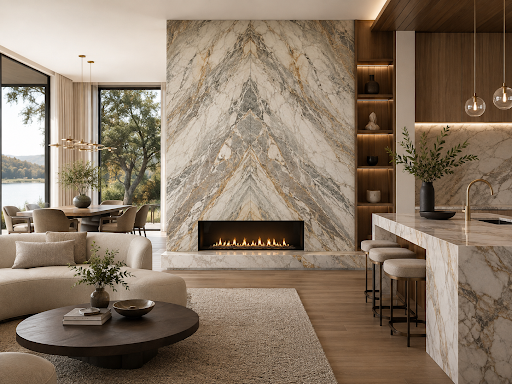

Modern interior design is increasingly moving away from rooms filled with competing decorative elements. Instead, many sophisticated homes rely on a smaller number of carefully selected materials to create personality, depth, and visual impact.
Natural stone fits this approach particularly well.
A dramatic kitchen island, floor-to-ceiling fireplace, bookmatched feature wall, sculptural vanity, or stone dining table can define an entire room without requiring excessive decoration. The variation within natural stone gives designers something mass-produced finishes often struggle to replicate: a surface that feels individual.
However, statement stone is not simply about selecting the slab with the boldest pattern.
The most successful interiors consider scale, colour, vein direction, lighting, application, surrounding materials, maintenance, and fabrication before deciding where the stone should become the focal point.
A highly expressive slab can make a minimalist room memorable. The same material used without restraint can overwhelm the architecture.
For homeowners, interior designers, architects, and developers, the challenge is therefore not to use more stone. It is to use the right stone in the right place.
What Is a Statement Stone Surface?
A statement stone surface is an architectural or interior feature where stone becomes one of the strongest visual elements in the space.
Rather than functioning only as a practical finish, the material becomes part of the design identity.
Typical applications include:
- oversized kitchen islands;
- waterfall countertops;
- full-height backsplashes;
- fireplace surrounds;
- floor-to-ceiling feature walls;
- bathroom vanity walls;
- reception counters;
- custom dining tables;
- bar counters;
- staircases;
- shower walls;
- decorative furniture.
What makes these applications effective is usually scale.
A small stone sample may show colour and texture, but a full slab reveals the movement of the material. Long veins, mineral clouds, crystalline areas, colour transitions, and directional patterns become more powerful when seen across a large uninterrupted surface.
This is why slab selection matters so much.
A stone that appears relatively simple in a small sample can become impressive across a three-metre island. Conversely, a highly dramatic slab that looks exciting on its own may feel too busy once cabinetry, flooring, furniture, lighting, and artwork are added around it.
Statement design requires context.
Why Natural Stone Works So Well in Modern Interiors
Modern spaces often depend on clean lines and simplified forms.
When decorative clutter is reduced, material quality becomes more noticeable.
Stone naturally offers several qualities that work well in these environments.
Natural Variation
No two natural slabs are completely identical.
Variations may include:
- vein thickness;
- background colour;
- mineral deposits;
- tonal transitions;
- crystalline sections;
- directional movement;
- subtle fissures and natural markings.
This uniqueness can make a home feel less standardized.
Visual Depth
Many natural stones contain multiple layers of colour and movement.
Under daylight, warm ambient lighting, or directional accent lighting, these details can become more visible and change throughout the day.
Architectural Presence
Stone has visual weight.
A substantial slab can make a kitchen island, fireplace, wall, or table feel permanently connected to the architecture rather than simply added as decoration.
Long-Term Design Potential
Trends in furniture and colour change relatively quickly.
Well-selected natural materials can often remain relevant through several interior updates because their character does not depend entirely on one design trend.
Marble as a Statement Material
Marble remains one of the most recognisable materials in architecture and interior design.
Its appeal comes from a combination of colour, natural veining, visual softness, and historical association with refined spaces.
Modern interiors do not necessarily need to use marble in a traditional way.
Instead of polished marble covering several surfaces, designers may select one major feature and allow it to become the visual focus.
For example, carefully selected marble surfaces can be used for a full-height fireplace, sculptural kitchen island, bathroom wall, vanity, staircase detail, or custom furniture where the natural veining becomes part of the composition.
Where Marble Makes the Strongest Impact
Marble can be especially effective when:
- the design needs a timeless visual character;
- the surrounding palette is restrained;
- natural veining should become a focal feature;
- the application is highly visible;
- the owner appreciates natural material variation;
- appropriate maintenance is understood.
White marble may create an airy and refined atmosphere.
Grey marble can support cooler contemporary interiors.
Black or dark marble can create stronger architectural contrast.
Green, red, brown, and gold-toned marbles can work as expressive accent materials where designers want greater individuality.
The important point is not whether a marble is light or dark.
It is whether its visual strength matches the role it needs to play.
One Statement Surface Is Often Better Than Five
A common interior design mistake is assuming that luxury increases as more statement materials are added.
It usually does not.
Imagine a kitchen containing:
- heavily veined stone flooring;
- a dramatic stone island;
- patterned backsplash;
- strongly figured timber cabinetry;
- decorative pendant lighting;
- bold hardware;
- colourful furniture.
Each individual component may be attractive.
Together, they can compete for attention.
A more sophisticated approach establishes visual hierarchy.
For example:
- Let the island become the main feature.
- Use simpler cabinetry behind it.
- Keep flooring relatively quiet.
- Repeat one subtle colour from the stone elsewhere.
- Use lighting to highlight the slab rather than compete with it.
This allows the eye to understand the space immediately.
Statement stone works best when the room gives it enough visual breathing room.
Kitchen Islands as Architectural Focal Points
The kitchen island has become one of the most obvious locations for statement stone.
In open-plan interiors, the island can be visible from the kitchen, dining area, and living room at the same time.
That makes its material selection unusually important.
Waterfall Edges
A waterfall edge continues the countertop material vertically down one or both sides of the island.
This can make the slab appear more architectural and allows the vein pattern to continue beyond the horizontal surface.
However, the visual effect depends heavily on fabrication planning.
If the vein changes direction abruptly at the joint, the waterfall can look disconnected.
For highly directional stones, the fabricator should review how adjoining pieces will be cut before fabrication begins.
Mitred Edges
Mitred construction can create the appearance of a thicker stone profile without requiring a solid slab of the same thickness.
This is frequently used in modern kitchens where designers want a substantial island.
The quality of the mitred joint matters.
Poor alignment can become very noticeable when the stone contains bold movement.
Full-Height Backsplashes
Using slab material from countertop to upper cabinetry can create a cleaner appearance than introducing another tile pattern.
For quieter kitchens, the backsplash and island may use related materials.
For more dramatic interiors, one can remain subtle while the other becomes the visual focus.
The Role of Veining in Statement Design
Veining should not be treated as random decoration.
Its direction can change the way a surface is perceived.
Horizontal movement may make an island appear longer.
Vertical veins can emphasize the height of a wall.
Diagonal movement can introduce energy.
Broad mineral clouds may feel softer than narrow high-contrast lines.
Before cutting, designers should think about:
- where the strongest vein should appear;
- whether the pattern should face the main entrance;
- how adjoining panels connect;
- where sinks or cooktops remove sections of the slab;
- whether the waterfall edge continues naturally;
- how the stone looks from several viewing angles.
These decisions become especially important with expensive or visually distinctive materials.
The best slab can still produce an average result when the layout is poorly planned.
Quartzite for Dramatic Contemporary Interiors
Quartzite has become particularly appealing in design-led interiors because some varieties combine strong natural movement with colours that are difficult to reproduce convincingly.
Depending on the stone, the slab may contain:
- sweeping grey veins;
- blue-green minerals;
- translucent crystalline areas;
- gold or bronze movement;
- strong black contrast;
- soft cloud-like backgrounds;
- layered geological patterns.
These characteristics make quartzite especially useful when designers want the stone itself to perform like artwork.
A carefully selected statement quartzite can become the centerpiece of a large kitchen island, feature wall, bar, fireplace, bathroom vanity, dining table, or other high-visibility surface where natural movement is meant to attract attention.
When Quartzite Makes Sense
Consider quartzite when:
- natural stone is important;
- the project needs strong visual movement;
- the kitchen island should become the room’s main feature;
- a large slab area will be highly visible;
- unique geological character is preferred over repeated patterns;
- a natural material is desired for substantial countertop applications.
Not every quartzite is highly dramatic.
Some varieties are relatively calm and neutral.
This gives designers flexibility to use quartzite either as a focal material or as a sophisticated background surface.
Bookmatching: Turning Slabs Into a Composition
Bookmatching is one of the most dramatic ways to use natural stone.
Two adjoining slabs are positioned so their patterns mirror one another, creating a symmetrical composition.
This technique is frequently used on:
- feature walls;
- fireplaces;
- hotel-style bathrooms;
- reception areas;
- large shower walls;
- dining-room features;
- luxury residential interiors.
When successful, the stone begins to resemble a large piece of abstract artwork.
But bookmatching is not suitable for every slab.
The material needs enough directional movement for the mirrored effect to be visible.
It also requires careful slab selection.
Before fabrication, the team should confirm:
- Which slabs form the pair?
- Where is the visual centre?
- How will the panels meet?
- Will furniture or fixtures block important areas?
- Does the room have enough width to appreciate the composition?
- Will lighting emphasize or flatten the pattern?
If these questions are answered after cutting, it may already be too late.
Stone Feature Walls Beyond the Kitchen
Kitchens receive much of the attention in contemporary stone design, but large wall applications can be equally effective.
Fireplace Walls
A full-height stone fireplace can establish a strong vertical element in a living room.
For dramatic stone, surrounding shelving and furniture should usually remain simple.
Bathroom Walls
A slab wall behind a vanity or within a shower can reduce grout lines and create a more continuous visual surface.
Stone selection should still consider moisture, cleaning requirements, finish, and installation conditions.
Entry Areas
A feature wall near the entrance can establish the material language of the entire home.
It works particularly well when the stone colour connects with flooring, timber, metal, or furniture elsewhere.
Home Bars
Bars are excellent locations for darker or more expressive stones because the area can tolerate stronger visual contrast than many kitchens.
Good lighting can also highlight crystalline and reflective details.
Match Statement Stone With the Right Materials
The surrounding palette determines whether stone looks sophisticated or excessive.
Stone and Natural Wood
Wood introduces warmth and softness.
Light oak can complement white, grey, green, or beige stone.
Walnut works particularly well with cream, brown, green, gold, and dramatic neutral slabs.
Stone and Metal
Metal changes the mood.
Brushed brass can make a space warmer.
Black metal adds architectural contrast.
Stainless steel can support a cleaner contemporary aesthetic.
Stone and Plaster
Textured plaster or lime-style walls can provide a quiet backdrop for dramatic stone.
The contrast between subtle wall texture and polished mineral movement can be especially effective.
Stone and Fabric
Linen, wool, leather, and upholstered furniture help prevent stone-heavy spaces from feeling cold.
Successful luxury interiors usually balance hard and soft materials.
Lighting Can Completely Change Stone Appearance
Stone should never be selected without considering lighting.
Natural daylight may reveal colours that appear muted under artificial light.
Warm lighting can strengthen beige, cream, brown, and gold tones.
Cooler lighting can emphasize grey, blue, and white backgrounds.
Directional lighting may highlight texture.
Strong reflections on polished surfaces can make patterns appear more dramatic.
When possible, designers should evaluate slab samples under lighting conditions similar to the final room.
This is especially important when surrounding cabinetry, flooring, or wall colours have already been selected.
A stone does not exist in isolation.
Every nearby material affects how its colour is perceived.
Polished, Honed or Textured?
Finish changes both the appearance and character of stone.
Polished
A polished finish typically increases reflectivity and strengthens colour and vein definition.
Choose polished surfaces when the project needs:
- stronger visual depth;
- more reflection;
- formal elegance;
- clearer mineral patterns.
Honed
Honed stone has a softer, lower-sheen appearance.
It can work particularly well in restrained modern interiors.
Choose honed when:
- the room has a matte material palette;
- subtle luxury is preferred;
- timber and textiles are important;
- the stone should feel softer rather than highly reflective.
Textured
Brushed, leathered, or other textured finishes can add tactile interest.
They can work especially well on architectural walls, bars, outdoor features, or designs where texture is more important than shine.
Common Mistakes With Statement Stone
1. Choosing From a Small Sample
A 10 cm sample cannot show the movement of a three-metre slab.
For expressive materials, review the full slab whenever possible.
2. Ignoring the Rest of the Room
A beautiful stone may still be wrong if it conflicts with cabinetry, flooring, wall colour, or furniture.
3. Using Too Many Dramatic Stones Together
One strong material usually has more impact than several competing patterns.
4. Planning Vein Direction After Cutting
Slab layout should happen before fabrication.
Otherwise, the most attractive parts may disappear into sink openings, seams, or offcuts.
5. Choosing Only by Trend
A stone surface may remain for decades.
Choose something compatible with the architecture rather than simply copying a current social-media look.
6. Forgetting Maintenance
The most beautiful material can become frustrating if its maintenance requirements do not match the household’s expectations.
A Simple Decision Framework for Statement Stone
Before choosing a slab, ask the following questions.
If You Want a Timeless, Classical Look
→ Consider marble with controlled natural veining.
If You Want the Island to Become the Main Artwork
→ Consider a highly expressive quartzite.
If the Room Already Has Strong Materials
→ Choose quieter stone rather than adding another competing pattern.
If the Space Is Small
→ Use statement stone selectively, such as on a vanity, backsplash, or fireplace rather than every surface.
If the Project Uses Several Slabs
→ Review them together before fabrication.
If the Stone Has Directional Veining
→ Plan cuts, waterfalls, seams, and bookmatching before production.
If Maintenance Is a Major Concern
→ Evaluate the practical behaviour of the specific material before making the final decision.
The objective is not to find the boldest slab.
It is to find the stone whose character supports the room.
Final Thoughts: Let the Material Become Part of the Architecture
Statement stone surfaces can transform modern interiors because they combine material authenticity with architectural scale.
A kitchen island can become more than a work surface.
A fireplace can become more than a heating feature.
A bathroom wall can become more than a waterproof finish.
When the correct stone is selected and carefully fabricated, these surfaces become part of the visual identity of the home.
The strongest results usually follow several simple principles:
- choose one clear focal point;
- review the full slab;
- respect natural variation;
- plan vein direction;
- coordinate surrounding materials;
- select an appropriate finish;
- understand maintenance;
- plan fabrication before cutting.
Most importantly, avoid using stone simply because it appears expensive.
Luxury does not come from adding the maximum amount of premium material.
It comes from making deliberate choices.
A single beautifully selected and properly positioned stone surface can create more impact than an entire room filled with competing finishes.
When material, scale, lighting, craftsmanship, and architecture work together, natural stone stops being decoration and becomes part of the space itself.
Frequently Asked Questions
1. What is the best natural stone for modern interiors?
There is no single best stone for every modern interior. Marble works well when timeless veining and classical elegance are priorities, while quartzite can be ideal when stronger natural movement and dramatic slab character are desired. Granite, travertine, limestone, and other natural stones may also suit specific applications.
If the room needs subtle elegance → consider quieter marble or neutral stone.
If the room needs a major focal point → consider a more expressive quartzite or marble.
The application and maintenance requirements should always influence the final decision.
2. Is marble still popular for modern interior design?
Yes. Marble remains relevant because modern designers use it differently from traditional interiors. Instead of covering many surfaces, marble is often used selectively for islands, fireplaces, vanities, feature walls, backsplashes, and furniture.
Its natural variation means it can work in minimalist, contemporary, transitional, classical, and luxury interiors depending on the specific colour and vein pattern.
3. Is quartzite good for a statement kitchen island?
Yes. Quartzite can be particularly effective for statement kitchen islands because many varieties contain dramatic natural movement, mineral variation, and strong colour transitions.
For the best result, buyers should review the complete slab and plan vein direction, waterfall edges, seams, sink locations, and adjoining pieces before fabrication.
A beautiful quartzite slab can become the main visual feature of an otherwise restrained kitchen.
4. What is a bookmatched stone wall?
A bookmatched stone wall uses adjoining slabs arranged so that their patterns mirror one another. This can create a symmetrical design similar to an open book.
Bookmatching is commonly used for feature walls, fireplaces, bathrooms, reception areas, and other large surfaces.
The effect works best with stone that has noticeable directional movement. Slab selection and layout should be planned before cutting.
5. How do you choose a statement stone for an interior?
Start by deciding where the visual focus should be.
Then consider:
- the size of the surface;
- surrounding colours;
- cabinetry and flooring;
- natural versus artificial lighting;
- vein direction;
- finish;
- maintenance;
- fabrication requirements.
Review full slab images or the actual slabs whenever possible.
If the room already contains several strong patterns → choose quieter stone.
If the rest of the room is restrained → a more dramatic slab can become the focal point.
The best statement stone is not necessarily the most colourful or expensive one. It is the material that creates the strongest relationship with the architecture around it.