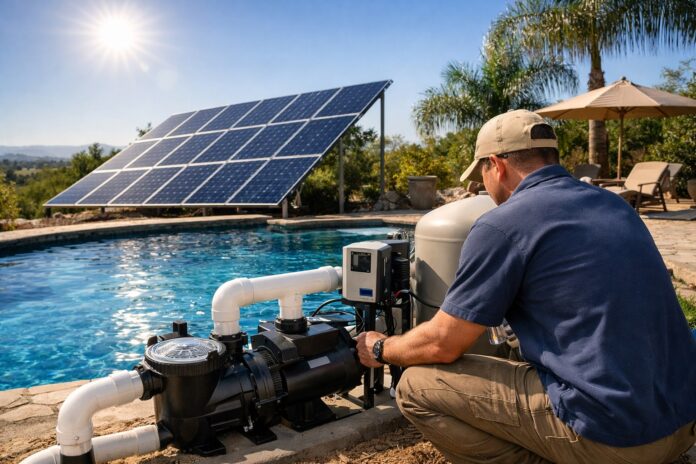

Solar pool heating sounds perfect for Perth’s climate. Free heating from abundant sunshine. Zero running costs. Environmental benefits. Yet many installations underperform dramatically despite professional installation and proper roof positioning.
The overlooked culprit? Your pool pumps.
Solar heating depends on water circulation through roof-mounted collectors. Inadequate pumping creates performance bottlenecks that no roof panel optimization compensates for.
The Flow Rate Problem
Solar collectors need specific flow rates for optimal heat transfer. Water moves through panels, absorbs heat, then returns to your pool. Too little flow and water barely warms while passing through collectors. Too much flow and water rushes through without absorbing adequate heat.
Most Perth pools use single-speed pumps designed for filtration requirements, not solar heating requirements. This mismatch means solar systems operate far below rated capacity regardless of sunshine availability.
A Baldivis property installed premium solar heating on perfect north-facing roof space. Performance disappointed consistently. Professional assessment revealed their pump was undersized for solar requirements. Upgrading to properly sized pump immediately improved solar performance by 40% without changing roof panels or collector positioning.
The Circulation Duration Gap
Solar heating requires minimum daily pump operation for effective heat collection. Families reducing pump hours to save electricity without considering solar implications sabotage their own heating.
If solar collectors need eight hours daily operation for adequate heat transfer but your pump runs only four hours, you’re wasting 50% of solar potential. Water never circulates long enough through collectors to absorb available heat.
This false economy saves electricity on pumping while losing heating benefits worth far more money.
The Dead Zone Effect
Solar systems heat water at collection point. Distribution to pool requires adequate circulation through return jets. Poor pump capacity or positioning creates dead zones where heated solar water concentrates without dispersing throughout your pool.
You’re producing solar heat but not distributing it effectively. Temperature monitoring at different pool locations often reveals concentrated warmth near returns while distant areas stay cold despite functioning solar system.
The Pressure Loss Issue
Solar panels mounted on roofs create elevation challenges for water circulation. Your pump must overcome this height differential while maintaining adequate flow rate through collectors.
Undersized pumps struggle against rooftop height resistance, creating pressure loss that restricts flow through solar collectors. Performance degrades as pumps work harder pushing water uphill while delivering less flow to collectors.
Professional assessment measures actual collector pressure to determine whether pumps are sized appropriately for your specific roof height and collector configuration.
The Seasonal Adjustment Reality
Solar heating performs differently across seasons due to changing sunshine angle and duration. Water temperature affects circulation requirements.
Winter heating needs maximum circulation despite colder ambient temperatures. Summer maintenance needs minimum circulation because sunshine does most heating work. Most Perth owners run identical pump schedules year-round, missing seasonal optimization opportunities.
Adjusting pump operation seasonally maximizes solar performance without equipment changes. This simple strategy costs nothing but delivers measurable performance improvements.
The Maintenance Impact
Clogged pump filters restrict circulation, reducing solar collector flow. Dirty filter baskets create suction problems limiting pump capacity. These maintenance issues specifically undermine solar performance because solar systems are circulation-dependent.
Gas or heat pump systems can compensate partially for poor circulation. Solar systems cannot. Inadequate circulation directly translates to inadequate solar heating.
Most Perth pool owners maintain pumps poorly, accidentally sabotaging their solar investment through neglect.
The Variable Speed Solution
Modern variable speed pumps adjust output continuously to match actual requirements. During solar heating season, they maintain optimal circulation. During non-heating periods, they reduce speed, minimizing wasted electricity while maintaining filtration.
Solar systems paired with variable speed pumps operate significantly more efficiently than solar systems paired with single-speed pumps running constant capacity.
This upgrade often costs less than expected and delivers measurable performance improvements immediately.
The Integration Assessment
Solar heating systems require proper integration with existing pool infrastructure. Incompatible pump capacity, inadequate return positioning, or restrictive plumbing creates performance limitations that solar panels cannot overcome.
Professional assessment evaluates whether your pump and circulation system support solar heating requirements. Often, modest upgrades to pumping improve solar performance dramatically.
The Realistic Expectation
Solar pool heating delivers excellent value when expectations match reality. Expecting rapid heating during cool weather disappoints. Expecting consistent winter warmth without backup heating disappoints. Expecting zero system requirements beyond installation disappoints.
Understanding that solar success depends on adequate circulation, seasonal adjustments, and maintenance discipline prevents regret and enables informed decisions.
Your solar investment succeeds when pumping supports heating potential, not when roof panels work in isolation.