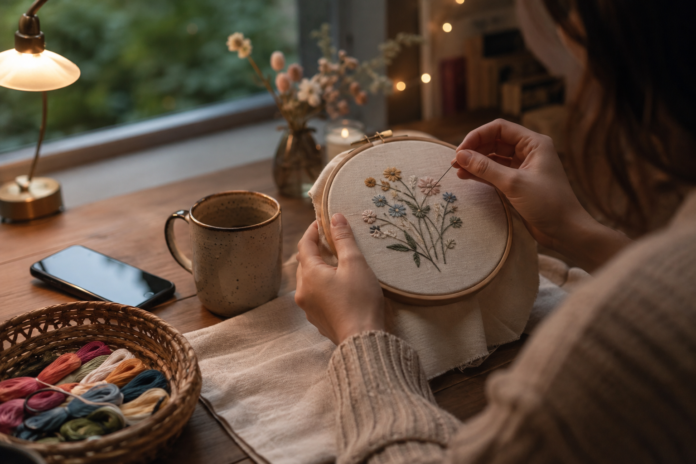

Something has shifted in how people spend their free evenings. The default for years was simple: sit down, pick up a device, scroll until sleep. That default is losing its grip. Not because anyone has sworn off technology, and not because of some grand act of willpower, but because the payoff stopped feeling worth it. People finish a two-hour session on a phone and feel like they’ve been handed nothing. The same two hours spent making something small, by hand, leaves behind an object and a sense that the time went somewhere.
This is the appeal of what’s now loosely called slow hobbies. They are unhurried, physical, and mostly analog. They resist optimization. And they are quietly pulling attention away from screens in a way that productivity apps and screen-time limits never managed.
The Problem Isn’t Screens. It’s What They Cost.
Blaming technology outright misses the point. Screens are useful. The issue is the shape of the attention they demand.
Fragmented Focus Feels Like Work
Scrolling isn’t restful. It looks passive, but the mind is switching constantly — new topic, new tone, new emotional register, every few seconds. That churn leaves people tired without leaving them relaxed, which is a strange combination and a fairly recent one. Research from the Pew Research Center has tracked how deeply this kind of use has embedded itself in daily routines, and the picture is consistent: constant availability, shrinking gaps of unstructured time.
Slow hobbies invert that. One task. One material. One repeated motion. The narrowing is the entire point.
Rest Requires Something to Do With Your Hands
Plenty of people have discovered that they can’t just sit still. Told to relax, they reach for a phone within ninety seconds. The hands need occupying, and handwork occupies them without asking the brain to keep up. That gap — hands busy, mind loose — is where the actual rest happens. The American Psychological Association has long pointed to activities that break the stress loop rather than distract from it, and repetitive manual work tends to fall in that category.
What Makes a Hobby Genuinely Slow
Not every offline activity qualifies. A hobby with a leaderboard is still a competition. A hobby with a subscription and a weekly delivery still runs on someone else’s schedule.
No Finish Line Anyone Else Set
Slow hobbies are self-paced to a degree that feels almost uncomfortable at first. Nobody is waiting on the work. Nothing expires. If a project sits untouched for three weeks, nothing happens — it simply waits, which is a rare quality in anything modern.
Progress You Can See Without Measuring
The reward is physical. A row of stitches that wasn’t there an hour ago. A row that’s straighter than last week’s. There’s no dashboard tracking improvement, and there doesn’t need to be, because the evidence sits in your lap. That kind of feedback is slower than a notification but far more durable, and it accumulates in a way that keeps people coming back after the novelty wears off.
Why Needlework Ended Up Leading the Pack
Of all the crafts pulling in new beginners, hand embroidery has grown fastest, and the reasons are practical rather than romantic.
The Barrier to Entry Is Genuinely Low
Embroidery needs almost nothing. Fabric, thread, a needle, decent light. No workshop, no ventilation, no expensive machine that has to earn its keep. It travels — a train, a waiting room, a sofa — and it can be put down mid-stitch without ruining anything. Compare that to pottery or woodworking, both wonderful, both requiring space most people don’t have.
It’s also old. Embroidered work sits in the collections of institutions like the Victoria and Albert Museum, which means a beginner today is doing more or less what someone did four hundred years ago with the same two tools. That continuity is part of the draw, even for people who’d never say so out loud.
It Rewards Practice More Than Talent
Nobody is naturally good at a French knot. It’s a technique, learned by repeating it badly until it stops being bad. This is oddly reassuring for adults who’ve spent years avoiding anything they might fail at publicly. Failure here is private, cheap, and fixable — pull the thread out and go again.
The Format That Solved the Beginner Problem
For a long time, learning embroidery meant buying a kit with one finished design on it. You’d complete a fox or a bunch of flowers, learn six stitches along the way, and then face a blank hoop with no idea what to do next.
Practice First, Project Later
A different format has taken over, and it’s shaped like a small fabric book. Each page carries printed guidelines for a set of stitches, and you work through them page by page — no final picture to get right, just technique after technique, laid out in order. Beginners who’ve stalled with traditional kits often find the pressure disappears entirely with this approach, because a practice page is allowed to look rough. Most versions bundle everything needed to begin, and a well-made stitch book will include threads, needles, a hoop, and a threader alongside the printed pages, so nothing has to be sourced separately before the first evening.
The finished object doubles as a reference. Months later, when you can’t remember how a chain stitch turns a corner, the page is right there in your own thread, in your own hand.
Why the Order Matters
Good versions build deliberately. Straight stitches early, then loops, then knots, then the fussier decorative work that depends on all three. Skipping ahead is possible but rarely satisfying. Working the sequence properly means each page borrows something from the last, and the difficulty rises slowly enough that it never quite feels like difficulty.
The Habit Sticks for Unglamorous Reasons
None of this holds unless the activity survives contact with a normal, tired weekday.
It Fits in Twenty Minutes
Long sessions are lovely and rare. What keeps a craft alive is that it works in short bursts — a quarter of an hour before bed, a few stitches while something plays in the background. There’s no setup cost. Pick it up, put it down.
The Objects Have Somewhere to Go
Practice work becomes patches, gift wrap, mending on a worn elbow, a bookmark for someone who reads. Skills learned on a sampler transfer directly to repairing clothes, which turns a hobby into something with a use. That gives the whole thing a second reason to exist beyond enjoyment, and second reasons are what carry habits through the weeks when enjoyment alone isn’t enough.
The Shift Is Smaller Than It Sounds
Nobody swapping an hour of scrolling for an hour of stitching is staging a rebellion against modern life. They’re making a narrow, practical trade: the same time, spent on something that leaves a mark. What the slow hobby movement has really uncovered is that the appetite for making things never went anywhere — it was just outbid, night after night, by whatever was closest to hand.
Given a low barrier, a clear starting point, and a format that forgives a bad first attempt, a surprising number of people pick the needle. The trend isn’t about rejecting screens at all. It’s about finally having something worth putting them down for.