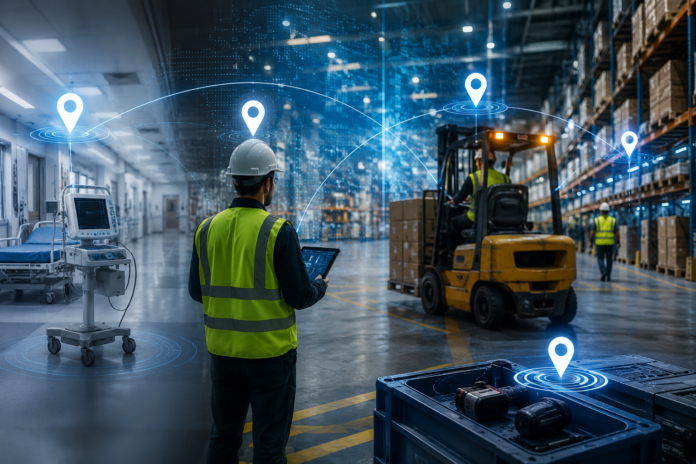

Walk the floor of any massive distribution center or Level 1 trauma hospital, and you’ll see the exact same margin killers. Forklift drivers burning twenty minutes looking for a specific pallet. Nurses stashing IV pumps in ceiling tiles because they don’t trust the equipment pool.
Every missing item represents a cascade of delays. A delayed pallet means a missed shipping window, while a missing bladder scanner means compromised patient care. The true cost isn’t just the missing asset itself; it’s the operational gridlock that follows.
Fixing this requires absolute truth about your physical footprint. That’s why RTLS Tracking is moving from a luxury to a survival requirement for high-volume operations. It forces accountability into spaces where ambiguity used to hide.
For CFOs and operations directors, this isn’t about dots on a map. It’s about stopping capital expenditure bleed and fixing broken workflows.
Real-Time Accuracy: Ending the Hoarding Culture
“Asset utilization” looks great on a boardroom spreadsheet. On the hospital floor, it usually means 40% of your infusion pumps are sitting idle in a closet. Staff hoard critical equipment when they can’t reliably find it.
The exact same dynamic plagues manufacturing lines. If an aircraft engineer has to walk half a mile to find a specialized calibration tool, they will lock it in their toolbox for the next shift. That creates an artificial shortage on the floor.
Purchasing departments buy more equipment to fill these false gaps. Suddenly, you have bloated inventory, higher maintenance costs, and capital tied up in assets you didn’t actually need.
When you rely on manual cycle counts, you are working with historical fiction. The moment a worker puts the clipboard down, the data is already obsolete. Real-time location replaces historical snapshots with continuous, undeniable truth.
Visibility destroys this shadow inventory. When every critical asset broadcasts its exact coordinates, the hoarding panic drops. You don’t need to buy 20% more IV pumps next quarter; you just need to utilize the ones gathering dust.
Live Alerts and Tracking: Eliminating Ghost Assets and Wage Theft
Ghost assets are the expensive pieces of equipment sitting on your ledger that haven’t been touched in two years. They artificially inflate your tax liability and clutter your preventative maintenance schedules.
Location data flags these dead zones immediately. You stop maintaining ghosts and start right-sizing your fleet based on raw, hard utilization metrics rather than guesswork.
Then there is the silent wage theft of “searching.” Paying highly skilled clinical staff or heavy machinery operators to walk around looking for missing items is a massive operational failure. Accurate tracking returns those lost hours directly to the floor.
RTLS Tracking Also Boosts Physical Worker Safety
Heavy industrial zones and sprawling medical campuses are inherently dangerous environments. Put fifty forklifts, two hundred workers or pedestrians, and blind corners in a million-square-foot warehouse, and near-misses become a daily reality.
Yellow paint on the floor and convex mirrors are the bare minimum. True physical safety requires dynamic, active spatial awareness.
When mobile equipment and pedestrian badges communicate, you build geofenced exclusion zones. If a forklift breaches a pedestrian-only lane, the system can automatically throttle the vehicle’s speed down to a crawl. It’s not a suggestion; it’s a hard physical intervention.
Emergency Mustering and Environmental Containment
Safety also means knowing exactly who is in the building during an emergency evacuation. In chemical plants or heavy manufacturing, relying on a paper sign-in sheet during a fire drill is reckless.
Active tracking provides an instant, accurate head count at designated muster points. First responders know immediately if someone is still trapped in a specific sector, eliminating fatal guesswork.
In healthcare, safety takes the form of environmental containment. Tagging wandering patients or monitoring restricted access zones ensures unauthorized personnel cannot breach sensitive areas unnoticed.
Productivity Increased Via Real-Time Data Monitoring
Most operations directors are drowning in data and starving for context. Another software platform showing a map of moving dots doesn’t help a shift supervisor make better decisions. It just creates dashboard fatigue.
Raw tracking is practically useless if it doesn’t trigger workflows. True productivity happens when the location data drives an automated, physical response.
If a high-value telemetry unit enters the soiled utility room, the system should automatically generate a cleaning work order in your CMMS. No one makes a phone call. No one logs into a portal. The physical movement dictates the workflow.
Many facilities fall into the trap of buying proprietary tags and getting stuck with a single vendor’s limitations. This hardware lock-in stifles growth. Your infrastructure should adapt to your actual operations, not the other way around.
You don’t need more screens to look at, and you certainly don’t need hardware lock-in dictating your infrastructure. You need a system that integrates deeply into your existing WMS or ERP to trigger actions without human intervention. That is the actual promise of implementing RTLS at scale.
Beyond Tracking: Integrated RTLS Digital Twin is the Answer
LocaXion is the world’s first pure-play RTLS & Digital Twin systems integrator. We engineer systems for your business outcomes-not just “tracking.”
That means less risk, less integration of guesswork, and faster time-to-value. And because we’re not locked to one technology stack, you get the freedom to scale with the right technology – not the technology we happen to sell.
RTLS tracks your assets. LocaXion transforms how your operation runs.
That’s the difference. And it’s not a small one.
Stop bleeding margins to lost equipment and dashboard fatigue and engineer your outcomes today at https://locaxion.com/