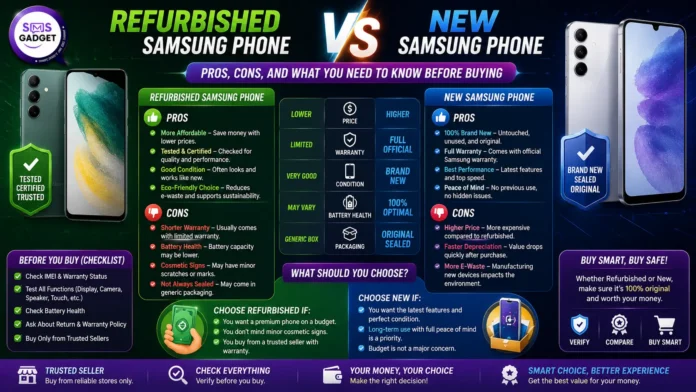

Refurbishing your Samsung phone compared to buying a new one will give you savings of up to 20-50%, depending on the model. And most often, there will not be much difference in performance. A refurbished phone is a phone that was used before and restored to working order after testing and fixing, while a second-hand phone does not pass through any additional procedures. In this article, you will learn about the true advantages and disadvantages of both options, potential savings, and what should be checked when purchasing a refurbished phone.
Refurbished vs New Samsung Phone – Quick Comparison
| Factor | New Samsung Phone | Refurbished Samsung Phone |
| Price | Full retail price | 20–50% cheaper, depending on model and age |
| Condition | Factory-sealed, unused | Tested, repaired, restored to working condition |
| Warranty | Full 1–2 year manufacturer warranty | Typically 30 days to 1 year, depending on seller |
| Battery | 100% original capacity | Often replaced during refurbishment, but not always guaranteed at 100% |
| Cosmetic Condition | Perfect | Minor scratches possible depending on grade |
| Software Updates | Full remaining update cycle | Same as new, since it’s the same model and software track |
| Environmental Impact | Higher (new manufacturing) | Lower (extends the life of an existing device) |
What Does “Refurbished” Actually Mean?
A refurbished Samsung phone is a previously owned device that has gone through a structured restoration process, inspection, cleaning, functional testing, and replacement of any faulty parts before being resold. This is different from a plain “used” phone, which is sold in whatever condition the previous owner left it in, with no guarantee of functionality or battery health. Refurbished units generally fall into three categories: manufacturer-refurbished (restored by Samsung itself or an authorized partner), carrier-refurbished, and third-party refurbished (sold through independent retailers).
Pros of Buying a Refurbished Samsung Phone
1. Significant cost savings: Refurbished Samsung phones typically cost 20–50% less than the same model brand new, and flagship devices tend to offer the biggest savings in absolute terms.
2. Same core performance as new: Since a refurbished phone is the same model as its new counterpart, it runs the same software, receives the same OS updates, and performs identically for everyday tasks like calls, browsing, and social media.
3. Professional testing and quality checks: A reputable refurbishment process tests the battery, screen, camera, buttons, and connectivity before resale, which often catches issues that wouldn’t be visible in a casual private sale.
4. Access to flagship features at a lower price: Buying refurbished lets you get flagship-tier cameras, displays, and processors—for example, on a Galaxy S-series model—for a price closer to what a new mid-range phone would cost.
5. More eco-friendly: Choosing a refurbished device extends the life of an existing phone and reduces electronic waste, which matters given how quickly smartphones are replaced worldwide.
Cons of Buying a Refurbished Samsung Phone
1. Shorter warranty coverage: New phones usually come with a 1–2 year manufacturer warranty, while refurbished units often only offer 30 days to a year, depending on the seller.
2. Possible battery wear: Not every refurbisher replaces the battery, and even when they do, some don’t guarantee 100% battery health. It’s worth confirming this directly before buying.
3. Cosmetic imperfections: Depending on the grading system used, a refurbished phone may have minor scratches or scuff marks, even if it functions perfectly.
4. Inconsistent quality between sellers: Not all refurbishers follow the same standards, so the reliability of a refurbished phone depends heavily on where you buy it from.
5. Foldables lose more value than bar-style phones: Foldable models tend to see a steeper price drop when refurbished compared to standard Galaxy S-series phones, which can be a pro for buyers but reflects durability concerns in the resale market.
How Much Can You Save Buying Refurbished?
Savings vary by model and how old the device is, but flagship Samsung phones commonly see a 25–30% price drop when refurbished, while foldables like the Galaxy Z Fold can drop by 40% or more. As a rough guide:
- Galaxy A-series (mid-range): Smaller absolute savings, but still meaningfully cheaper than new
- Galaxy S-series (flagship): Around 25–30% cheaper refurbished vs. new
- Galaxy Z-series (foldable): Can be 40%+ cheaper refurbished, reflecting faster depreciation
Refurbished vs Used vs Unofficial – Don’t Mix These Up
These three terms get confused often, but they mean different things:
- Refurbished: Previously owned, professionally tested and restored, sold through a retailer with some form of warranty.
- Used/second-hand: Sold as-is by the previous owner or a reseller, with little to no quality assurance.
- Unofficial (grey market): A brand-new phone imported outside the manufacturer’s authorized distribution channel, which is a completely different category from refurbished or used.
If you’re specifically comparing brand-new official phones against grey-market imports rather than refurbished units, that’s a separate decision with its own trade-offs. For buyers weighing that option, it helps to check a reliable Unofficial mobile shop in Bangladesh where IMEI numbers can be verified before purchase, since grey-market phones typically skip local warranty and BTRC registration entirely.
What to Check Before Buying a Refurbished Samsung Phone
- IMEI number: Always verify the IMEI to confirm the phone isn’t blacklisted or reported stolen.
- Battery health: Ask directly whether the battery was replaced during refurbishment, and if possible, check the reported battery health percentage.
- Cosmetic grade: Reputable sellers grade phones (e.g., “Like New,” “Good,” “Fair”) — review photos or the grading description carefully before buying.
- Warranty length: Look for a minimum of 30 days, ideally up to a year, from the seller.
- Return policy: A window of at least 7–14 days to test the phone properly is a good sign of a trustworthy seller.
- Software update eligibility: Confirm how many more years of OS and security updates the specific model has left, since this is identical to the new version of the same phone.
- Network compatibility: Especially important if the unit was originally sold for a different carrier or region.
Refurbished vs New – Which Should You Choose?
- On a tight budget but want flagship features? A refurbished Galaxy S-series phone gives you most of the new-phone experience for significantly less money.
- Need the absolute latest model with full warranty? Buying new is the safer choice.
- Care about sustainability? Refurbished is the more eco-conscious option.
- Buying for a child, a backup device, or a business fleet? Refurbished phones make strong practical sense here, since the cost savings scale with quantity.
- Planning to keep the phone for many years? A new phone gives you the longest possible runway of updates and warranty coverage from day one.
For buyers who want to compare current official new-phone pricing before deciding, checking the latest Samsung phone Price across models can help you see exactly how much a refurbished unit would actually save you.
FAQ – Refurbished vs New Samsung Phone
Is a refurbished Samsung phone as good as new?
In terms of performance and software, yes — a refurbished phone runs the same software and receives the same updates as a new one. The main differences are warranty length, battery condition, and possible minor cosmetic wear.
How much cheaper is a refurbished Samsung phone?
Typically 20–50% cheaper than the same model new, with flagship and foldable devices often seeing the largest discounts.
Does a refurbished Samsung phone come with a warranty?
Most reputable sellers offer somewhere between 30 days and 1 year of warranty coverage, though this varies by retailer.
Is the battery replaced in a refurbished phone?
Many refurbishers replace the battery as part of the process, but not all guarantee 100% battery health, so it’s worth confirming this before you buy.
What’s the difference between refurbished and used phones?
Refurbished phones go through professional testing, repair, and restoration before resale. Used phones are typically sold as-is, with no guaranteed quality checks.
Conclusion
However, if you want the best of both worlds in the form of great performance but without having to pay the top dollar for it, then getting yourself an already refurbished Samsung phone would make an excellent choice as well, especially if you don’t mind having a short warranty period as well as some minor physical imperfections. Regardless of whether you decide on purchasing either of these two options, getting yourself familiar with such aspects as your IMEI number, battery health and warranty conditions before buying would be highly advisable.