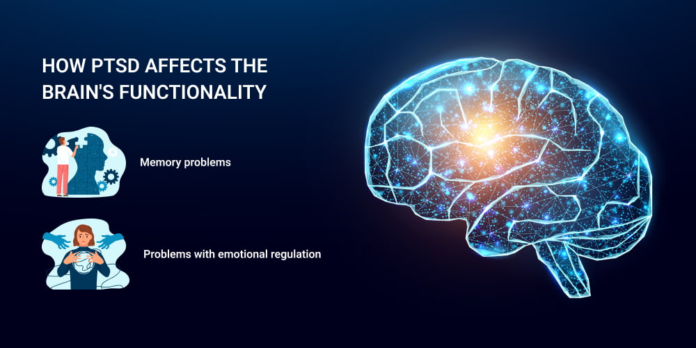

Most people have heard of PTSD. Far fewer understand what it actually does inside the brain and body, why some people develop it after trauma while others do not, and why certain treatments work while others fall short. If you or someone close to you is living with the aftermath of a traumatic event, understanding the mechanics of PTSD can make the difference between feeling helpless and feeling hopeful.
This article walks through the science of PTSD in plain language. You will learn how trauma reshapes brain chemistry, which symptoms are considered diagnostic, how different treatment approaches compare, and what the research says about long-term recovery. No medical degree required.
What Happens in the Brain During and After Trauma
When a person encounters a life-threatening or deeply distressing event, the brain’s threat-detection system fires at full intensity. The amygdala, a small almond-shaped structure deep in the brain, sends out an emergency signal that floods the body with stress hormones like cortisol and adrenaline. Heart rate climbs. Muscles tense. Attention narrows to the immediate danger. This is the classic fight-or-flight response, and it is genuinely useful in a crisis.
For most people, once the danger passes, the brain gradually returns to baseline. The prefrontal cortex, which handles rational thought and emotional regulation, reasserts control. The memory of the event gets filed away as something that happened in the past.
In PTSD, this return to baseline does not happen cleanly. Research published in journals like Biological Psychiatry has shown that people with PTSD often have a hyperactive amygdala and a comparatively underactive prefrontal cortex. The hippocampus, which helps the brain place memories in their correct time context, also shows structural differences in people with chronic PTSD. The result is a brain that keeps treating a past event as a present threat. Triggers, which can be smells, sounds, words, or situations that resemble the original trauma, can throw the nervous system back into full emergency mode without warning.
The Core Symptoms of PTSD
The Diagnostic and Statistical Manual of Mental Disorders, Fifth Edition (DSM-5) organizes PTSD symptoms into four clusters. Understanding these clusters helps explain why PTSD can look so different from one person to the next. Someone might describe their PTSD primarily as emotional numbness and withdrawal, while another person’s experience is dominated by nightmares and flashbacks. Both are valid presentations of the same condition.
| Symptom Cluster | Common Examples |
| Intrusion | Flashbacks, nightmares, distressing memories that feel involuntary |
| Avoidance | Steering clear of people, places, thoughts, or feelings tied to the trauma |
| Negative Cognitions and Mood | Persistent guilt or shame, distorted self-blame, emotional numbness, loss of interest in activities |
| Altered Arousal and Reactivity | Hypervigilance, exaggerated startle response, sleep disturbances, irritability or angry outbursts |
According to the National Center for PTSD, approximately 7 to 8 percent of the U.S. population will meet the criteria for PTSD at some point in their lives. Women are diagnosed at roughly twice the rate of men, though researchers note this gap may partly reflect differences in how and whether men seek diagnosis. Veterans represent a well-documented high-risk group, but PTSD is equally prevalent among survivors of sexual assault, serious accidents, natural disasters, childhood abuse, and sudden bereavement.
Why Trauma Does Not Affect Everyone the Same Way
This is one of the most common questions people ask after a traumatic event. Two people can experience the same car accident or the same violent situation and have entirely different outcomes. One recovers within weeks; the other develops PTSD that lasts for years. Why?
The honest answer is that vulnerability to PTSD appears to be shaped by a combination of factors, and no single factor is deterministic. Researchers have identified several categories of risk that interact with each other in complex ways.
- Prior trauma history: Exposure to trauma earlier in life, especially in childhood, appears to lower the threshold for developing PTSD after subsequent events.
- Social support: People who have strong, responsive support networks after a traumatic event tend to show better recovery outcomes. Isolation is a significant risk factor.
- Severity and duration of the trauma: Prolonged or repeated trauma, such as ongoing domestic violence or combat exposure over many months, carries a higher risk than a single acute event.
- Perceived controllability: Events that feel completely outside a person’s control tend to produce stronger PTSD responses than those where some agency was possible.
- Genetic and biological factors: Twin studies suggest that genetic predisposition accounts for a meaningful portion of PTSD risk, though researchers have not isolated a single PTSD gene.
- Dissociation at the time of the event: Experiencing a strong sense of unreality or detachment during the trauma is associated with higher rates of PTSD afterward.
Knowing these risk factors is not about assigning blame or predicting outcomes with certainty. It is about understanding that PTSD is not a sign of weakness. It is a biologically grounded response that develops under specific conditions.
Evidence-Based Treatments and How They Work
The good news is that PTSD is one of the more treatable anxiety-related conditions when the right approach is used. Several treatments have accumulated strong empirical support through randomized controlled trials. The key distinction is between treatments that directly engage with traumatic memory and those that focus on managing symptoms without processing the underlying material. Research consistently shows that trauma-focused therapies produce deeper and more lasting change.
Cognitive Processing Therapy (CPT)
CPT is a structured 12-session therapy originally developed for survivors of sexual assault and later validated across many trauma types. The central idea is that PTSD is maintained by distorted or unhelpful beliefs that formed as a person tried to make sense of what happened. Common examples include believing the event was entirely their fault, feeling permanently damaged, or concluding that the world is completely unsafe. CPT helps the person examine these beliefs systematically and develop more balanced, accurate ways of thinking. Crucially, this is not about positive thinking. It is about accuracy.
Prolonged Exposure Therapy (PE)
PE works on a different but complementary principle. Avoidance is a key driver of PTSD maintenance. When a person consistently avoids reminders of the trauma, they never give their nervous system the chance to learn that those reminders are not actually dangerous in the present. PE involves gradually and systematically confronting trauma-related memories and real-world situations that have been avoided, always at a pace the person can tolerate. Over time, the emotional intensity attached to those triggers decreases. This process is called extinction learning.
EMDR (Eye Movement Desensitization and Reprocessing)
EMDR has generated more debate than CPT or PE, partly because the theoretical explanation for why it works is still contested. What is well-established is that the outcomes data for EMDR are strong. The therapy involves recalling the traumatic memory in brief intervals while simultaneously tracking a moving object or sound, which produces bilateral sensory stimulation. The prevailing hypothesis is that this process mimics aspects of REM sleep and helps the brain reprocess the memory in a less emotionally charged way. The World Health Organization lists EMDR as a recommended treatment for PTSD.
Medication as a Complement, Not a Replacement
Two antidepressants, sertraline (Zoloft) and paroxetine (Paxil), are the only medications currently approved by the FDA specifically for PTSD. They belong to a class called selective serotonin reuptake inhibitors (SSRIs) and can reduce the severity of intrusion and arousal symptoms. However, medication does not process trauma the way therapy does. Most clinical guidelines recommend trauma-focused psychotherapy as the first-line treatment, with medication as a useful addition for people with severe symptoms or significant co-occurring depression.
What to Look for in a Treatment Provider
Not every therapist who treats anxiety or stress has specific training in trauma-focused modalities. When someone is ready to seek help, it is worth asking directly whether the provider is trained in CPT, PE, or EMDR, and whether they have experience working with the specific type of trauma involved. The fit between client and therapist also matters significantly. Research on therapy outcomes consistently finds that the quality of the therapeutic relationship is one of the strongest predictors of success.
For those living in Texas, access to qualified trauma specialists has grown considerably in recent years. People actively searching for PTSD treatment in the Dallas area have access to providers trained in the same evidence-based protocols used at major research and VA centers, which is meaningful because local access reduces one of the most common barriers to getting started: logistical friction.
When evaluating a provider, a few practical questions are worth asking during an initial consultation. How do they track progress over time? Do they use validated symptom measures like the PCL-5, a widely used self-report scale for PTSD symptoms? What is their typical treatment length for someone with your presentation? A provider who welcomes these questions is generally a good sign.
The Timeline of Recovery: What to Realistically Expect
PTSD recovery is rarely linear. Most people experience weeks where symptoms feel heavier, especially early in trauma-focused therapy when material is being actively engaged rather than avoided. This temporary intensification can feel discouraging, but it is a normal part of the process rather than a sign that treatment is failing.
Clinical trials of CPT and PE typically show meaningful symptom reduction within 12 to 15 sessions. A substantial proportion of participants no longer meet diagnostic criteria for PTSD by the end of treatment. That is a genuinely encouraging finding. It means that with the right approach, full or near-full remission is a realistic goal, not just symptom management.
Longer or more complex trauma histories, particularly those involving repeated childhood trauma or multiple traumatic events, often require longer treatment timelines. Some people benefit from a phased approach that builds stabilization skills before moving into direct trauma processing. This is not a slower path so much as a more thorough one.
Sleep is worth a specific mention. Sleep disturbances are among the most persistent PTSD symptoms and also among the most functionally disabling. Poor sleep impairs the emotional processing that happens naturally during rest, which can slow recovery from other symptoms as well. Some providers address sleep problems directly using image rehearsal therapy for nightmares, or brief cognitive behavioral therapy for insomnia, as a complement to the primary trauma treatment.
A Final Word on Getting Started
One of the biggest barriers to PTSD treatment is not lack of options. It is the way PTSD itself makes seeking help harder. Avoidance is a core symptom. Negative beliefs about oneself, about trust, and about whether recovery is even possible are core symptoms. The condition, in a very real sense, works against the behaviors that would lead to treatment. Recognizing this pattern is often the first genuinely useful step someone can take. The science is clear that effective treatment exists, that the brain retains the capacity for change, and that many people who once could not imagine feeling better have reached a place where the trauma is genuinely in the past.