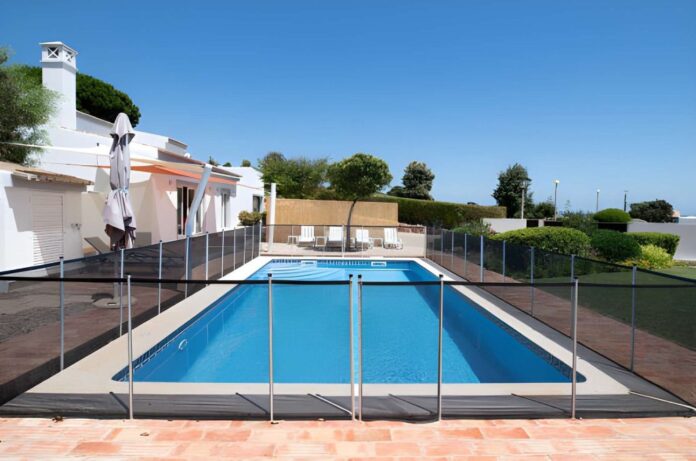

Modern backyard swimming pools across Australia must feature a compliant child-resistant safety barrier to prevent accidental drowning. Current pool fence regulations in Australia state that any residential pool or spa capable of holding water deeper than 300mm (30cm) requires a permanent fence at least 1.2 meters high.
This law applies to in-ground, above-ground, and portable pools. Key features include an outward-swinging gate that must be self-closing and self-latching, tight gaps under 100mm, and a strict 900mm non-climbable zone around the perimeter. Under the updated National Construction Code (NCC) standards starting May 2026, rules for boundary fences, gate latch heights (minimum 1400mm), and durability testing are being tightened. Regular safety checks through a professional pool fence inspection remain vital to ensure ongoing compliance, avoid hefty fines, and protect young lives.
Imagine your backyard on a warm summer day. The kids are laughing, the barbecue is sizzling, and your sparkling pool is inviting everyone in for a splash. Now imagine a curious toddler wandering near that water when no one is looking. It takes only seconds for a fun day to turn into a nightmare.
That is exactly why pool fence rules exist. They act as a silent lifeguard for your family. Australia loves its backyard pools, but with great fun comes great responsibility. According to Royal Life Saving Australia, safety barriers around backyard pools have saved thousands of toddlers’ lives over recent decades.
Whether you already own a pool or plan to build one, you need to know the latest safety laws to keep your little ones safe and keep your property legal.
What is the standard pool fence height and gate rule in Australia?
No matter which state or territory you live in, the core safety rules share a strong foundation. Think of these as the absolute minimum requirements to block a busy toddler from getting into danger.
- The 300mm Depth Rule: If your pool, spa, or even an inflatable backyard pool can hold water more than 30cm deep, it must have a legal safety barrier.
- The 1.2-Meter Height Rule: Your pool fence must be at least 1.2 meters tall from the ground outside the pool area.
- The Outward Gate Rule: Pool gates must never open inward toward the water. They must swing outward, away from the pool area.
- The Snap-Shut Rule: The gate must be self-closing and self-latching. If you open the gate even just a tiny bit and let go, it must snap shut and lock all by itself.
What is a non-climbable zone around a pool fence?
Children are natural explorers and fantastic climbers. A chair, a large flower pot, or even a nearby tree branch can look like a ladder to a curious child. To stop this, the law requires a 900mm “Non-Climbable Zone” (NCZ) on the outside of your fence.
Imagine a giant, smooth semi-circle arching down from the top of your fence. Inside this 90cm space, there can be absolutely nothing that a child could use as a foothold or handhold.
You must move barbecues, outdoor chairs, steps, big toys, and potted plants far away from this zone. Also, make sure the vertical bars on the fence are no more than 100mm apart so little bodies cannot squeeze through, and that gaps under the fence are less than 100mm so no one can crawl underneath.
What are the new Australian Standard AS 1926.1:2024 changes?
The rules just got their biggest update in 12 years. The new Australian Standard (AS 1926.1:2024) is rolled out under the updated National Construction Code. States are adopting these rules on their own timelines (Victoria started on May 1, 2026, while New South Wales plans to adopt them by May 1, 2027).
Here is what is changing for new pools and renovations:
| Rule Feature | Old Standard | New 2026 Standard |
| Gate Latch Height | Often 1500mm inside or lower | Must sit at least 1400mm from ground level on the pool side. |
| Gate Durability | Basic testing | Hinges and latches must survive a tough 25,000-cycle slam test to prove they will not wear out. |
| Boundary Fences | Strict 500mm clear zone inside | Inside items (like garden beds or pots) are allowed within 500mm only if the top of the boundary fence sits a full 1800mm vertically above the ground. |
Do pool fence laws differ between NSW, Victoria, and Queensland?
Yes, while the physical fence rules are very similar, the ways each state tracks and enforces the law vary widely.
- New South Wales: You must register your pool on the official NSW Swimming Pool Register. If you are selling or leasing your home, you must have a valid compliance certificate.
- Victoria and Western Australia: These states require regular, mandatory inspections. You must hire an expert to inspect your pool barrier every few years to obtain a certificate of pool safety compliance.
- Queensland: All pools must be registered on the QBCC pool safety register. If you sell or rent a property, a pool safety certificate is required, and failure to comply can result in substantial fines.
Taking Action: Keep Your Backyard Safe
A pool fence that worked perfectly last year might be dangerous today. Screws rust, ground shifts, and gate springs lose their bounce over time. Testing your barrier yourself takes just a few minutes and keeps your family safe.
- Step 1: Do the Push Test. Open your pool gate wide and let it go. Did it close and lock? Now open it just a few centimeters and let go. If it stays open even a crack, your springs or latches need immediate repair.
- Step 2: Clear the Area. Walk around the outside of your fence. Look for anything that crawled into the 900mm non-climbable zone. Move any stray chairs, garden tools, or toys back into the shed.
- Step 3: Call the Experts. The absolute best way to protect your kids and your wallet is to book a professional pool fence inspection.
A certified inspector will look at your gate, check your ground levels, measure your gaps, and give you total peace of mind. Do not wait for an accident or a council fine to tell you your fence has failed.
Let’s make this summer safe, happy, and worry-free. Check your gate today, clear those climbable objects, and book an expert review to ensure your pool remains a place of pure joy!