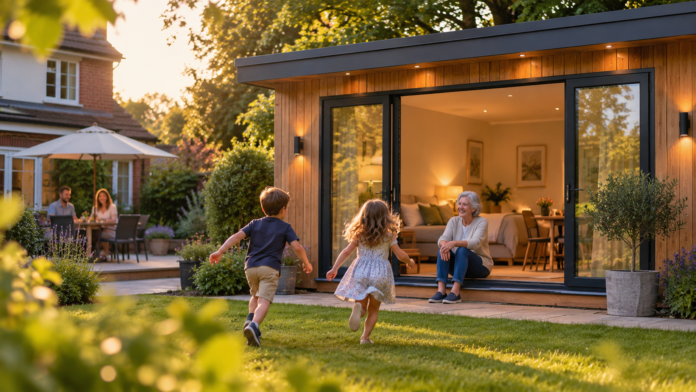

For most of human history, several generations of a family lived together or a few doors apart. The idea that everyone moves away and lives separately is a fairly recent one. Now many families are quietly moving back the other way. Grown up children are staying or returning home. Older parents are moving in with their sons and daughters. Grandparents are helping with the school run.
The reasons are practical as much as sentimental. Housing costs are high. Care homes are expensive and not always what people want. Childcare is hard to find and hard to afford. Living together, or very close together, solves several problems at once. The tricky part is doing it in a way that keeps everyone happy, and that is where a garden annexe comes in.
Why families are choosing to live together again
Ask a family why they decided to live with an older parent and you will hear a mix of answers. Someone was lonely after a partner died. A house had become too big and too much work. A health scare made the drive across the country feel too far. Money played a part, but it was rarely the whole story.
The same is true at the other end of the age range. A grown up child might come home after university, after a relationship ends, or simply because renting alone is out of reach. Some families have a relative who needs a bit of daily support but nothing like full time care.
What all these situations share is a wish to be close without being on top of each other. Sharing a bathroom with your father in law is not most people’s idea of family harmony. Nor is a teenager and a grandparent fighting over the television. Closeness works best with a door in between.
What a garden annexe actually is
A garden annexe is a small, self contained home built in the garden of the main house. It has its own front door, bedroom, bathroom and kitchen or kitchenette. The person living there can cook, sleep, wash and relax entirely on their own terms, and step across the garden to join the family whenever they choose.
It is worth being clear about what it is not. It is not a shed with a bed in it, and it is not a garden office with a sofa. An annexe that someone lives in is a proper dwelling. Depending on how it is designed and used, it may fall under permitted development or caravan rules, or it may need a full planning application, so check the route with your council or builder early. Either way it needs full insulation, proper drainage, heating and safety features. Done well, it is as warm, quiet and comfortable as any room in the house.
Sizes range from a studio with one open living space through to one and two bedroom designs. The right size depends on who is moving in and for how long. A parent in their seventies may want a bedroom and a small sitting room. A returning child may be happy with a studio and a good kitchen.
Because these buildings are real homes, most families use a specialist rather than a general builder. A firm that does this every week will handle the drawings, the planning application, the trades and the finish as one job. Grannexe is one such company, designing and building garden annexes for families in Kent and London. Whoever you choose, ask to see finished annexes and talk to the people living in them.
Who an annexe suits
The classic case is an older parent. They keep their independence, their own routine and their own space, but help is a few steps away if they need it. Grandchildren pop in after school. Nobody has to drive an hour every Sunday. If health needs increase over time, family or carers can support them at home rather than moving them somewhere unfamiliar.
The second case is the grown up child. An annexe gives them a real home of their own rather than a childhood bedroom. They can save towards their own place while paying far less than rent. Parents get their house back and still see their child every day.
The third case is less obvious. Some families build an annexe for a relative who needs regular care, and use it later as a home for a live in carer, a guest space, or somewhere for the parents themselves to move into when the main house passes to the next generation. A well designed annexe can serve a family for decades in different roles.
Independence on both sides
The success of any multigenerational arrangement comes down to one thing. Everyone needs to feel they have chosen it, and everyone needs somewhere to retreat to. An annexe gives both.
For the person moving in, having their own front door matters more than almost anything. They can have friends round, keep their own hours, watch what they like and cook what they like. They are a neighbour who happens to be family, not a lodger.
For the family in the main house, the same door means they keep their own life too. A couple can argue, relax or host without an audience. Children have a grandparent nearby but do not have to tiptoe around them. The relationship stays warm because it is not forced.
It helps to talk honestly before the build about what closeness will look like. Will meals be shared every night or once a week? Who does the garden? Is the annexe kitchen for real cooking or just breakfast? None of these questions has a right answer, but they all need one.
Making the practical side work
A few things smooth the path.
Money. Decide early who is paying for the build and what happens to the annexe if circumstances change. Many families treat it as an investment in the property, since a good annexe adds value to a home. Others fund it from the sale of the relative’s previous house. Either way, write it down.
Care. If the person moving in has health needs, think about how those might change. Level access, a walk in shower, wide doorways and good lighting cost little to include from the start and make the annexe usable for far longer.
Privacy in the garden. A path, a hedge or a small patio of their own gives the annexe a sense of its own territory. It is a small design detail that makes a big difference to how separate it feels.
Time. Planning checks, design and the build itself all take time. Start the conversation well before anyone needs to move.
A different way to be a family
Multigenerational living is not a step backwards. For many families it is a more sensible, more affordable and more loving way to live than the alternative of everyone struggling alone in separate houses. A garden annexe makes it possible without the friction that sharing a house can bring.
The best version looks like this. A grandparent waters the garden in the morning. The children run across the lawn after school. Sunday lunch is in the main house, and by the evening everyone is back behind their own front door. Close, but not too close. That balance is what an annexe is really for.