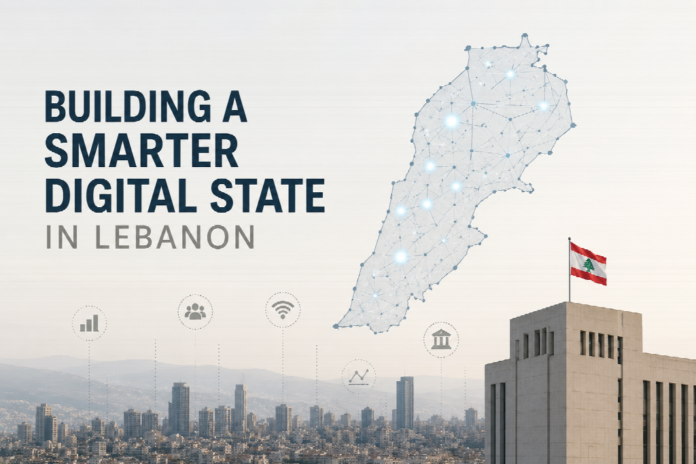

Lebanon’s digital transformation is beginning to move beyond promises of modernization. New systems, infrastructure and government services are taking shape. But a more difficult question sits behind that progress: will a more digital state actually become better at understanding the country it governs?
Computational researcher and software engineer Mohamed Soufan argues that the answer depends less on how many services Lebanon puts online than on what happens to the information those systems produce.
His concern is not that Lebanon lacks data. Public institutions, utilities, municipalities, hospitals and private organizations already generate information about how people live, move, spend and use essential services. The weakness is what happens afterward. Much of that information remains confined to the institution that collected it, often disconnected from other signals that could change its meaning.
That creates an unusual contradiction. Lebanon can become more digital while its institutions continue making decisions with only partial views of the problems in front of them.
Soufan has been making the case for a different measure of technological progress: whether institutions can turn scattered evidence into something decision-makers can actually use. As he argued in a recent Inside Telecom interview, the real challenge is not simply producing more information, but building institutions capable of understanding it, acting on it and later determining whether their decisions worked.
That distinction — between a government that stores data and one that can reason with it — may ultimately prove more important to Lebanon’s digital future than any individual platform or technology.
What a Data-Driven Government Actually Requires
The phrase “data-driven government” can easily become shorthand for dashboards, artificial intelligence and increasingly sophisticated software. But the harder part has little to do with acquiring more technology.
For Mohamed Soufan, the starting point is much more basic: public institutions need to know what information they already produce, how it relates to the decisions they make and what should happen when that information signals a problem.
Lebanon, in his view, is not starting from an absence of data. Ministries, municipalities, utilities, hospitals and other institutions already generate large amounts of information through their everyday work. The weakness is that much of it remains separated by institution, stored for different purposes and rarely brought together into a wider view of what is happening.
That distinction changes the meaning of digital government. Moving a form online may make an interaction faster. Digitizing a record may make it easier to retrieve. Neither automatically gives policymakers a better understanding of the country.
Soufan has argued that data analysis instead needs to become part of the machinery of routine decision-making. If an institution tracks an indicator, there should be a reason for tracking it, someone responsible for reviewing it and a clear understanding of what happens when it changes significantly. The same evidence can then be used later to judge whether the response worked.
This is also why Soufan has cautioned against beginning with ambitious AI systems. Before complex models can add much value, institutions need reliable records, compatible standards and the ability to exchange useful information securely. Otherwise, digitization risks preserving the same institutional boundaries in a newer technical form.
A genuinely data-driven government, then, is not defined by how advanced its software looks. It is defined by whether information can travel far enough through the state to influence a decision.
Why Lebanon Needs Faster Signals Alongside Official Statistics
In Lebanon, the pace of change can make yesterday’s data unusually expensive.
Prices move quickly. Families relocate. Demand for assistance rises or falls. Businesses see changes in spending, while municipalities and service providers can experience new pressure within weeks. Yet many of the statistics used to understand those shifts arrive only after the conditions themselves have changed.
Mohamed Soufan argues that this gap between the speed of events and the speed of measurement is one of the strongest cases for making better use of Lebanon’s digital data. In his work on the country’s fragmented information systems, he has pointed to sources that are already being generated continuously — from administrative records and service demand to prices, mobility and online behavior.
The advantage is not that these signals are necessarily more authoritative than official statistics. Often they are not. Their advantage is timing.
A change in search behavior, for instance, cannot establish that migration is increasing or that households are under greater financial pressure. But it can reveal a sudden rise in searches related to leaving the country, finding work or obtaining financial help. Similar changes may appear in spending patterns, requests for assistance or demand for particular public services.
Soufan’s argument is that such information should complement slower, more established measures rather than compete with them. Traditional statistics remain essential for understanding the scale and structure of a problem. Faster signals can serve a different purpose: making an emerging change visible while there is still time to examine it.
That distinction matters in a country where economic and social conditions can shift faster than conventional reporting cycles. Waiting for a complete statistical picture may produce greater certainty, but it can also mean understanding a problem only after it has become considerably harder to address.
For Lebanon, becoming more data-driven therefore requires more than producing better statistics. It also requires shortening the distance between something changing in society and institutions noticing that it has changed.
How Early-Warning Systems Could Work in Practice
An early-warning system for Lebanon would not need to predict the next crisis. It would need to notice when several ordinary indicators begin behaving unusually at the same time.
Mohamed Soufan has argued for approaching the idea as a monitoring system rather than placing confidence in a single predictive model. The distinction matters. Lebanon already produces signals through markets, public services, mobility, telecommunications and online behavior. The challenge is deciding when those signals collectively deserve attention.
Consider economic pressure. A rise in food prices alone may be temporary. More searches for financial assistance may reflect a news event. A fall in transactions may have a seasonal explanation. But if prices are rising while spending weakens, shortages appear, requests for assistance increase and searches related to jobs or emigration accelerate, the combined pattern becomes harder to dismiss.
The same logic could apply to migration or pressure on public services. Changes in mobility could be compared with school enrollment, housing demand or municipal records. Search trends around visas, studying abroad or jobs overseas could provide another layer. None of those indicators would prove that a major shift was underway, but several independent signals moving together could tell officials where closer investigation is warranted.
Geography would matter as much as the indicators themselves. Soufan has stressed that conditions should be compared with historical patterns and examined locally because pressure in Beirut may look very different from the Bekaa or the South. A national average can remain relatively stable while one area experiences a rapid change.
That also means such a system would have to accept false alarms. Not every unusual pattern would develop into a serious problem, and officials would still need to verify what the data appears to show.
The value is therefore not perfect foresight. It is time.
As Soufan has put it, early warning is about identifying something unusual while institutions still have an opportunity to investigate and respond. In a country accustomed to managing problems once they are already visible, even a modest improvement in that timing could change the way government responds to pressure.
The Architecture of a Smarter Lebanese State
The harder part of Lebanon’s digital transformation may not be technological at all. It may be organizational.
Mohamed Soufan’s argument is that data becomes useful only when it is tied to the decisions institutions already make. A ministry can collect increasingly detailed information and still gain little from it if nobody is responsible for reviewing the relevant indicators, questioning unusual changes or assessing afterward whether a policy had the intended effect.
That shifts the discussion away from building ever larger databases. Lebanon does not necessarily need every ministry feeding information into a single central system. What it needs is the ability for separate systems to communicate when there is a legitimate reason for them to do so.
Common standards for collecting and exchanging data are therefore as important as the platforms themselves. Soufan has warned that when institutions store information differently, potentially useful signals remain trapped inside organizational boundaries. His own analysis of Lebanon’s digital-government push similarly argues that interoperability, clearer rules for data sharing, regularly updated records and safeguards around privacy and access need to be designed into the system from the beginning.
There is also a human layer that technology cannot solve. Soufan does not argue that every Lebanese institution needs a large team of data scientists. More valuable, he says, may be people capable of working between technical staff and public officials — understanding both the operational problem and what the data can realistically say about it.
That is a less spectacular vision of digital government than an AI-powered state, but potentially a more consequential one. Software can make government faster. Connected institutions can make its decisions better informed.
For Lebanon, the real architecture of a smarter state may therefore be neither a new portal nor a single national database. It is a set of institutions that can exchange evidence safely, understand it consistently and make someone accountable for what happens next.