
Most crane projects begin with the wrong question. The buyer asks “how many tons?” long before asking “what shape of coverage does this work actually need?” Capacity matters, but it is a specification you settle once you know what kind of crane you are specifying. The more consequential first decision is the crane type, and that decision is really about geometry: the shape of the area the crane has to serve and whether the building can help carry it.
Jib, bridge, and gantry cranes each cover space in a fundamentally different way. Choosing among them by coverage geometry, and by how people actually move around the floor, is what determines whether the crane fits the work or fights it. Here is how to reason through the three.
Start With Coverage Shape, Not Capacity
Every crane type draws a different footprint of coverage, and that footprint is the first thing to match to the work.
- A jib crane covers a circle or an arc. Its boom pivots around a single fixed point, so it serves a compact zone around that point and nothing beyond the boom’s reach.
- A bridge crane covers a rectangle. Its bridge travels the length of a bay on elevated runways while the hoist crosses the width, so it can reach essentially every point in that rectangle.
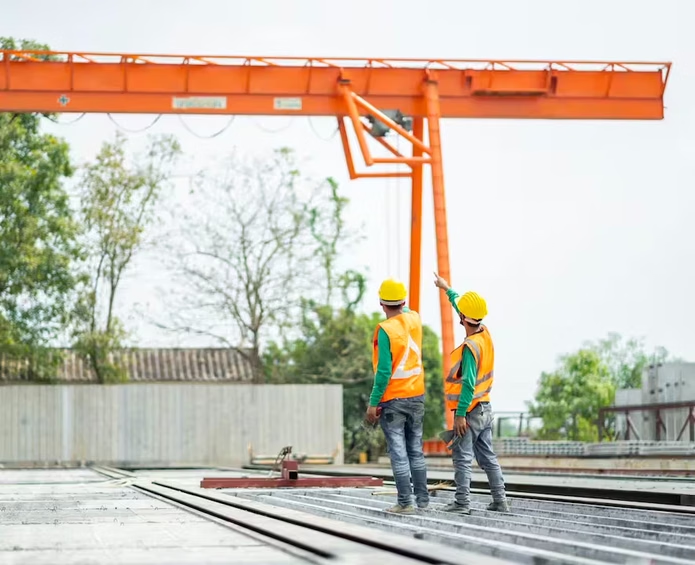
- A gantry crane also covers a rectangle, but it carries its own supports to the floor instead of hanging from the building, which lets it put rectangular coverage where no building structure exists to hang a runway from.
Once the shape of the needed coverage is clear, the choice narrows quickly. A single busy workstation wants a circle. A whole production bay wants a rectangle carried by the building. An outdoor yard or a space that cannot take a runway wants a rectangle that stands on its own legs.
The Jib Crane: Dense Coverage at a Fixed Point
A jib crane is the right tool when the lifting happens repeatedly in one spot. It puts a hoist directly over a workstation and swings it through a circular or semicircular area, which makes it fast and ergonomic for the operator who lifts the same kinds of parts in the same place all shift.
Its strengths are specific:
- Point-of-use lifting that is quick to engage, with no waiting for a shared crane to travel down the bay.
- A mast or floor-mounted jib can rotate a full 360 degrees, while a wall or column-mounted jib typically swings 180 degrees, which is often all a station against a wall needs.
- Lower cost and a smaller footprint than a full bay crane, so several jibs can serve several cells independently.
Its limits are equally specific. A jib covers only the area its boom can reach, usually enough for one or two workstations, so it cannot serve a whole floor. Place several jibs near each other and their arcs can interfere. And a jib still imposes real loads, so a floor-mounted unit needs a properly designed foundation and a column-mounted unit needs building steel rated to take it. A jib is built to solve one busy spot, and it does that better than anything else.
The Bridge Crane: Full Coverage Across a Bay
A bridge crane is the workhorse of overhead lifting, and it earns that role by covering an entire rectangular bay. When work moves across the whole floor, or when loads have to travel from one end of a space to another, the bridge crane’s geometry is hard to beat.
What it does well:
- Reaches nearly every point in the bay, so a single crane serves many stations and long travel paths.
- Keeps its structure overhead, which leaves the floor beneath it open for walkways, doors, and storage. Coverage in the air means the space below stays usable.
- Scales to high capacities and continuous duty, which is why it anchors most production and heavy handling operations.
The trade-off is structural. A bridge crane hangs from elevated runways that must be carried by the building’s columns and foundations, so the structure has to be engineered to take the crane’s loads. In an existing building that was never designed for a crane, that can mean reinforcement or, in some cases, that a bridge crane is not practical without significant structural work. The bridge crane gives the best coverage of a fixed indoor rectangle, provided the building can carry it.
The Gantry Crane: Rectangular Coverage Without the Building
A gantry crane brings the bridge crane’s rectangular coverage to places a bridge crane cannot go. Its bridge rides on freestanding legs that travel along rails or wheels at floor level, so the load path runs straight down the legs to the ground and the building carries nothing. That single structural difference opens up applications the other two cannot serve.
A gantry is the right call when:
- The work is outdoors or in a yard with no building structure to hang a runway from, such as a steel yard, a rail or shipping yard, or a laydown area.
- The building exists but cannot or should not carry a crane, so putting the load on the floor through the gantry’s legs avoids loading the structure entirely.
- Coverage needs to move. Many gantry cranes can travel between work areas, and some are built to be relocated across a site or packed up when a job ends.
Gantry cranes carry their own trade-offs. Their ground-level rails or wheel paths consume floor space and usually have to be kept clear, so the area under and around the crane is largely dedicated to it. The ground tracks are also more exposed to damage than overhead runways. In exchange, all the working parts sit at ground level where they are easy to reach for service, and a gantry can do something no bridge crane can: cantilever a load out past its uprights, which is how yard gantries pick containers or steel from a truck parked alongside them. For operations weighing this option, a closer look at how overhead gantry cranes are configured shows how much that freestanding geometry can flex to a site.
Choosing Among the Three
With the geometry of each type clear, a handful of practical questions usually settle the decision:
- What shape and size is the area to cover? A point favors a jib, a full bay favors a bridge or gantry.
- Can the building carry a runway? If yes, a bridge crane usually wins on coverage and floor access. If no, a gantry brings its own structure.
- Indoor or outdoor? Outdoor with no structure points to a gantry. Indoor at a fixed station points to a jib.
- How many stations need independent lifting? Several cells that each lift on their own schedule often favor several jibs over one shared bridge crane.
- Does the coverage need to move? A fixed area can take a bridge crane. Work that shifts between bays or sites favors a mobile gantry.
The most common mistakes come from skipping this reasoning. Some buyers default to a bridge crane and over-cover a floor where a couple of jibs at the busy stations would serve better and cost far less. Others try to force a bridge crane into a building that cannot structurally take one, when a gantry would have sidestepped the problem. And many overlook gantry cranes entirely for spaces where a runway is impractical, leaving a real option on the table.
It is also worth remembering that the three types are not mutually exclusive. A great many facilities run jib cranes at the individual cells for fast point-of-use lifting and a bridge crane over the whole bay for longer moves, each doing the job its geometry suits. The right answer is often a combination, matched to how the floor is actually used rather than to a single default choice.
Match the Crane to the Work
The tonnage a crane can lift is easy to specify once the type is right. The harder and more important decision is choosing the type that fits the shape of the work, the layout of the floor, and the structure of the building. Start from coverage geometry, be honest about how the space is used and where the loads need to go, and the choice among jib, bridge, and gantry tends to become clear. Get that decision right, and everything downstream, from the structure to the capacity to the way people work around the crane, falls into place behind it.