

Your face shape can help you choose hairstyles that complement your natural features. However, identifying it isn’t always straightforward, especially when your forehead, cheekbones, and jawline resemble more than one category.
An AI face shape detector analyzes facial proportions from a photograph to estimate whether your face is oval, round, square, heart-shaped, diamond, triangle, or oblong.
This guide explains how face shape detection works, how to interpret your results, and how to use them when choosing a flattering hairstyle.
How Does an AI Face Shape Detector Work?
A face shape detector examines facial proportions and contours to identify the geometric category that most closely matches your features.
AI-powered tools typically use computer vision and facial landmark detection to examine several characteristics:
- Forehead width: The distance across the upper face.
- Cheekbone width: The distance between prominent cheekbone points.
- Jaw width: The width across the lower jaw.
- Face length: The vertical distance from the forehead or hairline to the chin.
- Jawline shape: Whether the jaw appears rounded, angular, or tapered.
By comparing these measurements, an AI analyzer estimates the closest matching face shape.
However, facial classification isn’t an exact science. Many people have characteristics associated with multiple categories.
How to Identify Your Face Shape Using Facefy
You don’t need complicated measurements or specialized equipment to explore your facial proportions.
Facefy provides an online approach to facial analysis, helping users understand their face shape through a photograph before exploring suitable hairstyles.
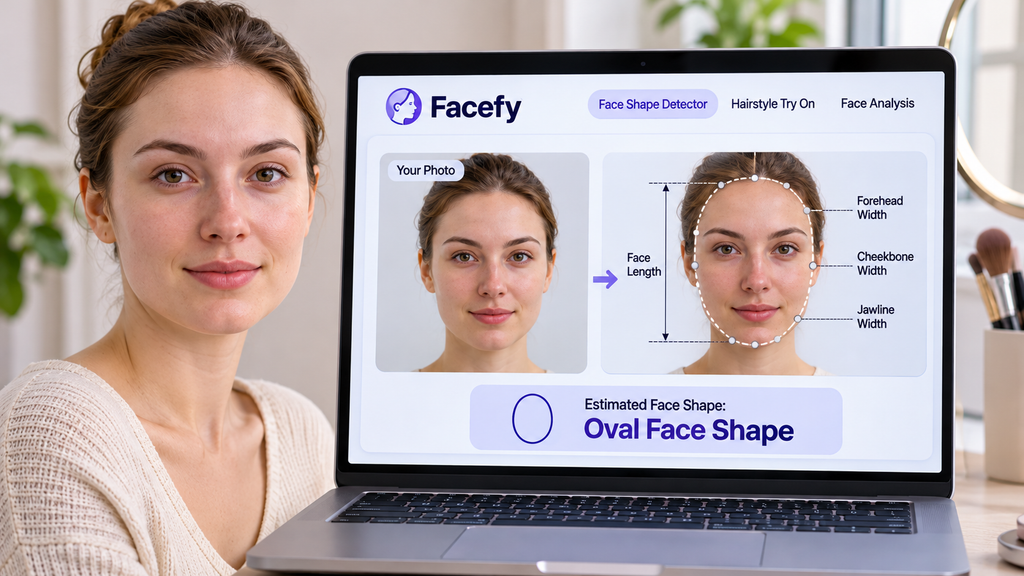
Step 1: Take a Clear Front-Facing Photo
Use a recent photograph showing your entire face with a neutral expression.
Keep your head straight, position the camera at eye level, and use even lighting.
Keep your hair pulled back from your forehead and jawline so the detector can see your full outline more clearly.
Avoid beauty filters that alter your proportions.
Step 2: Upload Your Photo
Open Facefy’s online face shape analysis tool and follow the instructions to upload your photograph.
The tool examines visible facial features and proportions to estimate your face shape.
Image quality can influence how accurately these characteristics are identified.
Step 3: Review Your Results
Once the analysis is complete, compare your result with the characteristics of different face shapes.
Consider your forehead, cheekbones, jawline, and overall facial length rather than relying entirely on one category.
Your result provides a starting point for exploring hairstyles, not an absolute definition of your appearance.
Photo Guidelines for Accurate Face Shape Detection
Camera positioning can make a face appear longer, wider, or more angular than it actually is.
For clearer results:
- Face the camera directly.
- Keep the camera approximately at eye level.
- Use soft, even lighting.
- Remove accessories that obscure facial features.
- Keep your forehead, cheekbones, and chin visible.
- Avoid extreme close-ups and wide-angle distortion.
- Maintain a neutral expression.
Selfies taken too close to the camera may exaggerate certain features and distort facial proportions.
If your result seems inconsistent, try another photograph from a slightly greater distance.
The Seven Face Shapes and Their Most Flattering Hairstyles
Understanding each face shape can help you choose hairstyles that emphasize or balance particular features, and it also answers how many face shapes are usually recognized: seven common categories.
1. Oval Face Shape
Oval faces are longer than they are wide, with softly rounded contours and gently tapered jawlines.
The cheekbones are often slightly wider than the forehead and jaw.
Flattering hairstyles: Long layers, bobs, curtain bangs, and textured cuts can complement oval proportions.
Oval faces accommodate many hairstyles, although hair texture and personal preferences still matter.
2. Round Face Shape
Round faces have relatively similar length and width, fuller cheeks, and softly curved jawlines.
Flattering hairstyles: Long layers, side-swept bangs, and styles with volume at the crown can create an elongated appearance, since round faces benefit from height and vertical lines that help the face appear longer.
Shorter hairstyles can also work beautifully when their proportions suit the individual. Angular frames also suit round faces by adding definition.
3. Square Face Shape
Square faces typically feature broad foreheads, an angular jaw, and relatively similar upper and lower facial widths, often with sharp angles.
Flattering hairstyles: Soft waves, layered cuts, textured bobs, and side-parted hairstyles can introduce movement around angular features.
Round frames can soften a square face.
Blunt cuts can also emphasize a strong jawline for a more structured appearance.
4. Heart Face Shape
Heart-shaped faces generally have wider foreheads and taper toward a pointed chin.
Flattering hairstyles: Chin-length bobs, side-swept bangs, and layered cuts that add fullness near the jaw can create visual balance. Aviator-style glasses can also help balance heart-shaped proportions.
5. Diamond Face Shape
Diamond faces feature prominent cheekbones as the widest point, with both the forehead and jawline narrower. It’s often considered the rarest face shape, found in about 5% of people.
Flattering hairstyles: Curtain bangs, chin-length bobs, and styles adding volume around the forehead or jaw can complement these proportions. Oval-framed glasses can also help balance diamond proportions.
6. Triangle Face Shape
Triangle faces have jawlines that appear wider than their foreheads, with a narrow forehead compared with a broader jawline.
Flattering hairstyles: Layered cuts, side-swept bangs, and hairstyles with volume near the crown or temples can balance the upper and lower face.
7. Oblong Face Shape
Oblong faces are noticeably longer than they are wide, with straight sides and a forehead, cheekbones, and jaw that are often similar in width.
Flattering hairstyles: Curtain bangs, shoulder-length layers, textured bobs, and styles that add width around the cheeks can visually balance facial length. Wide glasses frames can also help add visual width.
Using Your Face Shape Results to Choose a Hairstyle
Knowing your general face shape can make hairstyle selection more focused.
For example, someone with a round face may prefer a haircut that adds vertical volume, while someone with an oblong face may choose layers that create width.
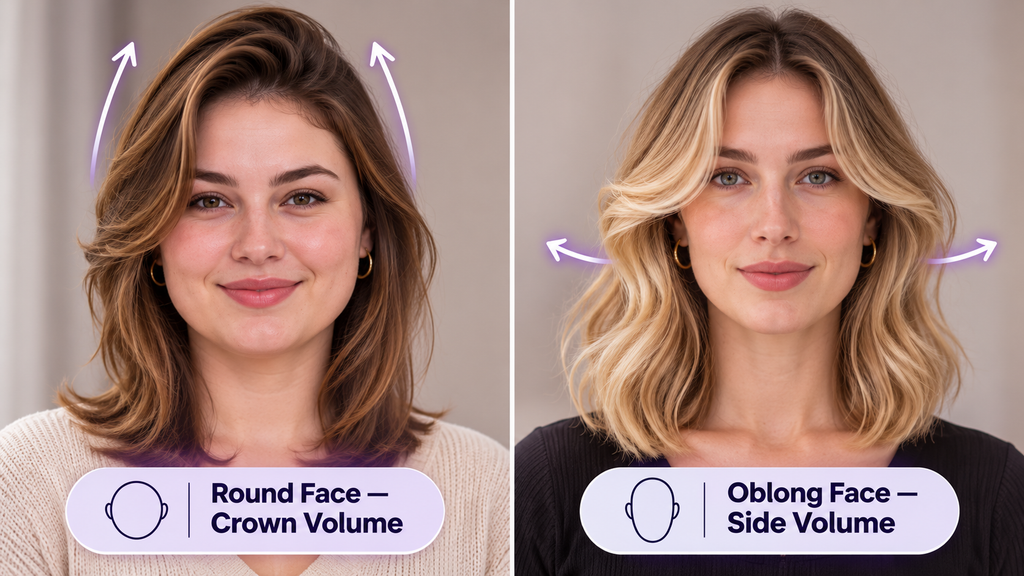
Instead of guessing your category, you can use Facefy’s Face shape detector to examine your facial proportions before comparing different haircut options.
This can help narrow your choices when discussing hairstyles with a barber or stylist.
Consider Your Hair Texture
Face shape isn’t the only factor influencing a flattering haircut.
Fine hair may benefit from cuts that create the appearance of fullness, while thick hair may require layering to manage volume.
Curly and wavy textures also affect how a hairstyle frames the face.
Consider Maintenance and Lifestyle
A hairstyle should complement your daily routine.
Some cuts require frequent styling, heat tools, or regular trims. Others maintain their shape with minimal effort.
Choose a style that balances your facial proportions with your preferred maintenance level.
How to Determine Your Face Shape Manually
If you prefer manual measurements, use a mirror and a soft measuring tape.
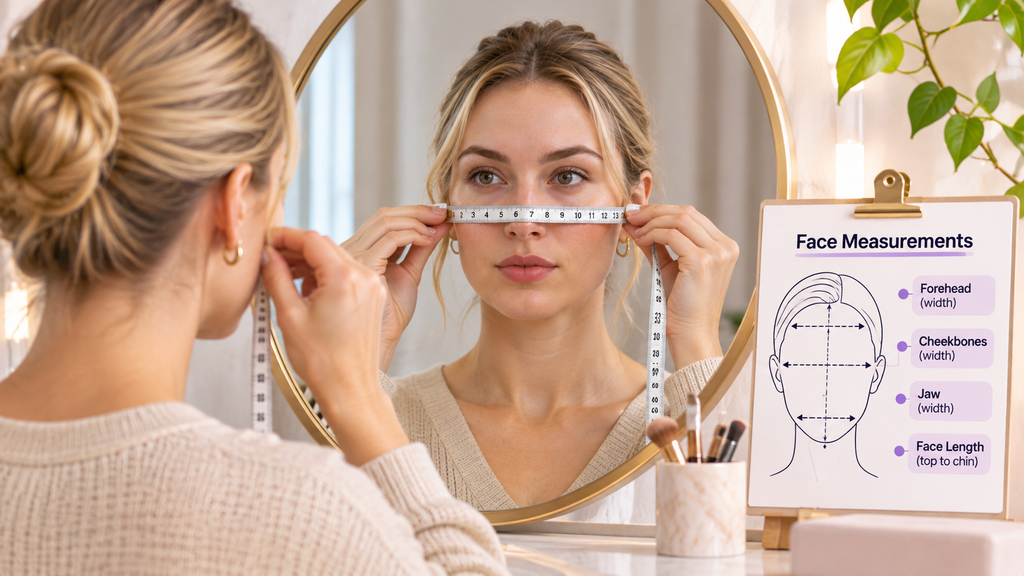
Pull your hair away from your face and measure:
- Forehead width: Across the widest visible forehead area.
- Cheekbone width: Between the prominent cheekbone points.
- Jaw width: Across the lower jaw.
- Face length: From the center of your hairline to your chin.
Compare your measurements and overall facial contours.
A longer face may suggest oval or oblong proportions. Similar length and width may indicate round or square features.
A wider forehead with a narrow chin may suggest a heart shape, while prominent cheekbones may indicate a diamond shape.
Manual measurements remain approximate because facial contours are three-dimensional.
Can You Have More Than One Face Shape?
Yes. Many people fall between two shapes rather than fitting only one category and have features associated with multiple categories.
Someone might have oval facial proportions combined with a square jawline. Another person may have prominent diamond-shaped cheekbones and a heart-shaped forehead.
These combinations are normal.
Face shape categories simplify complex facial structures, so an AI result should be interpreted as guidance rather than a rigid classification. There is no single most attractive face shape or attractive face shape, because overall balance and harmony matter more than one label.
Can Your Face Shape Change Over Time?
Facial appearance changes throughout life.
During childhood and adolescence, facial bones continue developing. In adulthood, changes in facial fat, skin, muscle, and soft tissue can influence visible proportions even when the underlying bone structure stays the same.
Weight fluctuations and aging may also affect cheekbone and jawline definition, which can make a face shape appear different over time.
Hairstyles and facial hair can change the perceived shape without altering the underlying bone structure.
How Accurate Are AI Face Shape Detectors?
AI face shape detectors provide estimates based on facial landmarks, proportions, and classification methods.
Accuracy depends on image quality, camera angle, lighting, facial expression, and the underlying model.
Different tools may produce different classifications because face shape categories overlap.
For this reason, use AI results as a practical styling reference rather than a scientifically definitive assessment.
Final Thoughts
Understanding your face shape provides a useful starting point for choosing hairstyles that complement your natural features.
Whether you use AI analysis or manual measurements, focus on your overall proportions rather than trying to fit every feature into one rigid category.
Ultimately, the most flattering hairstyle is one that suits your face shape, hair texture, lifestyle, and personal style.