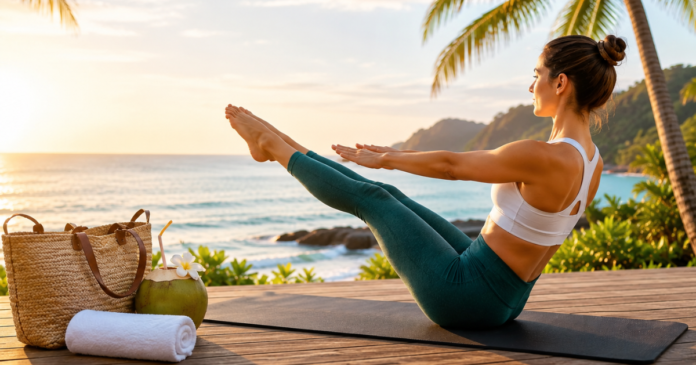

Staying fit on vacation does not mean turning your trip into a pilates training camp. It means keeping your body moving in simple, consistent ways, so you return home feeling energized, not like you need a week to recover from your recovery.
Tropical vacations are genuinely restorative. The slower pace, the warm air, the shift away from your usual routine, all of that is good for you. The challenge is that the same qualities that make tropical destinations so relaxing are also the ones that quietly pull you away from the habits you’ve worked hard to build.
You do not need to fight that pull. You just need to understand it and have a flexible plan that works with your vacation, not against it.
Why Tropical Vacations Can Disrupt Your Fitness Routine
Before exploring what to do, it helps to understand why fitness routines break down in the first place. This is not about willpower or motivation; it is about structure, environment, and biology.
Changes in Your Daily Schedule
At home, your routine is largely automatic. You wake up at the same time, move through familiar rhythms, and exercise fits somewhere predictable in your day. On vacation, that structure disappears almost immediately.
Travel days stretch long. Excursions eat into mornings. You stay up later, sleep in longer, and every day looks different from the last. Without a fixed anchor in your schedule, even the most committed exercisers find it easy to keep putting off movement until the day is already over.
Hot Weather Can Affect Energy Levels
Tropical heat and humidity are not just uncomfortable; they are physiologically taxing. Your body works significantly harder to regulate its core temperature in hot, humid conditions. That means you fatigue faster, sweat more, and often feel less motivated to move than you would at home.
This is not a sign of weakness. It is your body doing exactly what it should. Understanding this helps you adjust your expectations rather than push through inappropriately and end up exhausted or dehydrated.
Vacation Food and Lifestyle Changes
Eating out every meal, indulging in local food and drink, staying up late, skipping breakfast because the day started differently, all of these shift your energy availability in ways that ripple into how you feel during movement.
None of this is a problem. It is a vacation. But it does mean that workouts that felt easy at home might feel harder here, and that is worth accounting for rather than ignoring.
Limited Access to Fitness Equipment
Most tropical destinations are not built around access to gyms. You might have a small hotel gym with one wobbly cable machine, or nothing at all. If your routine depends on barbells, machines, or a specific class format, that gap can feel demotivating rather than like an opportunity to try something different.
Pilates Is a Travel-Friendly Way to Stay Fit
If there is one form of movement that adapts most naturally to travel, it is Pilates. It requires minimal space, no equipment for mat-based practice, and delivers real results in short sessions, which makes it ideal for vacation schedules.
Pilates Requires Minimal Equipment
Mat Pilates is entirely bodyweight-based. You need a flat surface and enough room to extend your body; that is it. A hotel room floor, a balcony, a patch of grass, or a quiet spot on the beach all work perfectly. There is no equipment to pack, no gym to find, and no excuse not to practice.
Pilates Supports Strength and Mobility
Pilates trains the deep stabilizing muscles of the core, hips, and spine while simultaneously improving flexibility and joint mobility. This combination is particularly valuable during travel, when your body spends long hours in unusual positions, cramped in a plane seat, sitting in a car, or sleeping on a different mattress.
A short Pilates session after a travel day can undo a surprising amount of physical tension. It wakes up the muscles that went quiet during transit and restores the sense of length and ease in your body.
Pilates Helps Counter Travel Fatigue
One of the quieter benefits of Pilates during travel is its effect on your nervous system. It is not just about the muscles. The focused, controlled nature of the practice has a calming effect that helps manage the overstimulation that comes with being in a new place, navigating unfamiliar situations, and sleeping less deeply than usual.
A 20-minute morning Pilates session can genuinely set a different tone for the rest of your day.
Short Pilates Sessions Fit Into Vacation Schedules
You do not need an hour to do meaningful Pilates work. A 15 to 20-minute session targeting the core, hips, and spine is enough to maintain strength and mobility across a two-week trip. This is short enough to fit before breakfast, between activities, or at the end of the day without taking time away from anything you actually came to do.
Simple Vacation Workout Routine (No Gym Needed)
If you want a concrete framework to follow, here is a simple structure that works well in tropical destinations.
- A 15–20 Minute Workout Is Enough: A complete short session might look like this: five minutes of gentle movement to warm up your joints (hip circles, shoulder rolls, gentle twists), eight to ten minutes of bodyweight or Pilates exercises (squats, lunges, glute bridges, push-ups, core work), and three to five minutes of stretching and deep breathing to finish.
- Bodyweight Exercises That Travel Well: A handful of exercises cover all the major movement patterns without any equipment at all. Squats and lunges build lower-body strength. Push-up variations work the chest, shoulders, and arms. Glute bridges and single-leg exercises train hip stability. Plank holds and their variations build the core. Add some mobility work; cat-cow, hip flexor stretches, thoracic rotation, and you have a complete routine.
- Morning Workouts Help You Stay Consistent: The single most reliable strategy for maintaining fitness on vacation is to do your movement first thing in the morning, before the day makes other plans for you. Excursions, late breakfasts, and afternoon swims, everything is more likely to get in the way later in the day.
It does not need to be long. Twenty minutes before you shower is enough. The consistency matters more than the duration.
How Pilates Compass Supports Your Travel Wellness Routine
Pilates Compass supports a more mindful and flexible approach to movement, especially when you are traveling or living in a tropical environment where routines naturally shift.
Rather than focusing on rigid workout schedules, the platform is built around the idea that staying connected to your body through consistent, intentional movement is more valuable than chasing performance. This makes it easier to maintain your fitness routine on vacation without the pressure or rigidity that often leads people to give up entirely.
Through guided classes, structured programming, and a supportive global community, Pilates Compass helps you stay active in a way that genuinely fits your travel lifestyle, whether you are practicing in a hotel room, on a beach, or during a quiet hour before the day begins. The focus stays on balance, awareness, and sustainability.
The platform also helps you understand how to adapt your movement based on your environment. Travel does not have to interrupt your progress. With the right approach, it becomes part of your wellness routine rather than a disruption to it.
Final Thoughts
The most important thing to take from this is also the simplest: consistency matters far more than intensity. You do not need perfect workouts. You do not need to replicate your home fitness routine in a foreign country. You do not need to feel guilty about rest days, indulgent meals, or the fact that your week looked different than usual.
What you need is a general commitment to keeping your body moving in ways that feel good, some walking, some stretching, a few short sessions of meaningful effort, and a willingness to adapt that commitment to whatever environment you are in.
Tropical vacations are good for you. The warmth, the slower pace, the time in nature and water, the rest, these things support your health in ways that no workout can fully replace. Let yourself enjoy them. Keep moving alongside them. That is the entire formula.