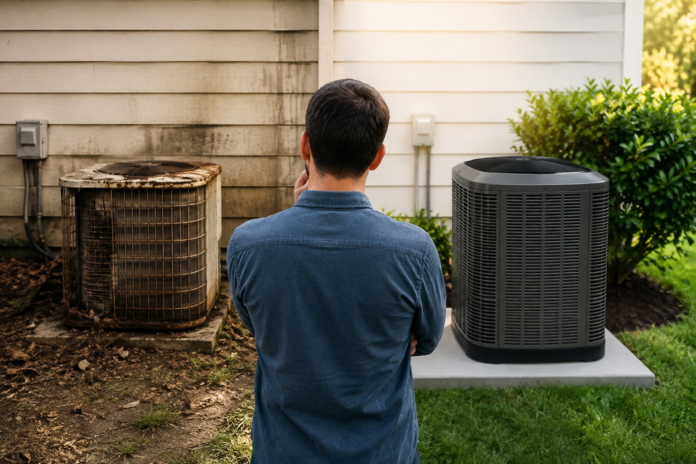

Your HVAC unit breaks down in the middle of July. The technician quotes you $1,400 for a compressor. That stings, but so does buying a whole new system. This is the decision that trips up homeowners every summer, and most people make it based on gut feeling rather than any real criteria.
That’s a mistake you can avoid. There’s a logical way to read the signals your system is sending, weigh them against your real costs, and land on a choice you won’t regret twelve months later. Here’s how to do it.
The Age Rule (It’s More Nuanced Than You Think)
Age is the single most useful data point you have. Central air conditioners typically carry a service life of 10 to 12 years, while furnaces can last 15 to 20 years, but those numbers assume consistent maintenance, which most homeowners don’t do.
If your system is past that window, every repair you make is essentially funding a unit that’s already serving overtime. Parts are harder to source, refrigerant compatibility becomes an issue if your system still runs on R-22 (phased out in 2020), and the efficiency gap between your aging unit and a current model grows wider every year.
The honest answer is this: age alone shouldn’t trigger a replacement, but it should change how you weigh every other factor on this list. A 7-year-old unit that needs a $600 fix is usually worth repairing. The same fix on a 16-year-old system rarely is.
What ENERGY STAR Says You Should Actually Watch For
The symptoms of an HVAC system in decline are predictable. Rooms that used to cool evenly start developing hot or cold spots. You notice your system cycling on more frequently than it once did. Your utility bill creeps up even though your usage habits haven’t changed.
Unusual noises, particularly grinding, banging, or a persistent hum that wasn’t there before, are worth taking seriously. Those sounds usually point to mechanical wear in components like the blower motor or the compressor, and fixing one failing part doesn’t stop the cascade. It just buys you time until the next part goes.
Humidity control is another underappreciated signal. A properly functioning central system should keep your indoor humidity in a comfortable range. When it stops doing that, when your home feels swampy in summer even with the AC running, the system is no longer doing its full job.
ENERGY STAR’s replacement guidance recommends evaluating any heat pump or air conditioner that’s more than 10 years old, noting that correctly installed high-efficiency replacement units can save up to 20 percent on heating and cooling costs.
The Repair-or-Replace Decision Matrix
Here’s a framework I use to cut through the noise. Score your situation against five criteria, then read across the table. If you land in the “Replace” column on three or more rows, the math favors a new system.
| Criteria | Repair Makes Sense | Replace Makes Sense |
| System age | Under 10 years | Over 12 years (AC) / Over 18 years (furnace) |
| Repair cost vs. replacement | Repair is under 30% of new system cost | Repair is 50% or more of new system cost |
| Repair frequency | First or second repair in system’s life | Third or more repair in the last 3 years |
| Energy bill trend | Stable or consistent with prior years | Rising 15% or more without usage changes |
| Refrigerant type | Uses R-410A or newer | Still running on R-22 (phased out) |
This matrix won’t make the call for you, but it puts the decision on a factual footing. If your repair quote runs to 50% of what a new installation would cost, and your unit is already past its expected lifespan, you’re essentially paying to delay the inevitable.
The Real Cost of Staying With an Old System
Here’s the part homeowners routinely underestimate: an aging system doesn’t just break down; it gets more expensive to run every single month before it breaks down. Heating and cooling account for the largest annual uses of electricity in U.S. homes, according to the U.S. Energy Information Administration’s Residential Energy Consumption Survey data, which consistently identifies air conditioning as the top electricity end use in residences.
An aging unit working at degraded efficiency doesn’t produce less cooling. It produces the same cooling for more energy. That difference shows up in your utility bill month after month, year after year, long before any component actually fails.
“The age and condition of your heating or cooling equipment may have caused it to become less efficient. Your heating and cooling equipment is more than 10 years old or needs frequent repairs, and your energy bills are going up.”- ENERGY STAR, U.S. Environmental Protection Agency, 2024 home energy guidance
The efficiency gap between an older system and a current one is real. A unit installed 15 years ago may carry a SEER rating of 8 or 9. Today’s systems start at SEER 14 and go well above 20. That gap doesn’t just represent potential savings; it represents money leaving your account every month you postpone the conversation.
A Scenario Worth Playing Out
Picture a homeowner in Collierville, Tennessee, dealing with a 14-year-old split system that’s been making a rattling noise for two summers. A technician finds a failing contactor and a refrigerant leak. Combined repair cost: $890. The system uses R-22 refrigerant, which is no longer manufactured domestically and must be sourced as reclaimed stock, making future top-offs expensive and uncertain.
Should they pay the $890? On paper, it’s less than a new system. But the R-22 issue alone changes the calculus — any future refrigerant leak becomes a crisis rather than a routine fix. Add in the age, the efficiency gap, and the pattern of recurring issues, and the decision to pursue HVAC replacement Collierville makes more financial sense than propping up a system that’s past its useful life.
That kind of scenario plays out across the South every summer, when systems hit their limits right when homeowners need them most. Planning the conversation in the spring, before a system fails mid-July, gives you time to get quotes and make a considered choice rather than an emergency one.
What to Do Right Now
You don’t need to wait for a breakdown to start gathering information. Here’s where to begin:
- Find the manufacture date on your system’s data plate, usually on the side of your outdoor condenser or your furnace cabinet. If you can’t find it, search the model number online.
- Pull up your last 12 months of utility bills and compare them to the same period two years ago. If costs have climbed without a usage change, that’s your system losing efficiency.
- Document every repair from the past three years and what it cost. Total that number and compare it against what a new system would run in your area.
- Check your refrigerant type. R-22 on anything older than 10 years is a reason to accelerate your timeline.
- Get a diagnostic inspection from a certified technician, not just a repair quote. Ask specifically whether the system is undersized or oversized for your current square footage, since either condition forces the unit to work harder than it should.
The best time to plan for an HVAC replacement is when your system is still running. You’ll negotiate from a position of patience rather than desperation; you’ll have time to explore financing options, and you won’t be sleeping in the heat while you wait for an installation slot to open up. Make the call before the call makes itself.
Also Read: Repair or Replace Your HVAC System: How to Make the Right Call