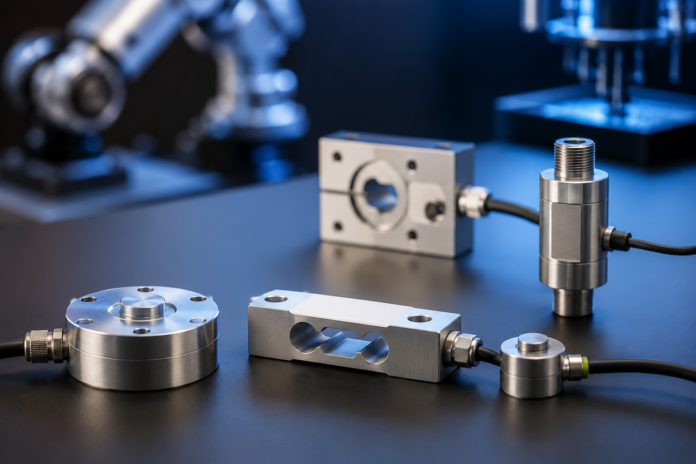

Choosing the right strain gauge load cell manufacturer comes down to precision, application compatibility, and environmental durability. Look for manufacturers that offer custom solutions, proven performance in demanding industries, and sensor technologies—like FBG—that go beyond conventional limits.
Force measurement is everywhere. It keeps robotic arms from crushing delicate components. It monitors pressure in aerospace systems. It ensures semiconductor manufacturing lines run without interruption. Behind every accurate force measurement is a load cell—and behind every reliable load cell is a manufacturer that understands the physics, the environment, and the stakes.
But not all manufacturers are built the same. Some produce off-the-shelf sensors that work fine in standard conditions. Others engineer precision instruments capable of surviving radiation, submersion, extreme heat, and electromagnetic interference. The difference matters enormously when your application sits at the intersection of performance and safety.
This guide walks through what strain gauge load cells actually do, what separates a capable manufacturer from an average one, and what cutting-edge force sensing technology looks like today.
What Is a Strain Gauge Load Cell and How Does It Work?
A strain gauge load cell converts mechanical force—compression, tension, or shear—into an electrical signal that can be measured and recorded. At its core, the load cell contains one or more strain gauges: thin, conductive elements bonded to a flexible structure. When force is applied, the structure deforms slightly. The strain gauges detect that deformation and produce a corresponding change in electrical resistance.
That resistance change is proportional to the applied force, which makes strain gauge load cells highly accurate across a wide range of applications. They are compact, cost-effective, and well-suited to industrial environments where continuous monitoring is required.
Where Are Strain Gauge Load Cells Used?
Strain gauge load cells appear across an impressive range of industries:
- Robotics and automation — for gripping force control and delicate component handling
- Aerospace — for structural testing and flight-critical monitoring
- Semiconductor manufacturing — for precision process control in cleanroom environments
- Medical devices — for surgical robotics and implant testing
- Industrial machinery — for load monitoring, safety systems, and process feedback
Each application comes with its own set of environmental and performance requirements. That’s why selecting the right strain gauge load cell manufacturer is as important as selecting the sensor itself.
What Separates a Quality Strain Gauge Load Cell Manufacturer from the Rest?
The market has no shortage of sensor suppliers. What distinguishes serious manufacturers is their ability to engineer sensors that perform reliably at the edges—in conditions where generic sensors degrade, drift, or fail entirely.
Here are the key criteria to evaluate:
Precision and Measurement Accuracy
Accuracy is non-negotiable in high-stakes applications. A quality manufacturer will specify sensitivity, linearity, hysteresis, and repeatability clearly. Look for manufacturers that validate their sensors under real-world load conditions, not just controlled lab settings.
Customization Capability
Every application has unique dimensional, performance, and interface requirements. A manufacturer that offers only standard catalog products will eventually become a limitation. The best manufacturers can tailor sensor geometry, materials, output signals, and environmental sealing to meet exact project specifications—without adding months to the development timeline.
Environmental Durability
Standard strain gauge load cells struggle in extreme environments. High temperatures cause thermal drift. Electromagnetic interference corrupts signal quality. Radiation exposure degrades sensor materials. Moisture ingress causes failure over time.
Manufacturers that have solved these problems—through advanced materials, optical sensing technology, or ruggedized enclosures—offer a fundamentally different product category.
Industry Experience and Application Knowledge
A manufacturer with deep experience across robotics, aerospace, and medical applications brings more than hardware. They bring application insight. They know how sensors behave under dynamic loading, how cable routing affects signal integrity, and how to design for long-term stability in demanding field conditions.
FBG Sensors: What Makes Fiber Bragg Grating Technology Different?
Fiber Bragg Grating (FBG) technology represents a significant leap beyond conventional strain gauge load cells. Instead of measuring electrical resistance changes, FBG sensors use light passing through an optical fiber. A grating embedded in the fiber reflects a specific wavelength of light, and changes in force, temperature, or pressure shift that wavelength in a measurable way.
The practical benefits are substantial:
- EMI immunity — optical signals are completely unaffected by electromagnetic interference, making FBG sensors ideal for semiconductor fab environments and surgical rooms
- RF resistance — RF-intense environments, including surgical suites and research facilities, no longer disrupt measurement accuracy
- High-temperature performance — dual FBG sensors can operate above 200°C, providing real-time temperature compensation that eliminates the thermal drift common in conventional load cells
- Radiation immunity — nuclear power plants, military environments, and aerospace systems generate radiation levels that would degrade traditional sensors; FBG technology remains stable
- Submersion capability — FBG force sensors can handle deep liquid submersion over extended periods without performance degradation
- Overvoltage safety — unexpected electrical surges that would damage standard sensors pose no risk to FBG-based systems
For mission-critical applications where sensor failure is simply not an option, FBG technology offers a reliability margin that conventional strain gauge load cells cannot match.
LILIKOI Innovation: A Modern Strain Gauge Load Cell Manufacturer
LILIKOI innovation LLC is a California-based engineering company founded in 2023, specializing in advanced force sensing technologies for high-performance and mission-critical applications. As a strain gauge load cell manufacturer, LILIKOI designs and manufactures precision force, torque, pressure, and temperature sensors built for demanding environments where reliability and accuracy are essential.
LILIKOI’s product range spans several distinct categories, each engineered for specific performance requirements.
Smart Bracket Sensors
The Smart Bracket series are strain gauge force sensors designed as drop-in replacement solutions for T-slotted extrusion systems. They allow engineers to add real-time force feedback to existing machine frames without significant redesign. Smart Bracket sensors support process control, machine learning integration, artificial intelligence applications, and safety capabilities for automation equipment—making them a practical upgrade path for modern industrial machinery.
Robotic Tactile Sensors
LILIKOI’s robotic tactile sensors are designed for integration into robotic gripper fingers and actuators. Available in both strain gauge and FBG load cell configurations, these sensors enable precise gripping force control for delicate component handling. They perform reliably in harsh environments and mission-critical applications where conventional sensors would compromise performance.
Femto Inline Load Cells
The Femto series represents some of the smallest, most capable inline force sensors available. Engineered specifically for semiconductor, aerospace, and medical applications, these sensors offer resistance to high temperatures, submersion, overvoltage, and electromagnetic interference. Their compact form factor allows integration into tight spaces without sacrificing measurement accuracy.
FBG Force, Torque, and Pressure Sensors
LILIKOI’s FBG sensor lineup covers force, torque, and pressure measurement for environments where conventional sensing fails. Applications include nuclear monitoring, aerospace structural testing, surgical robotics, and EV battery pack management and testing. Each FBG sensor is built around optical fiber technology that eliminates the vulnerabilities of electrical-based sensing.
Custom Solutions
Recognizing that every transducer application is unique, LILIKOI offers rapid custom sensor development across force, torque, pressure, and temperature measurement. Their engineering team works with clients across medical, aerospace, and industrial automation sectors to design sensors tailored to specific performance requirements, environmental conditions, and integration constraints.
How to Evaluate Sensor Specifications Before You Buy
Before committing to a sensor or a supplier, work through these practical checkpoints:
Define your load range. Know the minimum and maximum forces your application will encounter. Choose a load cell rated appropriately—oversizing or undersizing both compromise accuracy.
Identify your environmental conditions. Will the sensor encounter moisture, heat, radiation, or electrical noise? Standard strain gauge load cells have clear limits in these conditions. FBG sensors expand those limits significantly.
Clarify your output requirements. Different control systems expect different signal types. Confirm compatibility between the sensor output and your data acquisition or control hardware.
Consider long-term stability. Sensors that drift over time increase maintenance costs and reduce process reliability. Ask manufacturers about long-term repeatability data.
Assess integration complexity. A sensor that’s difficult to mount or calibrate adds engineering hours to every project. Smart Bracket-style sensors that replace existing structural components reduce integration effort substantially.
The Future of Force Sensing in Precision Industries
Force sensing technology is advancing rapidly alongside robotics, autonomous systems, and smart manufacturing. As automation increases in complexity—from surgical robots performing minimally invasive procedures to EV battery manufacturing requiring precise compression monitoring—the demand for accurate, durable, and miniaturized force sensors will only grow.
The convergence of FBG optical technology with traditional strain gauge design is producing sensors that cover both standard and extreme applications. Manufacturers that invest in both technology tracks are better positioned to serve customers across industries rather than locking them into a single product approach.
Working with an experienced strain gauge load cell manufacturer that also develops FBG and tactile sensing solutions means your sensor supply chain can evolve alongside your applications—without switching vendors as requirements change.
Making the Right Choice for Your Application
Selecting a force sensor is a technical decision, but it’s also a long-term partnership. The right strain gauge load cell manufacturer doesn’t just ship hardware—they bring application knowledge, customization capability, and a technology roadmap that supports your engineering goals over time.
Whether your application requires a compact inline sensor for semiconductor processing, a tactile force sensor for robotic gripping, or a radiation-immune FBG system for aerospace or nuclear environments, the starting point is always the same: find a manufacturer that understands your environment, not just your load range.
Explore LILIKOI innovation’s full range of force sensors, load cells, and FBG automation sensors at lilikoi.com to see how precision sensing can be tailored to your exact application requirements.
Frequently Asked Questions
What industries use strain gauge load cells most commonly?
Strain gauge load cells are widely used in robotics, aerospace, semiconductor manufacturing, medical devices, and industrial automation. Any application requiring accurate, real-time force measurement is a potential fit.
What is the difference between a strain gauge load cell and an FBG sensor?
A strain gauge load cell measures force by detecting changes in electrical resistance as a structure deforms. An FBG (Fiber Bragg Grating) sensor measures force optically, using shifts in reflected light wavelength. FBG sensors are immune to EMI, RF interference, radiation, and extreme temperatures—making them suitable for environments where electrical sensors fail.
Can load cells be customized for unusual applications?
Yes. Manufacturers like LILIKOI innovation offer custom sensor development for applications requiring non-standard geometries, materials, or environmental ratings. Custom solutions are common in medical, aerospace, and nuclear applications.
How do I know if I need an FBG sensor instead of a standard strain gauge load cell?
If your application involves high temperatures above 200°C, electromagnetic interference, radiation exposure, liquid submersion, or risk of electrical overvoltage, FBG sensors offer clear performance advantages over conventional strain gauge load cells.
What is a Smart Bracket sensor?
A Smart Bracket sensor is a strain gauge force transducer designed to replace standard structural brackets in T-slotted extrusion systems. It adds real-time force measurement capability to existing machine frames, enabling process control, safety monitoring, and AI integration without significant mechanical redesign.
How small can inline load cells be?
Miniaturized inline load cells, such as LILIKOI’s Femto series, are engineered for tight integration in semiconductor, aerospace, and medical devices. Their compact form factor does not compromise performance, with full resistance to EMI, overvoltage, submersion, and high temperatures.