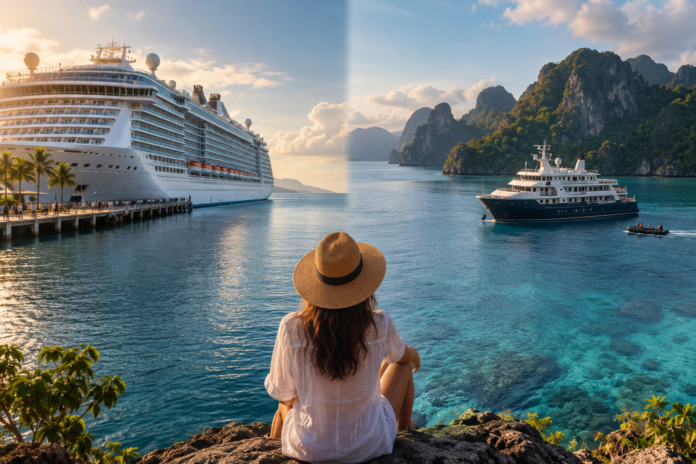

Roughly 30 million people take an ocean cruise every year, and almost all of them board vessels that carry more than 1,000 passengers. Only a sliver of that crowd ever steps onto a ship that holds fewer than 100. The gap between those two experiences is not a matter of luxury versus budget. It is a completely different way of moving through the world, and most travelers pick wrong because they never ask the one question that actually matters.
The real difference is your relationship with the destination. On a big ship, the destination is the ship. On a small one, the destination is the sea itself. So here is the promise: by the end of this guide, you will know which camp you belong in, without a single brochure influencing your judgment. We will walk through passenger counts, itinerary logic, shore time, and the quiet math of cost that nobody prints on the booking page.
What Actually Happens on Each Size of Ship
Let’s be blunt about the daily reality, because the marketing photos blur everything.
On a large vessel, your day is scheduled around the ship’s needs. Dining windows, showtimes, pool deck reservations, and tender queues all operate on a rhythm set by thousands of people moving at once. You wake up, you eat, you go ashore for a few hours with a crowd, you return, and the ship sails overnight to the next port. It is efficient, comfortable, and genuinely fun if you love variety and entertainment.
On a small expedition vessel, the day bends around the destination. The captain might spot a pod of dolphins at 6 a.m. and alter course. A local guide might flag an unexpected village festival, and suddenly the afternoon itinerary changes. You are not herded. You are led, and that difference changes how you remember the trip.
Neither version is wrong. They are simply built for different travelers, and the mistake happens when you book based on price alone without understanding what you are actually buying.
The Four Question Filter
I have developed a simple framework over years of watching travelers describe their trips. I call it the Four Question Filter, and it takes about ten minutes to complete honestly. Answer each one before you look at any cruise line website.
Question one: What is your primary souvenir? If you want photos of yourself on a spectacular ship with endless food options, big works. If you want memories of swimming in water so clear you can count the coral heads from the surface, small works.
Question two: How do you feel about people? Not people in general, but people in large groups. If a busy mall drains you, a ship with 4,000 passengers will exhaust you by day three. If crowds energize you, a quiet vessel with 30 passengers might feel too slow.
Question three: What is your patience level with logistics? Big ships require airports, transfers, and disembarkation processes that resemble airport security. Small ships often operate from smaller ports, which means less waiting and more actual exploring.
Question four: What does “remote” mean to you? For most large cruise itineraries, remote means a port that requires a slightly longer bus ride. For expedition cruising, remote means places where the only way in is by water. According to baseline data from the National Oceanic and Atmospheric Administration, some of the most biodiverse marine habitats on Earth sit in archipelagic regions that large commercial vessels simply cannot navigate.
That last question matters more than any other, because it determines whether you ever see the places that made you dream about island travel in the first place.
The Shore Time Reality Check
Here is a number that will change how you read itineraries: the average big ship passenger spends roughly six to eight hours ashore per port day. That sounds like plenty, until you subtract the time spent walking from the gangway to the town, waiting for group members, and returning early to beat the all aboard call.
Compare that to a small ship experience in a place like Raja Ampat or the Komodo region. The vessel can anchor close to reefs, drop zodiacs within minutes of a snorkel site, and offer two or three distinct activities in a single morning. You are not touring a destination. You are living inside it for the whole day.
And here is the part nobody frames honestly: the biodiversity you are traveling to see lives in shallow, complex waters. A trip through the Coral Triangle, which holds more than 75 percent of the world’s known coral species, is not a trip you can do justice to from a port city. According to the Food and Agriculture Organization of the United Nations, this region contains the highest marine biodiversity on the planet, and most of it is only accessible by smaller research and expedition vessels.
When you look at an itinerary, do not count the number of ports. Count the number of hours you will actually spend in the water or on a trail. That is the number that predicts your satisfaction.
The Myth of the Cheaper Fare
Let’s talk money, because the sticker shock stops a lot of people cold.
A big ship fare covers your cabin, meals, and basic entertainment. Then you pay for specialty dining, excursions, drinks, Wi-Fi, gratuities, and the shore tours that actually get you to the interesting spots. By the time you add a worthwhile excursion package, the advertised per day price can jump by 50 percent or more.
An expedition cruise fare typically includes far more in the base price: guided excursions, equipment like kayaks and snorkel gear, most meals, and often beverages. The comparisons people make are almost always unfair because they compare the big ship base fare to the small ship all inclusive fare without adding the big ship extras back in.
If you are the type who books every excursion and never skips the add ons, the gap between big and small shrinks dramatically. If you are happy eating at the buffet and never leaving the pool deck, the big ship wins on value every time. Both answers are legitimate. The key is being honest about which one you are before you run the numbers.
Dockside Math: A Simple Test You Can Run Tonight
Here is a practical exercise I recommend to anyone torn between the two styles. I call it Dockside Math, and you can do it in under an hour with nothing but a notebook and a search engine.
Pick a specific region you want to visit. Write down the names of three islands or marine areas you genuinely dream about seeing. Then research two things: whether large commercial cruise ships stop there at all, and if they do, what the actual excursion time looks like versus the sailing time.
Most people discover that their dream list skews toward places big ships skip entirely. The UNESCO listing process exists precisely because certain sites hold exceptional natural value, and the United Nations Educational, Scientific and Cultural Organization documents these areas worldwide, from Komodo National Park to the greater Coral Triangle region. Many of these protected sites have restrictions on vessel size, passenger numbers, or both.
Run the test honestly. If your list comes back empty because every place you wanted to see is off limits to large vessels, you have your answer without reading another review site.
When a Small Ship Makes Sense
You should seriously consider a small expedition vessel if any of these apply: you want to spend more time in the water than on deck, you value local expertise over Broadway style shows, you hate standing in lines, or you are drawn to destinations defined by nature rather than by ports.
A route through eastern Indonesia, for example, is a geography lesson in scale. The country spans more than 3,000 miles of ocean, and its marine habitats are the draw, not its harbors. For that kind of voyage, a smaller vessel is not a compromise. It is the only practical tool for the job. If this sounds like your style, an indonesia small ship cruise offers a way to see the region’s reefs and islands without spending your days in transit between mega ports.
When a Big Ship Wins
Stay with the large vessel if your priority is entertainment, dining variety, and the energy of a floating resort. Big ships are also the better choice for multigenerational groups where some members want constant activity, and others want a quiet pool. The logistics of feeding and entertaining a large family get much easier when the ship handles it all.
There is also a legitimate argument for big ships on your first cruise ever. The familiar comforts and predictable schedule make it an easier introduction to life at sea. You can always graduate to a smaller vessel later, once you know which aspects of cruising you actually love.
Do not let anyone shame you for that choice. A vacation is not a flex. It is a reset.
So ask yourself the four questions tonight, run the Dockside Math, and book the version that matches how you actually want to feel at the end of each day. The right answer is the one you will still be describing to strangers years from now.
Also Read: Adventure Awaits: Boat Trip from Lombok to Komodo Islands