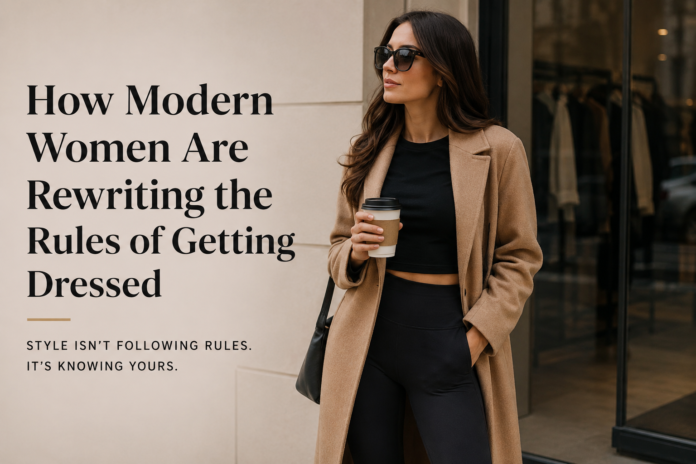

Something shifted in how women approach clothing over the last several years — and it isn’t reversing.
The old frameworks about what was appropriate where, what constituted real effort, and what “dressed up” even meant have been almost entirely renegotiated. What replaced them is more interesting: a genuine plurality of approaches, and a growing understanding that personal style is fundamentally about intention rather than compliance with a code.
Getting dressed well today is less about following rules and more about knowing yourself clearly enough that the rules become irrelevant.
The Collapse of the Casual-Formal Binary
For most of the twentieth century, dressing operated within a fairly legible structure. Workwear looked different from weekend wear, which looked different from evening wear. The categories were distinct, the signals were clear, and deviation from them read as error rather than choice.
That structure has largely dissolved. Not because standards have dropped — because they’ve become more personal. The woman who shows up to a dinner in well-fitted performance pieces and the one who shows up in tailored separates are both making valid choices, and both can be entirely right for the occasion.
What matters now is coherence: does the outfit reflect something true about the person wearing it, or does it look like an approximation of what someone thought they were supposed to wear? The first always reads better.
Why Activewear Became a Fashion Language
The clearest example of how the rules changed is activewear.
What was once strictly for the gym has become one of the dominant visual languages of contemporary women’s dressing. The reason isn’t a collapse of standards — it’s that the best activewear genuinely performs across contexts in a way older casual clothing never could. Fabrics that move with the body, hold their shape through a full day of varied activity, and look intentional rather than thrown-together have made the boundary between athletic and everyday dressing largely obsolete.
A well-cut pair of leggings and a structured top reads completely differently from sweats. The women who dress this way know the distinction and are making it deliberately. This isn’t dressing down — it’s dressing with a different set of priorities than previous generations operated under, and the results are often sharper than what they replaced.
Investment Pieces and the Case Against Accumulation
The other major shift worth naming is in how women think about building a wardrobe rather than simply accumulating one.
The fast fashion model — constant novelty, minimal cost, rapid turnover — has lost significant cultural ground to a more considered approach. Not because of any single factor, but because the long-term math eventually stops working. Clothes that don’t hold their shape, don’t fit well over time, and don’t reflect genuine personal taste end up costing more in aggregate than fewer, better pieces would have. Designer-influenced fashion that hits the intersection of real design attention and accessible pricing — like Gianni Bini — earns its place in a modern wardrobe precisely because it offers the fit, fabric quality, and detail that would cost significantly more at the luxury tier.
The modern wardrobe has room for a few well-chosen investment pieces and a number of more accessible versions of the same quality thinking. What it doesn’t have room for is things that were bought in a mood and never quite fit the life being lived.
Dressing for Your Actual Life
One of the most useful exercises any woman can do for her personal style is audit what she actually wears against what she owns.
Most wardrobes contain a significant percentage of items worn rarely or never — bought on sale, for an occasion that passed, or because they suited someone else’s life rather than the one actually being lived. The gap between what hangs in the closet and what gets worn every week is where style clarity lives. The pieces reached for repeatedly are the signal: they fit the body correctly, they work with things already owned, and they suit the actual rhythm of the week.
Building toward more of those and fewer of the others is the practical work of developing a genuine personal style rather than just having a lot of clothes.
Color, Pattern, and Understanding What Works
Style has rules — but they belong to the person applying them, not to a seasonal authority somewhere deciding what’s current.
Understanding which colors work with your skin tone, which silhouettes are genuinely flattering rather than theoretically so, and which patterns you return to intuitively is worth considerably more than following trends. Trends are inputs. Personal style is the filter those inputs pass through.
The women who look most consistently well-dressed aren’t always following what’s current. They’ve identified their own aesthetic language and apply it consistently, updating selectively when something new genuinely earns a place rather than adopting changes wholesale.
Fit as the Non-Negotiable Foundation
Regardless of what’s being worn, fit is the variable that determines whether an outfit works.
This is worth saying because it’s consistently underweighted. Expensive clothing that doesn’t fit correctly looks worse than inexpensive clothing that does. Tailoring even basic pieces makes a disproportionate difference. And fit is proportional to the individual — what’s perfect on one person is wrong on another, regardless of size labeling.
Understanding your own proportions, knowing which cuts work for your body rather than just which ones are fashionable, and being willing to have things altered are the practical skills that separate consistently well-dressed women from those who have a lot of clothes that don’t quite work.
The Confidence Variable
None of this lands without the one thing that can’t be purchased.
Confidence — the kind that comes from knowing the outfit was chosen deliberately rather than defaulted into — changes how clothing registers on a person. The same piece worn with certainty and worn with ambivalence are two different garments. One says something; the other asks a question.
The modern approach to dressing isn’t about rules or the breaking of them. It’s about understanding your own preferences clearly enough that getting dressed in the morning is an act of self-expression rather than a daily negotiation. That’s the standard that replaced the old codes — and it’s a better one than anything that came before it.