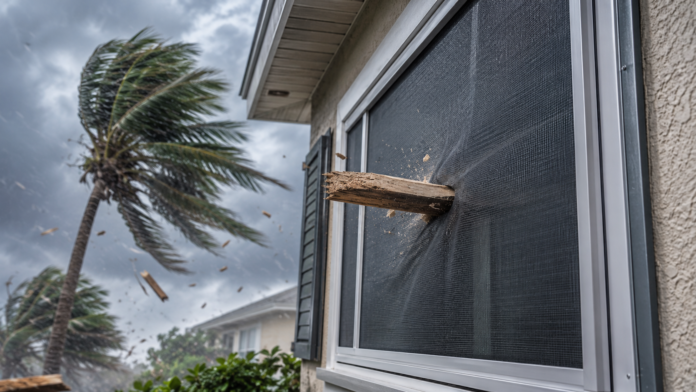

Heavy-duty hurricane screens protect homes by using advanced basket-weave materials to catch, absorb, and decelerate flying debris, rather than acting as a rigid wall. Preparing for a storm is physically exhausting, and finding a reliable alternative to hauling heavy metal shutters is a top priority for coastal residents. The stakes of storm preparation are incredibly high. In 2024 alone, the U.S. experienced 27 billion-dollar weather disasters resulting in $182.7 billion in damages. Homeowners need modern, engineered solutions that secure their property without adding to the physical strain of storm preparation.
The Exponential Danger of Wind-Borne Debris
Structural failure during a hurricane rarely starts with sheer wind force. The devastation usually begins when wind-borne debris breaks a single unprotected window. As wind speeds rise, the destructive potential of everyday objects multiplies, turning patio furniture and tree branches into lethal projectiles.
Understanding the physics of wind pressure highlights exactly why windows need heavy-duty protection. When wind speed doubles, the force it exerts on a building increases four times. At 100 miles per hour, the wind generates a massive 100 pounds of pressure per square foot. This extreme force instantly turns common yard debris, such as a loose 2×4 or a broken roof tile, into a high-speed weapon targeting your glass.
Standard glass cannot withstand this concentrated blunt force. Even some rigid barriers fail when struck by dense, fast-moving objects. The initial impact shatters the window, but the true danger is what happens to the house immediately after the glass breaks. High-velocity winds require a completely sealed home to flow over the roof harmlessly. Once debris compromises the barrier, the wind finds a way inside.
The Physics of the “Trampoline Effect”
The trampoline effect is a mechanical process where flexible materials catch, stretch, and safely decelerate a flying object. Instead of forcing a high-speed projectile to a sudden stop, an advanced basket-weave fabric absorbs the kinetic energy and dissipates it safely across the entire barrier.
A rigid wall forces an impacting object to shed all its energy in a fraction of a second. This sudden transfer of power creates a massive shockwave that often breaks the barrier itself. Flexible materials take a completely different approach. When an object hits a woven screen, the fabric yields slightly. This brief moment of flexibility extends the duration of the impact, significantly reducing the peak force applied to the material.
According to Raw Magazine, “Fabric screens operate on a ‘trampoline effect.’ When flying debris strikes the barrier, the woven material flexes, catching the object and decelerating it before it can shatter your windows.” The threads distribute the load outward toward the edges of the frame, sparing the center point from taking the full brunt of the blow.
Load Distribution and Building Envelope Protection
Engineered with a high-tenacity polypropylene and polyester basket-weave mesh, this hurricane screen system disperses kinetic energy laterally into extruded aluminum tracks and perimeter anchors rather than concentrating stress at a single strike point. Tested to meet strict Miami-Dade and Florida Building Code (FBC) High-Velocity Hurricane Zone (HVHZ) large-missile impact standards, the woven barrier deflects windborne debris while reducing wind load pressure by up to 95%. Because the fabric decelerates projectiles smoothly without fracturing, the glass behind the screen remains intact, and the home stays securely sealed against internal pressurization.
Rigid vs. Flexible Barriers: Why Traditional Shutters Fail Under Impact
Traditional rigid barriers often fail because surfaces like steel, aluminum, and wood suffer abrupt kinetic energy transfers when struck by high-speed debris. This immediate, localized blunt force causes metal to dent, plywood to shatter, and heavy anchors to pull completely out of the wall.
A common myth among homeowners is that a barrier must be heavy and solid to offer legitimate storm protection. People naturally assume that thick steel or heavy wood provides the ultimate defense. However, physics proves that rigid materials struggle to handle concentrated point loads. When a flying 2×4 hits a solid metal shutter, the energy has nowhere to go but directly into the metal plate and its mounting bolts.
These mechanical flaws compromise the safety of the house. The abrupt transfer of kinetic energy easily strips concrete anchors out of the surrounding stucco. If the anchors fail, the entire metal panel can tear away in the wind, leaving the window completely exposed to the elements. Wood panels face similar issues, often splitting or splintering upon impact.
Flexible barriers solve this problem through energy distribution. High-strength woven fabrics dissipate the force across the material and into a reinforced aluminum framing system. Because the barrier absorbs the shock rather than fighting it rigidly, the anchors experience far less stress. The mounting hardware stays secure in the wall, and the building envelope remains fully intact.
Why Preventing a Window Breach Saves Your Roof
Keeping your building envelope sealed is the most critical element of hurricane survival. A broken window allows storm winds to rush into the house, causing rapid interior pressurization that acts like a popping balloon and triggers catastrophic roof lift-off.
The building envelope is the physical barrier that separates the interior of your home from the outside environment. During a severe storm, wind flows over and around a sealed building envelope smoothly. If a piece of debris shatters a window, the envelope breaks. High-pressure air immediately floods into the living room, searching for a way out.
This chain reaction is devastating. The wind pushes outward on the interior walls and violently upward against the ceiling. At the same time, the wind passing over the top of the house creates an upward suction effect. A 2019 Congressional Budget Office report estimated that hurricane-related wind damage causes $14 billion in losses to the residential sector annually. A large portion of these structural failures begins with a single broken window.
Flexible screens stop this process before it starts. The tightly woven material deflects 95 percent of wind and rain while allowing a safe, controlled amount of airflow to pass through. This minimal airflow equalizes the pressure on both sides of the screen, completely neutralizing the pressurization threat and keeping the roof firmly attached to the house.
The Proof: Burst Strength and High-Velocity Certifications
Legitimate storm screens require certified burst strength and high Design Pressure ratings to legally and safely protect a home. Homeowners must look for rigorous high-velocity testing and official product approvals to ensure their flexible barrier will actually stop flying debris.
Engineered storm screens are not standard bug mesh or patio shade cloth. They are industrial-grade protection systems. Manufacturers prove their strength through a Design Pressure rating. A Design Pressure rating is a metric that measures the structural wind load a window or barrier can withstand before failing. High-quality screens feature ratings of +90/-90 or greater, meaning they can survive immense pushing and pulling forces.
Achieving these ratings requires specialized construction elements. Certified screens utilize four-sided reinforced seams that are heavily stitched every 16 inches. They also rely on reinforced aluminum bar systems to hold the fabric tight and secure it to the home. These components ensure the screen does not rip or pull away from its frame under extreme stress.
Government building codes dictate strict testing requirements for these products. The Florida Building Code requires that homes in High Velocity Hurricane Zones use protection tested via large missile impact tests. In these tests, a cannon fires a nine-pound piece of lumber at the screen at 34 miles per hour. Homeowners should always check for an official Florida Product Approval number, such as #FL11379-R5, before purchasing a system.
Practical Benefits: Translucency and Rapid Deployment
Flexible screens eliminate the physical strain of hauling heavy panels and the misery of sitting in a pitch-black house. These lightweight systems offer translucent visibility and a rapid deployment process that prepares your home for a storm in minutes.
Traditional plywood and metal shutters create a dark cave effect inside the home. Once the panels are bolted to the walls, the house is plunged into total darkness. When the neighborhood loses power, families are left sitting in the dark for days, unable to see outside to assess the damage or check for floodwaters. Translucent fabric screens solve this problem by preserving natural light and allowing outward visibility.
These flexible systems also offer tremendous physical relief. Homeowners no longer have to endure the physical strain of carrying sharp, heavy metal panels out of the garage and wrestling them up a ladder. Lightweight screens remove the risk of injury and eliminate the delayed installation that often leaves homes vulnerable to fast-moving storms.
Modern screen systems utilize a simple, three-step deployment process. The homeowner simply unrolls the fabric from a permanently integrated storage pouch, attaches it to the anchors, and pulls the heavy-duty straps to tighten the barrier. One person can easily secure the entire house quickly, leaving plenty of time to focus on other essential preparations.
Conclusion
Flexible, heavy-duty hurricane screens offer superior defense against flying debris by absorbing kinetic energy rather than fighting it with rigid force. The trampoline effect safely decelerates high-speed projectiles, protecting your glass from shattering and keeping your family safe from dangerous wind pressure.
Maintaining a sealed building envelope is the ultimate key to saving your home’s roof and overall structure. By relying on certified burst strength and rigorously tested materials, homeowners can confidently prevent the rapid interior pressurization that causes catastrophic damage.
Take the physical strain and darkness out of your severe weather preparation. Review certified Category 5 screen options today to upgrade your home defense before the next storm season arrives.