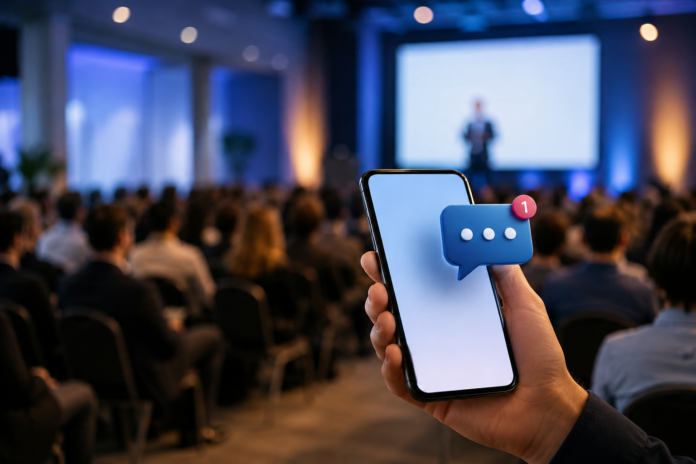

You spent three months planning an event. The registration list looks great. Then the day arrives, and half the seats are empty. That’s not a hypothetical disaster. Free events experience 40 to 60% no-show rates across multiple industry studies, validating the roughly 50% show rate that organizers commonly report. Fifty cents of every registration dollar you earned in attention goes to waste before a single slide loads. The fix isn’t a fancier registration page or a more aggressive social calendar. It’s a communication channel that people actually read. This article walks through a practical three-phase SMS playbook you can run before, during, and after your next event to turn registered names into actual bodies in the room.
The No-Show Problem Is Bigger Than You Think
Most organizers treat no-shows as an unfortunate fact of life. They overbook, cross their fingers, and move on. But the numbers tell a more costly story. The average no-show percentage for virtual events sits at 35%, and in-person events fare only slightly better, according to research compiled by Markletic in 2024.
The deeper issue is that no-shows are not random. They cluster around events that went quiet after registration. A person signs up four weeks out, feels genuinely excited, then gets buried in work. By the time your event morning arrives, they’ve completely forgotten they even registered. That’s not apathy. That’s just how memory works under information overload.
Email reminders help, but not as much as most teams assume. According to Markletic research, 76% of marketers say email is the single most effective driver of event registrations, but open rates for reminder emails rarely clear 25%, meaning three out of every four reminder messages go unseen. You’re already in a hole before the event starts.
SMS changes that math entirely.
Why Texts Beat Every Other Reminder Channel
The core advantage of SMS is not reach. It’s timing. A text message lands on someone’s lock screen and demands a micro-decision within seconds. That immediacy is what makes it so effective for time-sensitive communications like event reminders.
According to Validity research cited by Infobip, 90% of SMS messages are read within three minutes of delivery. Compare that to an email that gets skimmed at lunch, bumped by a meeting notification, and quietly archived. The window where a reminder actually changes behavior is tiny, and SMS is the only channel reliably operating inside it.
There’s also the consent factor. When someone gives you their phone number at registration, they’re signaling a higher level of engagement than someone who just handed over an email address. That phone number is a direct line to their actual attention. Treat it accordingly.
The right approach to managing that line at scale is bulk sms texting, which lets your team send personalized, segmented messages to thousands of registrants simultaneously without manually typing a single text. You set the message, pick the segment, schedule the send, and the system handles delivery.
The Pre/During/After Sequence: A Three-Phase SMS Playbook
Most teams that try SMS for events do it wrong. They send one reminder the morning of the event and wonder why it didn’t move the needle. Effective SMS communication follows a sequence, not a single blast. Here’s the framework I’d run for any event over 100 registrants.
Phase 1: Pre-Event Warmup (7 Days to 24 Hours Out)
The goal here isn’t just to remind. It’s to rebuild the emotional context around why someone registered in the first place. Consider this scenario: you’re running a 400-person corporate summit. Seven days out, a text goes to all registrants confirming their spot and including a short agenda teaser. Three days out, a second message highlights a specific speaker or session that’s generating buzz. The day before, a simple logistical text covers parking, check-in times, and a direct link to the venue map.
Each message does two things. It keeps the event alive in their working memory. And it gives them one less logistical excuse to bail. Research from event SMS platforms shows that sending reminders in the 24- to 48-hour window before an event cuts no-show rates by up to 30%. That’s a meaningful swing on attendance, and it costs a few cents per message.
Phase 2: Day-of Activation (Morning and 1 Hour Before)
The morning-of text is your highest-leverage send. Someone wakes up on the fence about driving across town, and the right message at 7:45 AM can tip the decision. Keep it short. Reference their name. Give them the one specific thing they’d miss if they stayed home.
An hour before the event starts, send a second text. This one handles friction. “Doors open at 1 PM. Parking validated in Garage B. Questions? Reply here.” You’re not selling anymore. You’re removing the last reasons to skip.
Segmentation matters here. VIP attendees, general admission, and remote participants all need different day-of messages. A single undifferentiated blast treats your most important guests the same as a cold registrant who hasn’t clicked a single email. That’s a missed opportunity.
Phase 3: Post-Event Follow-Up (Within 2 Hours of Close)
This phase gets skipped most often, and that’s a mistake. The two hours after an event closes are your best window for gathering feedback, driving next-registration interest, and converting attendees into repeat guests. A thank-you text with a one-question survey link can capture sentiment while the experience is still fresh. A follow-up SMS with the replay link or resources lands better than an email sent 48 hours later when the moment has passed. The post-event text also sets the tone for the next event. End every sequence with something forward-looking. “Stay tuned for our spring summit” is a seed. Most organizers never plant it.
The Compliance Layer You Can’t Skip
SMS only works when people want to receive it. That means explicit opt-in at registration, clear messaging about frequency, and an easy opt-out path in every text. In the US, TCPA compliance is not optional. Sending event reminders to contacts who didn’t specifically opt into SMS communications can expose your organization to real legal risk. Build the opt-in directly into your registration form. A simple checkbox asking permission to send event updates via text is sufficient. Keep a record of that consent. Scrub opted-out contacts before every send. It takes five minutes to set up, and it protects the entire program.
What Good Results Actually Look Like
Here’s a realistic benchmark table for event SMS campaigns based on available industry data:
| Metric | Email Benchmark | SMS Benchmark |
| Message open rate | 20 to 25% | 90 to 98% |
| Response or click rate | 2 to 4% | 18 to 35% |
| Avg. time to read | Hours to days | Under 3 minutes |
| No-show reduction (with reminders) | Minimal lift | Up to 30% reduction |
“If you only have 2 people at a 500 or even a 5,000 person event, you can do far more impact with texting as engagement.” This observation from Dax Miller, co-founder of event engagement company Happily, reflects a broader consensus among event professionals: SMS punches well above its weight relative to the staff time it requires.
The economics are just as favorable. According to Event Tech Live’s 2026 analysis, free events consistently lose 40 to 60% of registrants to no-shows across multiple industry studies. Even recovering 10 percentage points of that gap through a disciplined SMS sequence represents a real return on an investment that costs a fraction of a cent per message sent.
Your registration numbers are not your attendance numbers. They don’t have to be that far apart. Build the sequence, respect the opt-in, and send messages that treat registrants like people who made a real commitment. Most of them want to come. They just need the right nudge at the right moment. What’s stopping you from sending your first reminder today?
Also Read: SMS Marketing in 2026: A Practical Guide for Growing Businesses