
A construction company in Dubai closes its most profitable quarter on record. Revenue is up, contracts are signed, the pipeline looks strong. Two weeks later, the finance director is scrambling to cover payroll because three large clients have not paid their invoices and a major supplier is demanding a settlement within seven days. The bank account tells a story that the income statement does not. This contradiction profitable on paper, stressed for cash is one of the most common and least discussed problems in the UAE business environment, and it is precisely why treasury management services have moved from a corporate luxury to an operational necessity for businesses of every size. This article explains why cash flow risk is a timing problem rather than a profitability problem, what treasury discipline actually involves in practice, and what UAE businesses can do to prevent liquidity crises before they arrive uninvited.
Why UAE Businesses Experience Cash Flow Problems Even When Profitable?
The confusion between profit and cash is where most problems begin.
Profit is an accounting concept. It records revenue when it is earned and expenses when they are incurred, regardless of when money actually moves. Cash is what sits in the bank account on a Tuesday morning when the payroll run needs to execute. A business can be genuinely profitable, growing revenue, healthy margins, strong order books and simultaneously unable to meet a payment obligation because the timing of inflows and outflows does not align.
In the UAE, several specific factors make this worse than in most other markets. Payment terms of 60 to 120 days are common in B2B sectors, particularly construction, trading, and government-adjacent supply chains. That means a company delivering work or goods in January may not receive payment until April or May, while its own obligations, salaries, supplier payments, rent, VAT continue arriving monthly without adjustment. Add to that the upfront supplier payments that import-heavy trading businesses typically face, and the cash conversion cycle stretches in ways that surprise even experienced finance teams.
Growth compounds the problem rather than solving it. More sales means more receivables sitting unpaid on the balance sheet. More orders means more inventory purchased before it generates revenue. More hiring means a higher fixed cost base that continues regardless of whether clients pay on time. Fast-growing UAE businesses often discover that their cash position worsens during their strongest growth phases not because anything is wrong with the business, but because nobody managed the timing gap between output and inflow.
The Hidden Cash Flow Risks UAE Businesses Ignore
Late Payment Culture
The B2B payment culture in the UAE creates structural working capital pressure that most businesses absorb without quantifying properly. A company with AED 10 million in annual revenue and 90-day average collection terms is effectively extending AED 2.5 million of interest-free credit to its customers at any given moment. That is not a financing decision most boards have explicitly made.it is just the accumulated result of accepting whatever payment terms clients request.
Lack of Real-Time Cash Visibility
Multi-entity structures and multiple bank accounts are normal at a certain stage of UAE business growth. The problem is that financial reporting in these structures typically operates on a monthly lag by the time consolidated figures are available, the cash position they describe is already four weeks old. Decisions get made on yesterday’s data in a business environment where cash positions can shift significantly within days.
FX Exposure
Most UAE businesses operate in AED, but their supply chains do not. Importing goods priced in USD, EUR, or GBP even with the AED-USD peg providing some stability creates exposure that many SMEs have never formally assessed. A business buying from European suppliers in euros while billing local clients in AED absorbs currency movement silently until a bad month makes it visible.
Liquidity Shocks
Sudden, concentrated cash demands a large VAT payment, a supplier requiring advance settlement for a bulk order, an unexpected equipment failure can overwhelm a business whose cash reserves are thin. Without scenario planning, these events feel unpredictable. With it, they are manageable.
What Treasury Management Actually Does?
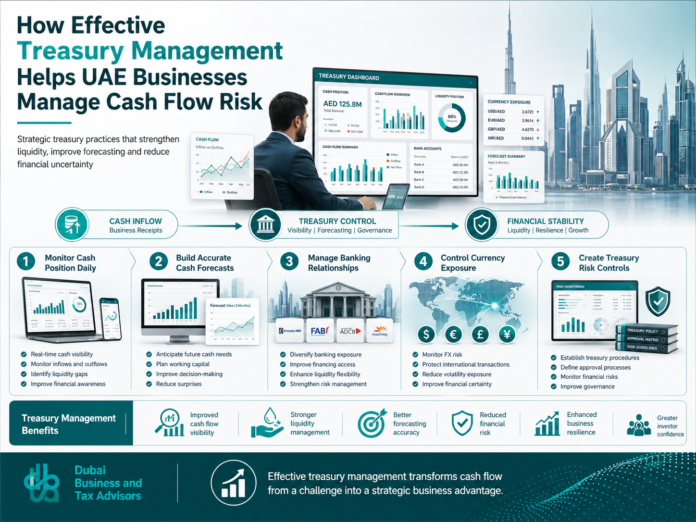
Strip away the jargon and treasury management is about one thing: ensuring the business always has the cash it needs, where it needs it, when it needs it.
That sounds straightforward. In practice it involves four interconnected functions.
Cash flow forecasting projects inflows and outflows across short-term (weekly, monthly) and longer-term (quarterly, annual) horizons. A well-built forecast does not just describe what is expected.it identifies the gaps between expected and required cash positions and creates enough lead time to act before a shortfall becomes a crisis.
Working capital management controls the three levers that determine how much cash a business ties up in its operating cycle: how quickly it collects from customers (Days Sales Outstanding), how long it takes to pay suppliers (Days Payable Outstanding), and how efficiently it converts inventory into sales (inventory days). Moving any one of these by meaningful amounts releases or requires significant cash.
Liquidity management maintains appropriate reserves and access to contingency funding so that normal business variability does not become existential.
| Function | Accounting | Finance | Treasury |
| Primary focus | Historical records | Planning and analysis | Cash and liquidity control |
| Time orientation | Backward-looking | Forward-looking | Real-time and near-term |
| Key output | Financial statements | Budgets and forecasts | Cash position and risk management |
| Cash responsibility | Records transactions | Models scenarios | Controls availability |
How Treasury Discipline Reduces Cash Flow Risk in Practice?
The most valuable thing a treasury function does is create visibility early enough to act.
A business with a rolling 13-week cash flow forecast knows six weeks in advance that a particular week will produce a shortfall because a large payment is due, three invoices are unlikely to have been cleared, and payroll falls in the same window. With six weeks of lead time, the options are wide: accelerate collection on one of those invoices, negotiate a short deferral with a supplier, draw on an available credit facility, or simply resequence payments. With three days of lead time, the same problem becomes a crisis.
Receivables management is where most UAE businesses find the fastest cash improvement. Implementing structured credit control automated payment reminders, escalation at 30 days overdue, credit limits reviewed quarterly typically reduces average collection days by 15 to 25 days in businesses where collection has previously been handled informally. On a revenue base of AED 20 million, that improvement releases AED 800,000 to AED 1.4 million of cash that was previously trapped in the collection cycle.
Payables management works in the opposite direction. Suppliers willing to negotiate extended terms in exchange for reliable, on-time payment (rather than late, irregular settlement) can effectively extend the business’s free financing window without any formal borrowing.
Liquidity buffers a reserve maintained at a level equivalent to six to eight weeks of fixed costs absorb the inevitable variability in any business without requiring emergency action every time inflows are delayed.
Why the UAE Business Environment Creates Specific Treasury Pressures?
Several structural features of operating in the UAE make treasury discipline more important than in many comparable markets.
The import-dependent nature of UAE commerce means that supply chain financing gaps are common. Goods shipped from Asia or Europe are typically paid for before they arrive, stored in a warehouse for weeks or months, and sold on credit terms. The cash conversion cycle in this model is long, and the financing requirement embedded in it is substantial.
VAT compliance creates a quarterly cash demand that catches businesses off guard when it has not been modelled. A business carrying AED 2 million in VAT collected from customers needs to have that cash available at filing time.it is not income and should never have been treated as available cash, but many finance functions lack the controls to ring-fence it effectively.
The rapid growth culture of the UAE creates its own pressures. Businesses expand headcount, open new locations, and enter new markets faster here than in most other business environments. Each of those moves generates cash demands before the new activity produces cash returns, a funding gap that treasury planning manages and that unmanaged cash positions fall into unexpectedly.
Treasury Management for SMEs vs Large Corporations
Large corporations in the UAE operate treasury functions as dedicated departments with specialised systems, hedging programmes, and centralised cash pooling across entities. That level of infrastructure is not what most SMEs need but the underlying discipline is.
An SME treasury approach focuses on three practical priorities: a rolling cash flow forecast updated weekly, a structured receivables process with clear escalation, and a defined liquidity reserve that is treated as genuinely unavailable for operational spending. These three changes alone without any specialist technology or dedicated headcount transform the cash management of most businesses that have been running on reactive instinct.
Where SMEs are most exposed is the dependency on a small number of large clients. A single customer representing 30 percent of revenue and paying consistently late creates a structural liquidity problem that no amount of internal efficiency can fully offset. Treasury discipline makes that exposure visible and creates the case for addressing it commercially through tighter credit terms, partial advance payments, or concentration risk limits.
Key Treasury KPIs Every UAE Business Should Track
| KPI | What It Measures | Why It Matters |
| Cash Conversion Cycle | Days from cash out to cash in | Lower is better; shows overall cash efficiency |
| Days Sales Outstanding (DSO) | Average days to collect invoices | High DSO means cash trapped in receivables |
| Days Payable Outstanding (DPO) | Average days to pay suppliers | Managed DPO extends available cash |
| Operating Cash Flow | Cash generated from core operations | Profitability check profit should convert to cash |
| Current Liquidity Ratio | Current assets vs current liabilities | Below 1.0 signals near-term risk |
| Free Cash Flow | Cash available after capex | Measures true financial flexibility |
Tracking these six figures monthly not quarterly, monthly gives a finance team the early warning signals that prevent cash surprises. Most businesses already have the data to calculate all six; they simply have not built the habit of reviewing them together.
Common Misconceptions About Treasury Management
The most persistent one: that treasury is for large corporations and irrelevant below a certain revenue threshold. Cash flow stress does not scale that way. An SME with AED 5 million in revenue and 90-day collection terms faces the same structural timing problem as a corporation with AED 500 million.it just has less margin for error when the shortfall arrives.
The second: that profit solves cash flow problems. It does not, and the UAE businesses that have learned this expensively are not unusual. Profit is a necessary but not sufficient condition for financial stability. Cash flow management is the other half of that equation.
Third: that accounting already covers this. Accounting records what happened. The Treasury manages what is about to happen. The two functions are complementary but they answer entirely different questions.
Practical Treasury Checklist for UAE Businesses
Businesses that find this checklist difficult to manage internally should consider that treasury management services exist specifically to build and maintain this discipline as an ongoing function rather than a periodic exercise.”
Weekly: Review actual cash position against forecast. Chase overdue receivables above agreed threshold. Confirm upcoming payment obligations for the next two weeks.
Monthly: Update rolling cash flow forecast with actuals. Review DSO and DPO trends. Assess FX exposure across active supplier and customer contracts. Review VAT cash position ahead of the filing period.
Quarterly: Full liquidity review against scenario plans. Assess credit limits and payment terms across major customers. Review banking structure for efficiency gaps.
Frequently Asked Questions
A UAE business is profitable but constantly short of cash is something wrong?
Not necessarily. It is almost always a timing issue, not a viability one. Revenue is recognised when earned but cash arrives when clients pay and when payment terms run 60 to 90 days, a profitable business can genuinely struggle for liquidity. The problem is structural and manageable, not a sign the business is failing.
What is the single most effective change a UAE SME can make to improve cash flow?
Reduce Days Sales Outstanding. Introducing structured collection processes and clear escalation at 30 days overdue typically cuts average collection time by two to three weeks within one quarter releasing significant cash without any borrowing or cost cutting required.
How much cash reserve should a UAE business maintain?
Six to eight weeks of fixed costs as a minimum. The reserve should cover salary, rent, and recurring obligations, be treated as genuinely unavailable for day-to-day spending, and be reviewed quarterly as the cost base changes.
Does FX exposure matter for UAE businesses given the AED-USD peg?
Yes. The peg covers dollar transactions but much UAE importing is priced in euros or sterling. A business buying from Europe and billing in AED absorbs currency movement on every purchase cycle, an unplanned cost most SMEs have never formally quantified.
When should a UAE business bring in external treasury expertise?
When cash shortfalls recur despite profitable trading, payroll pressure appears repeatedly in the same months, or there is no rolling forecast beyond the current month. Any one of these signals the internal approach has reached its limit.
Conclusion
Cash flow risk in the UAE is not a sign that a business is struggling. It is a structural feature of operating in a fast-moving, credit-term-driven economy where timing gaps between revenue and cash are normal and businesses that manage those gaps deliberately outperform those that discover them by accident.
Dubai Business and Tax Advisors works with UAE businesses to build that discipline from cash flow forecasting and receivables optimisation to liquidity planning and banking structure reviews so finance teams make confident decisions rather than urgent ones.
For businesses serious about sustainable growth, that foundation is not optional. Dubai Business and Tax Advisors is here to help build it.