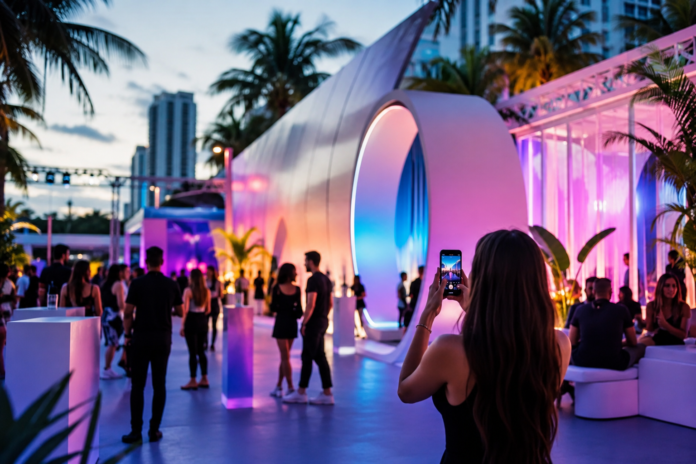

Experiential marketing transforms passive audiences into active participants through live events, brand activations, and immersive installations. In Miami’s competitive market, brands that invest in memorable, in-person experiences see stronger audience connections and longer-lasting brand recall than those relying solely on digital advertising.
Miami has always been a city that runs on energy. The art, the culture, the people—everything here moves with a pulse that’s hard to replicate anywhere else. For brands looking to make a real impression, that energy is an opportunity. Experiential marketing taps directly into it, turning brand messages into moments that people actually feel.
Traditional advertising tells people about a product. Experiential marketing lets them experience it firsthand. The difference isn’t just philosophical—it’s measurable. When someone interacts with a brand in a physical, memorable way, the emotional connection formed is far deeper than anything a banner ad or social post can create. Miami, with its density of events, foot traffic, and culturally engaged communities, is one of the best cities in the country to make that happen.
What Is Experiential Marketing and Why Does It Work?
At its core, experiential marketing is about creating live, interactive moments between a brand and its audience. This might take the form of a pop-up event, an interactive installation, a product sampling experience, or a large-scale brand activation tied to a cultural moment.
The reason it works comes down to memory. Humans form stronger memories through experience than through passive consumption. When a consumer interacts with a brand in a meaningful way—touches a product, participates in an activity, or engages with a piece of custom-built creative—that interaction sticks. They’re more likely to recall the brand later, and more likely to share the experience with others.
For marketers, that kind of organic amplification is invaluable.
How Does an Experiential Marketing Campaign Come Together?
A well-executed experiential campaign is far more than a cool idea. It requires strategic planning, precise production, and creative execution working in sync. Here’s how the process typically unfolds:
Defining Goals and Creative Concept
Every campaign starts with a clear question: what does this experience need to do? Is the goal to drive product awareness, generate social content, build community around a brand, or launch something new? The answer shapes everything that follows—the concept, the format, the venue, and the messaging.
From there, creative teams develop the event concept, build out strategy and design boards, and map the experience to specific brand objectives.
Designing the Experience
This is where the vision becomes visual. Design encompasses everything from physical décor and graphic design to custom-built structures and interactive elements. Environmental design and exhibit design play a major role in how attendees feel the moment they enter a space.
Branded premiums, printed collateral, and gifting elements are also developed at this stage—all contributing to a cohesive brand story that carries through every touchpoint.
Producing and Executing On the Ground
Production is where most experiential campaigns succeed or fall apart. Venue and vehicle procurement, staffing and training, routing and logistics, permitting, liability management—each of these moving parts needs to be managed with precision.
Strong account management and real-time reporting ensure that the client stays informed throughout, and social media integration ensures the live experience extends beyond the physical footprint into digital channels.
What Industries Benefit Most from Experiential Marketing in Miami?
Miami’s diverse economy means experiential campaigns span a wide range of sectors. Some of the industries that consistently see strong results include:
- Consumer packaged goods and retail, where sampling and product interaction drive purchase intent
- Beauty and wellness brands, which benefit from sensory, hands-on experiences
- Technology and telecom companies, looking to demo products in engaging, non-traditional settings
- Media and publishing, which often use live events to build audience communities
- Philanthropy and cause-based organizations, which use experiential formats to build emotional resonance and donor connection
Miami’s concentration of cultural events—Art Basel, Formula 1, Ultra Music Festival, and beyond—also gives brands a natural calendar of moments to activate around.
Why Work with a Boutique Experiential Marketing Agency in Miami?
Not all agencies approach experiential work the same way. Larger, generalist agencies often apply templated solutions across clients. Boutique agencies tend to take a more tailored approach—starting with a brand’s specific goals and building outward from there.
Event Rhythm is an experiential marketing agency in Miami that combines strategic thinking, creative design, and flawless on-the-ground execution. Their process begins with a deep exploration of each project’s unique needs, ensuring that no two campaigns look the same. The philosophy is simple: one design does not fit all. That kind of specificity is what separates a forgettable event from one that genuinely moves people.
Their team has delivered brand experiences across South Florida for both globally recognized companies and emerging businesses, spanning activations in advertising, technology, CPG, beauty, and beyond.
What Makes a Brand Experience Truly Memorable?
The brands that get the most out of experiential campaigns are the ones that approach every detail with intention. A few principles consistently separate high-impact activations from average ones:
- Authenticity: The experience should feel like a natural extension of the brand, not a disconnected stunt
- Interactivity: Passive observation rarely generates the same emotional response as active participation
- Shareability: Designing moments that people want to photograph, post, and talk about extends the campaign’s reach exponentially
- Precision execution: Even the best creative concept falls flat with poor logistics or untrained staff
Is Experiential Marketing Right for Your Brand?
Experiential marketing delivers the most value for brands that want to build genuine relationships with their audience—not just impressions. If your goal is to deepen loyalty, generate buzz around a launch, or stand out in a competitive market, a well-crafted live experience is one of the most effective tools available.
Miami’s market is sophisticated and brand-aware. Consumers here have seen a lot. Standing out requires more than a clever ad—it requires a moment worth remembering.
Frequently Asked Questions
What does an experiential marketing agency in Miami actually do?
A Miami-based experiential marketing agency handles everything from campaign concept and creative design to production, logistics, staffing, and post-event reporting. The goal is to create live brand experiences that connect with audiences on a personal level.
How long does it take to plan an experiential marketing campaign?
Timelines vary depending on the scale and complexity of the activation. Smaller pop-up events may come together in four to six weeks, while large-scale brand activations tied to major events can require three to six months of planning.
What types of events fall under experiential marketing?
Pop-up shops, product launch events, interactive installations, brand activations at festivals or trade shows, and sampling experiences all fall under the experiential marketing umbrella.
How do brands measure the success of experiential campaigns?
Common metrics include foot traffic, social media reach and engagement, earned media coverage, lead generation, and post-event brand sentiment surveys.
What budget do I need for an experiential marketing campaign?
Budgets vary widely based on the format, location, and duration of the activation. Working with an experienced agency helps ensure that every dollar is allocated strategically, with detailed budget forecasting built into the planning process.