
Key Takeaways
- Company vehicles can reinforce local brand awareness while driving, parked, or visiting a customer.
- Simple, high-contrast layouts are generally easier to recognize at a glance than crowded designs.
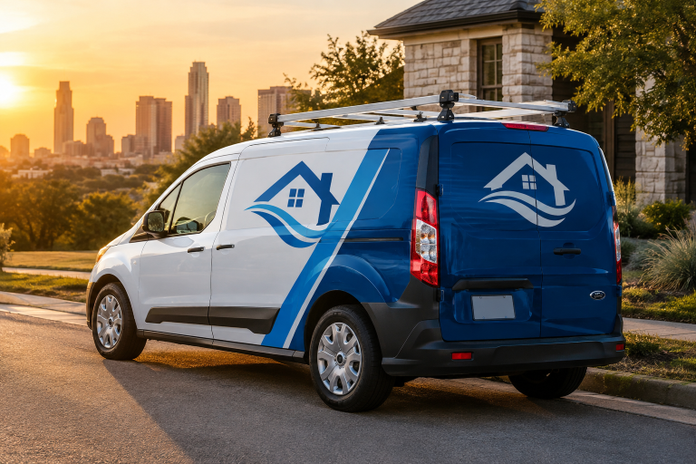
- A clear vehicle graphic identifies the business, primary service, service area, and one contact method.
- Lettering, decals, magnets, partial wraps, and full wraps can each serve different purposes and suit different budgets.
- Vehicle branding is stronger when it matches a company’s website, uniforms, signage, and social profiles.
- Customer feedback, direct traffic, branded searches, and trackable calls can help measure results.
Table Of Contents
- Introduction
- Why Vehicle Branding Works for Austin Businesses
- Design for Fast Reading
- Choosing the Right Graphic Format
- Building a Message That Sticks
- Matching Graphics to the Service Area
- Common Mistakes to Avoid
- Ways to Track Results
- A Practical Launch Plan
- Common Questions
- Conclusion
From early-morning service calls in Cedar Park to afternoon deliveries in South Austin, company vehicles spend time where local customers live, work, and shop. Hightech Signs helps businesses across the Austin area turn cars, trucks, trailers, and fleet vehicles into consistent brand assets through its vehicle wraps Austin services, which include vehicle graphics, decals, magnets, and vinyl branding solutions.
A branded vehicle should not replace a useful website, strong reviews, local search visibility, or dependable customer service. It can, however, make a business easier to recognize after people see the same name, colors, and service message in their neighborhood more than once.
Why Vehicle Branding Works for Austin Businesses
A work vehicle already travels through the communities a business serves. Whether it is moving along Mopac, parked near a job in Round Rock, or unloading supplies in Pflugerville, it can repeatedly present a recognizable identity to nearby residents and business owners.
Vehicle vinyl graphics are adhesive graphics applied to part or all of a vehicle. They can range from cut lettering and individual decals to partial and full wraps. The basic vehicle vinyl wrap format enables the use of a vehicle for advertising, custom branding, or a more unified fleet appearance.
Design for Fast Reading
A vehicle is a moving message board, so the design needs to work quickly. People may see it while waiting at an intersection, passing it in traffic, or walking past it in a parking lot. The goal is recognition, not a complete sales presentation.
Design Elements to Prioritize
- Business name or logo
- Main service or service category
- Primary city or local service area
- One phone number or short website address
- Strong contrast between lettering and background
- One memorable visual element, such as an icon or simple image
The doors and rear of a vehicle are often valuable placement areas because they are visible when the vehicle is parked or stopped. Keep the most important details away from door handles, seams, wheel wells, and heavily curved panels whenever possible.
Choosing the Right Graphic Format
Door Lettering and Small Decals
Door lettering can suit contractors, property managers, consultants, and delivery businesses that want a clean, straightforward appearance. It puts the business name and essential contact details on the vehicle without covering large areas.
Vehicle Magnets
Magnets can be practical for shared vehicles or personal cars used for work. They should be removed periodically so the surface and magnet can be cleaned, helping prevent dirt and moisture from collecting underneath.
Partial and Full Wraps
Partial wraps add substantial color and visual interest while leaving some original paint visible. Full wraps create a more complete branded look and can be a sensible choice when the vehicle itself is central to the customer experience.
- Choose lettering when clarity and a modest starting investment are priorities.
- Choose magnets when removable branding matters.
- Choose a partial wrap when the design needs more color and visual range.
- Choose a full wrap when the vehicle should make a bold brand impression.
Building a Message That Sticks
The strongest vehicle messages are short enough to understand quickly. Start with the business name, state the primary service, add a location cue if useful, and provide one clear contact option. Details that cannot be read from a short distance belong on the website, not on the vehicle.
For example, “Emergency Plumbing, Austin, Call 512-000-0000” is easier to scan than a long list of services, credentials, discounts, and social media handles. A focused statement gives viewers something they can remember when they later need that service.
Matching Graphics to the Service Area
Austin businesses should use accurate geographic language. A company that regularly serves Austin, Bee Cave, Lakeway, Cedar Park, and Round Rock can communicate that regional reach, while a smaller operation may be better served by naming Austin and its immediate service area.
Local relevance also comes from consistency. The same logo, colors, and tone should appear on the vehicle, estimate forms, yard signs, uniforms, invoices, and online profiles. When a prospect sees the vehicle outside a neighbor’s home and later encounters the same identity online, the business is easier to connect and recall.
Common Mistakes to Avoid
- Using too many words, phone numbers, or calls to action
- Choosing colors with weak contrast
- Placing key information across seams, handles, or windows
- Enlarging a low-quality logo until it looks blurry
- Ignoring curves, bumpers, mirrors, and body lines
- Giving each fleet vehicle a different look without a clear reason
- Neglecting cleaning, inspection, and repair of damaged graphics
- Expecting visibility alone to create immediate sales
Ways to Track Results
Brand recall is not always measured by an instant phone call. Businesses can still look for useful signals by asking new customers how they heard about the company, using a trackable phone number, monitoring branded searches, and comparing direct website visits before and after installation.
A short web address can be easier to remember than a long URL. QR codes can also help if they are large enough to be scanned safely while the vehicle is parked. Customer comments such as “I keep seeing your truck around my neighborhood” are valuable qualitative feedback.
A Practical Launch Plan
- Set the goal: Decide whether the vehicle should build awareness, generate calls, support a new service, or create a more professional appearance for the fleet.
- Define the audience: Identify the neighborhoods, property types, or industries the vehicle most often reaches.
- Gather brand files: Provide approved logos, colors, fonts, photos, and contact information.
- Compare layouts: Review a simple option, a bolder option, and an image-led option.
- Check readability: View the proof from several feet away and consider how it will look outdoors.
- Track feedback: Record calls, leads, branded searches, and customer comments after installation.
Common Questions
Are Vehicle Graphics Only for Large Fleets?
No. One service van, pickup, trailer, or company car can improve local visibility. A fleet simply creates more opportunities to repeat the same message on different routes.
Is a Full Wrap Always Better Than a Partial Wrap?
No. The better option depends on the vehicle, budget, brand style, and marketing goal. A clean partial wrap can be more effective than a full wrap with too much information.
Can Vehicle Graphics Support Other Marketing?
Yes. They can reinforce local search listings, digital ads, uniforms, storefront signs, printed materials, and social posts when the business uses the same visual identity across channels.
Conclusion
For Austin businesses, a branded vehicle is most useful when it communicates one clear idea repeatedly across the routes customers already travel. A readable identity, focused service statement, accurate service area, and consistent design can turn ordinary driving into a practical part of a broader local marketing system.