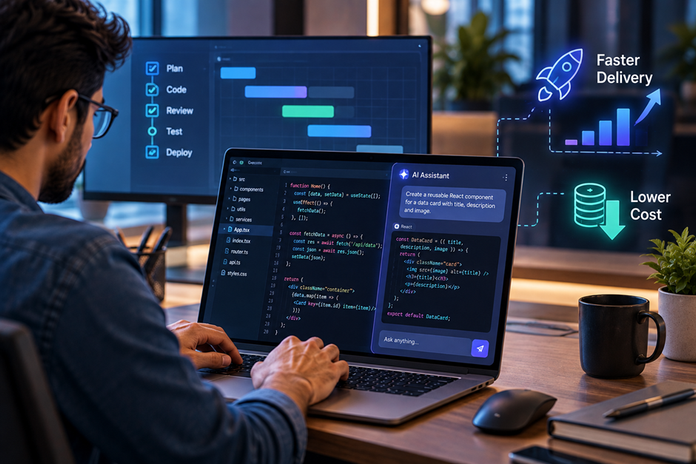

AI application development services are being reshaped by a new generation of coding assistants. Tools that once offered autocomplete now draft code, write tests and refactor across a codebase, changing how fast software ships and what it costs to build. The shift is real, but it is not a free lunch, since the gains come with new demands on review and governance. This article looks at how AI coding assistants change delivery speed and cost, where human engineers still matter and how teams capture the benefit without inheriting the risk.
AI coding assistants use AI to help write, test and review software, speeding delivery and lowering the cost of routine engineering while shifting more effort toward review and human oversight.
What AI Coding Assistants Do
AI coding assistants generate code from natural-language prompts, complete code as it is written, draft tests and explain or refactor existing code. The newer tools go further, acting as agents that carry out multi-step tasks across a project rather than suggesting a single line. In practice, an assistant can scaffold a new service, write the boilerplate and draft a first set of tests in minutes. What it cannot do is decide whether any of that is the right thing to build, which is where the engineer stays in control.
The range of tools matters here. Simple assistants stay inside the editor, completing code and answering questions, while agentic tools can plan and execute a task across several files with limited supervision. The more autonomy a tool has, the more it can do and the more careful the review has to be. A sensible team matches the autonomy to the risk, giving an assistant free rein on low-stakes scaffolding while keeping a tight hand on anything that touches security or core logic.
How They Change Delivery Speed
The clearest effect is on the repetitive work that fills much of a developer’s day. Boilerplate, tests, data models and routine integrations are drafted far faster, so more of each cycle goes to the parts that need judgment. The points below are where the speed shows up most.
● Faster first drafts: assistants produce working first-pass code and tests quickly, so engineers edit and review rather than start from a blank file.
● More work in parallel: routine tasks can run alongside the harder design work instead of queuing behind it.
● Quicker onboarding: developers use assistants to explain an unfamiliar codebase, cutting the time to a first contribution.
● Shorter feedback loops: drafting tests and catching simple issues earlier shortens the path from idea to a reviewable change.
The result is a faster path through the routine parts of delivery. The catch is that speed on the first draft is only a saving if the review and testing behind it keep pace, which is where cost comes in.
How They Change Cost
On the surface, assistants lower the cost of building software by cutting the hours spent on routine engineering. The real picture is more careful. Faster is not automatically cheaper, because the generated code still has to be reviewed, tested and maintained. That effort moves upstream rather than disappearing. There is also the direct cost of the tools and the inference they run on. Net savings are real where teams pair the speed with strong review and governance, and thinner where unreviewed output creates defects that cost more to fix later than they saved to write.
Where Human Engineers Still Matter
AI handles the volume, but accountability stays with people. The decisions that carry real consequences still belong to engineers. The areas below are where human judgment remains the difference between fast and reckless.
● Architecture and design: the shape of the system and the trade-offs behind it need judgment an assistant cannot supply.
● Security and correctness review: generated code can be plausible and wrong, so a person has to verify it before it ships.
● Context the model lacks: business rules, edge cases and intent live outside the codebase, where only the team can bring them in.
● Ownership of the result: accountability for what reaches production stays with the engineer, not the tool that drafted it.
The pattern that works is augmentation, not replacement. The assistant removes the manual load while experienced engineers stay responsible for the architecture, the review and the result.
Capturing the Value Without the Risk
The teams that gain from AI coding assistants treat them as part of a disciplined process, not a shortcut around one. The practices below are what keep the speed from turning into technical debt. Each pairs the gain with the control that protects it.
● Keep review non-negotiable: every AI-generated change goes through the same review and testing as human-written code.
● Build security in: scan and review generated code for vulnerabilities rather than assuming it is safe.
● Measure real outcomes: track delivery speed and defect rates, so the benefit is proven rather than assumed.
● Set clear usage standards: agree where assistants help and where they do not, so use is consistent across the team.
Handled this way, AI application development services become faster and more cost-effective without lowering quality. Engineering partners such as Successive Digital build these assistants into the development lifecycle with review, security and governance kept firmly in place.
Conclusion
AI coding assistants are changing software delivery by taking over the routine work that slowed it down, which speeds delivery and lowers the cost of building. The gain is real, but it depends on keeping review, security and accountability with human engineers rather than handing them to the tool. Teams that pair the speed with discipline ship faster and cheaper, while those that skip the review trade a short-term saving for a longer-term bill. Used well, these tools raise what a team can deliver without lowering what it can trust. Firms offering AI application development services, including Successive Digital, are building exactly that balance into how modern software gets made.