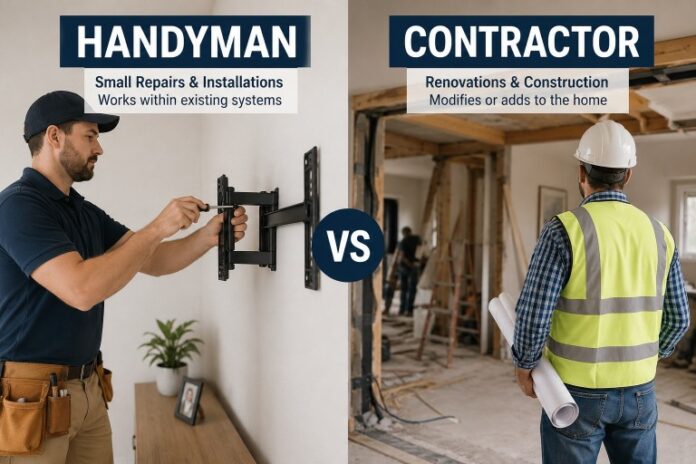

One of the most common and most expensive points of confusion for Toronto homeowners is the difference between a handyman and a contractor. Hire a contractor for a job a handyman handles in an hour and you overpay — often by a factor of three. Hire a handyman for a job that genuinely needs a licensed contractor and you risk work that fails inspection, voids insurance, or has to be redone. The two roles overlap in the middle, which is exactly where the confusion lives. This guide draws the line clearly, with the specific jobs that fall on each side and the grey-zone cases that could go either way.
The core difference is scope. A handyman handles small repairs and installations that work within a home’s existing systems — mounting, patching, assembling, fixture swaps, adjustments. A contractor handles larger projects that modify or add to those systems — renovations, additions, new construction, and anything requiring permits, licensed trades, and inspections. Knowing which category a job falls into is the single most useful thing a homeowner can figure out before making any calls. When a job is clearly handyman-scale, the fastest path is to compare local handyman options through a single channel rather than requesting contractor quotes for work that does not need one.
What a handyman does
A handyman is a generalist who handles the broad category of small jobs that do not justify a contractor. The defining trait is that the work stays within existing systems rather than modifying them:
- TV mounting, shelf and mirror hanging, picture hanging
- Furniture assembly
- Drywall patching and small repairs
- Faucet, showerhead, and toilet replacement
- Light fixture and ceiling fan swaps on existing wiring
- Door repair, adjustment, and hardware replacement
- Caulking, weatherstripping, and small moisture fixes
- Cabinet hardware, closet organizers, and storage build-outs
- Smart-home device installation on existing setups
- Seasonal maintenance and small exterior repairs
Handymen typically charge by the hour ($90 to $140 in Toronto in 2026) or a flat rate per small job, and most work is completed in a single visit. They are the right call for the repair-and-install list that accumulates in any home.
What a contractor does
A contractor manages larger projects that involve multiple trades, permits, and structural or system changes. The defining trait is that the work modifies or adds to the home rather than maintaining it:
- Kitchen and bathroom renovations
- Additions, extensions, and new construction
- Removing or moving walls (structural changes)
- New electrical circuits, panel upgrades, and rewiring
- New plumbing runs, repiping, and water heater replacement
- Gas line work and HVAC installation
- Roofing, foundation, and major exterior work
- Basement finishing and legal suite conversions
Contractors usually price by project rather than by the hour, pull permits, coordinate licensed trades, and manage timelines that run weeks to months. They carry different insurance and, for regulated work, hold or subcontract to the appropriate licenses.
The grey zone: jobs that could go either way
Some jobs sit genuinely in the middle, and the answer depends on the specifics:
Plumbing fixtures. Replacing a faucet or toilet is handyman work when the shut-off valves are modern and functional. But in a pre-1940 Toronto home with corroded valves that may fail when turned, the job can cross into plumber territory the moment a valve needs replacing.
Electrical fixtures. Swapping a light fixture or installing a ceiling fan on existing modern wiring is handyman scope. The moment aluminum or knob-and-tube wiring appears behind the box — common in older Toronto homes — the work belongs to a licensed electrician.
Tiling. Repairing a few loose backsplash tiles is handyman work; tiling an entire bathroom as part of a renovation is contractor scope.
Appliance installation. Installing a dishwasher where the connections exist is often handyman scope; adding the electrical and plumbing rough-in where none existed is trade work.
A capable Toronto handyman recognizes these transitions during the job and stops rather than improvising past the line — and that candour is a sign of someone worth hiring.
A simple decision rule
The rule that resolves almost every case: if the job works within what is already there, it is a handyman job; if it modifies or adds to the electrical, plumbing, gas, or structure, it needs a contractor or licensed trade. Replacing a fixture — handyman. Adding a new one where none existed — trade. Patching a wall — handyman. Removing a wall — contractor. Fixing a deck — handyman. Building a deck — contractor. When in doubt, describe the job to the provider and ask directly whether it falls within their scope; a good one will tell you honestly, even when the answer sends the work elsewhere.
Why hiring the right one saves money
The cost difference is real in both directions. A contractor’s minimum engagement and project-based pricing make small jobs disproportionately expensive — paying a renovation-scale operator to mount a TV or patch drywall wastes money. In the other direction, hiring a handyman for work that needs a licensed contractor risks unpermitted electrical or structural work that complicates insurance, fails at resale inspection, and requires expensive remediation to bring up to code. The savings from cutting the corner reappear later as a larger cost.
The bottom line for Toronto homeowners
For the steady list of small repairs and installations that every home generates — mounting, patching, assembling, fixture swaps, adjustments — a handyman is the right, cost-effective choice, and comparing a few local handyman options by job type is the fastest way to book one. For renovations, additions, and any work that changes the home’s electrical, plumbing, gas, or structure, a contractor is the correct and legally necessary choice. The homeowners who manage repair costs best are simply the ones who correctly identify which category a job falls into before they start making calls — and who are not talked into contractor-scale spending for handyman-scale work, or into handyman-scale hiring for work that genuinely needs a licensed trade.