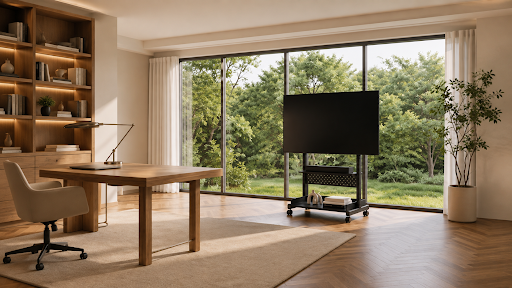

A flexible TV setup in a multipurpose room should be planned around how the room changes, not around the assumption that the television needs to stay in one permanent spot. Start by identifying the furniture and areas that rarely move, then decide which positions the TV needs to serve during different uses of the room. In some spaces, changing the viewing angle is enough. In others, the screen may need to move between two clearly defined positions.
The goal is not to make the TV movable for its own sake. It is to make sure the screen can adapt without forcing the rest of the room to revolve around it.
Start With What Already Has a Fixed Place
Before deciding where the TV should go, identify the parts of the room that are difficult or impractical to move.
A desk may need to stay near power outlets and network equipment. A sectional sofa, sleeper sofa, large storage cabinet, doorway, or window can also place clear limits on the usable layout. Main walking paths matter as well because moving the TV should not require people to weave around furniture.
These fixed elements should usually be established first.
For example, in a room that doubles as a home office, the desk may be used every day and depend on several connected devices. Moving that desk just to create a better TV position would make little sense. The television is often the more adaptable element, so its placement should work around the established workspace rather than dictate it.
Once the fixed parts of the room are clear, it becomes much easier to decide where the screen actually needs to be.
Give the TV a Clear Position for Each Main Room Use
Flexible placement does not mean finding a new place for the television every time the room changes. A more practical approach is to give the TV one or two planned positions that correspond to the room’s main uses.
| Room Setup | TV Position | Why It Works |
| Workspace + evening lounge | Outside the main desk sightline during work, then facing the seating area later | Keeps work and viewing zones from competing |
| Living area + workout space | Parked beside the seating zone when more floor space is needed | Preserves the open area for exercise |
| Guest room + media space | Positioned for everyday viewing, then moved clear of the temporary sleeping area | Lets the room change use without a full furniture reset |
The important point is that each position should solve a specific layout need.
A room used for work during the day and entertainment at night may need one position that keeps the screen from dominating the desk area and another that gives the sofa a direct view. A workout space may need the TV nearby for exercise content but moved to the edge when the central floor area is required.
Not every multipurpose room needs several TV positions. If the television works equally well across the room’s main uses, keeping it in one place may be the simpler solution.
Decide Whether the TV Needs to Turn or Move
The most useful question is whether the screen needs to change its angle or its location.
If the TV can remain in one part of the room but needs to face different seating or working positions, swivel adjustment may be enough. For example, a screen positioned between a sofa and desk may only need to turn toward whichever area is being used.
If the television needs to leave one functional zone and enter another, the problem is different. A room may need the TV beside the desk during a presentation, closer to the sofa for evening viewing, or moved away entirely when floor space is needed.
A rolling TV stand is most useful in this second situation, where the screen needs to move between defined positions rather than simply change direction.
Mobility should therefore respond to an actual layout change. A multipurpose room does not automatically need a movable television. If the screen stays in essentially the same place across every use, a fixed stand or wall-mounted setup may remain more practical.
Plan the Route Between TV Positions
Once two useful TV positions have been identified, check whether the television can actually move between them without disrupting the room.
Think of the route as Position A to Position B, rather than assuming the TV needs unrestricted movement everywhere.
Check whether desk corners, chairs, doors, or other furniture narrow the path. Rugs and changes in floor level can also affect how easily a movable setup passes through the room. More importantly, the TV should not arrive at its second position only to block a doorway or the main walking route.
Power access also needs to work at both destinations. If the TV reaches a useful viewing position but the power cable then has to cross the middle of the room, that position is not genuinely practical.
This is why a clear route matters as much as mobility itself. A movable screen is useful only when it can reach the places where the room actually needs it.
Keep the TV From Taking Over One Function of the Room
In a multipurpose room, the television should support the current use of the space rather than make every use conform to the TV.
A room that doubles as a workspace, for example, does not necessarily benefit from having the screen directly in front of the desk all day if it is mainly used for entertainment. The TV can remain off to the side during work and face the seating zone later.
The same principle applies to workout or guest use. A screen can be useful for exercise content without permanently occupying the open floor area, while a temporary sleeping setup should not have to fit around a TV that cannot be repositioned.
Flexibility is valuable when it allows each room mode to function properly, not when it simply adds another movable object.
Choose Flexibility Around How the Room Actually Changes
The right TV setup depends on how often the room changes and whether the screen genuinely needs to change with it. FITUEYES offers freestanding TV solutions for spaces where television placement needs to adapt as the same room shifts between work, viewing, exercise, or guest use.
The most flexible setup is not the one that can move anywhere. It is the one that can reach the few positions the room actually needs without making everything around it harder to use.