
Ask any plumbing business owner what eats up their day outside of actual plumbing work, and scheduling is almost always near the top of the list. Someone calls with a leak. Someone else needs a quote. A technician finishes early and now needs a new job on the other side of town. By the afternoon, the whiteboard or spreadsheet you started the day with barely resembles reality anymore.
That’s the problem scheduling automation actually solves. Just a practical fix to a very ordinary daily headache. Heading into 2026, more plumbing companies are moving away from manual scheduling, and it’s worth understanding exactly why, and what to look for if you’re considering it.
What Does Scheduling Automation Actually Mean for a Plumbing Business?
Scheduling automation simply means your booking, dispatching, and job assignments happen through software instead of a person manually juggling a calendar, a phone, and a group chat with technicians.
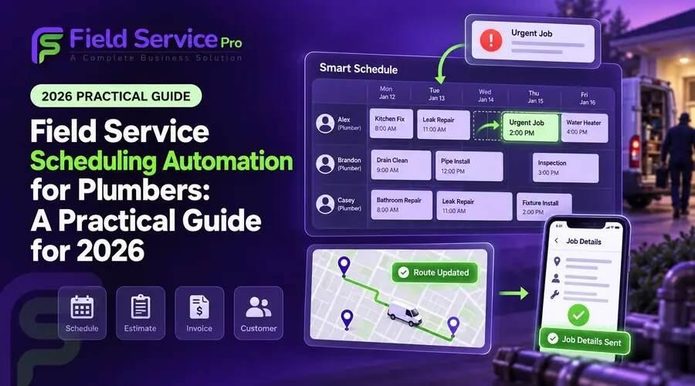
A customer calls or books online, the system checks which technician is closest and free, the job gets added to that technician’s route automatically, and everyone, the customer, the office, and the plumber, gets notified without anyone having to type out a text message.
It’s not about replacing the judgment of your dispatcher or office manager. It’s about removing the repetitive, error-prone parts of the job so people can focus on the calls that actually need a human decision, like a tricky emergency or a customer with special requests.
Why Is This Becoming So Important for Plumbers in 2026?
A few real shifts are pushing plumbing companies toward automation this year, and none of them are hype.
- Customers expect faster responses.
People are used to booking a ride or ordering food and getting instant confirmation. When they call a plumber and have to wait for a callback just to get a time slot, it feels slow by comparison, and slow often means they call the next plumber on the list.
- Labor is tight.
Skilled technicians are hard to find and expensive to train. Every hour a plumber spends waiting around because of a scheduling mix-up is an hour that a stretched labor market can’t afford to waste.
- Emergency calls are unpredictable by nature.
A burst pipe doesn’t wait for a convenient time. Automated scheduling helps a company slot in urgent jobs without completely wrecking the rest of the day’s plan, something that’s much harder to do by hand under pressure.
- Small teams are competing with bigger ones.
A two-truck plumbing company using smart scheduling can respond almost as fast as a twenty-truck company. That levels the playing field in a way that wasn’t really possible before.
How Does Scheduling Automation Actually Save Time and Money?
It helps to think about where the waste happens without automation, because the savings come directly from fixing those spots.
- Less driving, more working.
When jobs are assigned based on location instead of whoever picks up the phone first, technicians spend less time stuck in traffic between jobs on opposite sides of town and more time actually working.
- Fewer double-bookings.
Manual calendars are prone to human error, especially when more than one person is booking jobs. Automated systems catch conflicts before they happen instead of after a customer is already upset.
- Faster response to emergencies.
Because the system already knows who’s free and where, urgent jobs can be slotted in within minutes instead of someone making phone calls to figure out who can go.
- More jobs fit into each day.
Tighter, smarter routing usually means an extra job or two gets done that would have otherwise been impossible to fit in, which adds up fast over a month.
Why Does This Connect Directly to Your CRM?
Something that a lot of plumbing companies miss. Scheduling automation only works really well when it’s connected to good customer information. That’s where a CRM for plumbers comes in.
A CRM, or customer relationship management system, holds the history for every customer, their address, past jobs, equipment installed, and notes from previous visits. When scheduling automation is built on top of that data, it becomes much smarter. The system can automatically send the technician who already worked on that property before, flag that a customer is on a maintenance plan, or warn the dispatcher that a job usually takes longer than expected based on past visits.
Without a CRM behind it, scheduling automation is just a calendar that fills itself in. With a CRM behind it, it becomes a tool that actually understands your customers and your business.
This is why, when plumbing companies search for the best CRM for plumbers, they’re often really looking for something broader than just contact storage. They need a plumbers CRM that’s tightly connected to scheduling, dispatch, and job history, not a separate piece of software that has to be manually kept in sync.
What Should You Look for in a Plumbers CRM With Scheduling Built In?
If you’re evaluating options for 2026, a few things matter more than flashy features.
- Real-time technician availability: The system should know who’s free right now, not rely on someone manually updating a status.
- Location-based job assignment: Jobs should go to the nearest available technician automatically, cutting down on wasted drive time.
- Full customer history tied to every job: When a job gets booked, the assigned technician should immediately see everything relevant about that customer and property.
- Mobile-first design: Your technicians live on their phones in the field, not at a desk. If the system isn’t smooth on mobile, it won’t get used properly.
- Simple enough for your whole team: The most advanced scheduling engine in the world doesn’t help if your office staff or technicians find it confusing. Automation should make the day simpler, not add a new layer of complexity to manage.
Why FieldServicePro Is Built for This Exact Need
This is precisely the gap FieldServicePro was designed to fill. Rather than treating scheduling and customer records as separate tools bolted together, FieldServicePro combines them into one connected system built specifically for plumbing and field service businesses.
Jobs are automatically matched to the right technician based on location and availability. Every job pulls from a full CRM record, so nobody’s guessing about a customer’s history or previous work. Technicians see their day clearly from their phone, updates happen in real time, and emergency calls can be slotted in without throwing off the whole schedule.
For plumbing companies heading into 2026 who want to respond faster, waste less drive time, and keep customers coming back, FieldServicePro brings the CRM and scheduling automation together in one place, built to be simple enough for a small team and powerful enough to grow with the business.
The Bottom Line
Scheduling automation isn’t about replacing the people who run your plumbing business. It’s about giving them a system that removes the daily guesswork, connects to real customer history, and lets emergency calls get handled without chaos. Paired with a strong CRM for plumbers, it’s one of the most practical upgrades a plumbing business can make heading into 2026, and FieldServicePro was built to deliver exactly that