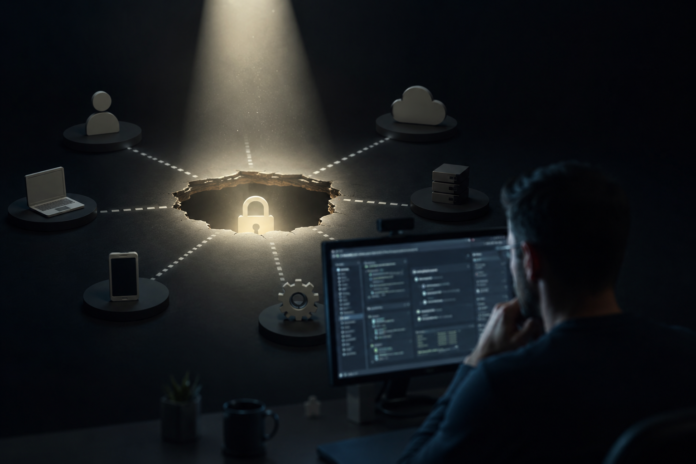

Cybersecurity problems do not always start with a dramatic hack or an obviously suspicious email. More often, attackers find their way in through something far less exciting: an old account nobody remembered to delete, a device that missed a software update, or an employee who reused a password.
These small gaps can be easy to overlook, especially when a business is growing quickly or juggling dozens of competing priorities. Unfortunately, cybercriminals are very good at finding the weak spots organizations miss. Here are some of the cybersecurity blind spots businesses should be paying closer attention to.
Forgotten User Accounts
When someone leaves a company, their access should leave with them. That sounds simple, but old employee accounts can remain active for months or even years if there is no clear offboarding process.
Every unused account creates another potential way into company systems. Businesses should regularly review user access and remove accounts, permissions, and credentials that are no longer needed. It is also worth checking whether employees have accumulated access to systems that are no longer relevant to their roles.
Unmanaged Devices
Laptops are not the only devices connected to a business network. Employees may also use smartphones, tablets, printers, smart office equipment, and personal devices.
If these devices are not properly managed, updated, and monitored, they can become weak points. Businesses should know what is connecting to their networks and have clear policies covering personal devices, remote access, and software updates.
Not Paying Attention to Security Alerts
Modern businesses generate huge amounts of security data. The problem is that collecting information is not particularly useful if nobody is actively reviewing it.
Security teams can quickly become overwhelmed by alerts, making it difficult to distinguish genuine threats from everyday noise. Services such as managed SIEM can help organizations centralize security information, monitor activity, and investigate potential threats more effectively.
The goal is not simply to generate more alerts. It is to make sure suspicious behavior is noticed and acted on quickly.
Third-Party Access
Businesses increasingly rely on outside software providers, freelancers, contractors, and other partners. These relationships can make operations much easier, but they can also introduce cybersecurity risks.
A third party with access to sensitive systems or data should not automatically be treated as safe. Businesses need to understand what information suppliers can access, how that access is protected, and whether it is still necessary.
Human Error
Employees are often described as a cybersecurity weakness, but that does not mean businesses should blame individuals whenever something goes wrong. People make mistakes, particularly when security procedures are confusing or inconvenient.
Regular training can help employees recognize phishing attempts, suspicious login requests, social engineering, and other common threats. Just as importantly, security policies should be straightforward enough for people to actually follow.
Assuming “It Won’t Happen to Us”
Perhaps the biggest blind spot is believing a business is too small, too ordinary, or too well protected to become a target.
Cybersecurity is not something that can be set up once and forgotten. New vulnerabilities appear, employees change roles, technology evolves, and attackers adapt their methods.
Businesses that regularly review their security, monitor what is happening across their systems, and deal with small weaknesses before they become bigger problems are far better placed to reduce their exposure. In cybersecurity, the risks you are not looking for can often be the ones that cause the most damage.