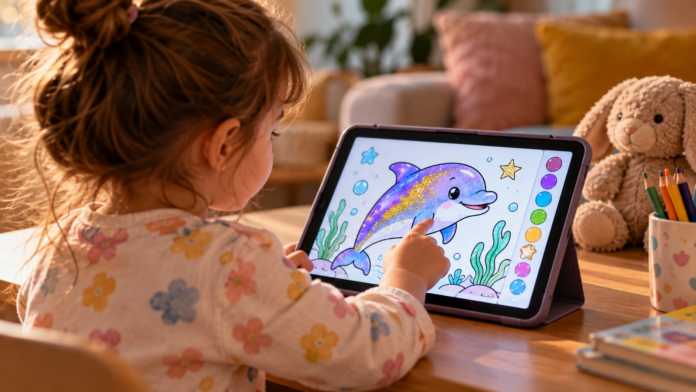

There is an unspoken hierarchy in children’s art. Finger painting beats everything. Watercolors are charming. Crayons on paper are classic. Coloring on a tablet, though, tends to get filed somewhere near the bottom of the list, behind “real” art and somewhere above “probably should have gone outside instead.” This ranking is worth questioning. Coloring games do considerably more than most parents give them credit for, and the case for them is stronger than it might look when your child is hunched over a screen at the kitchen table.
What Coloring Actually Builds
Before getting into where the screen version fits, it helps to remember what coloring does in the first place. It is not passive. Every time a child picks a color, decides where to apply it, and fills in a section, they are making a genuine creative decision. Doing that repeatedly across a picture builds aesthetic judgment, i.e., a sense of how things look and what feels right.
Coloring also builds focus in a format that young children find genuinely accessible. There is a clear start, a clear end, and visible progress along the way: three things that help a young brain stay oriented during a task. And the fine motor work of dragging, tapping, and filling in shapes maps closely to the hand control children develop for writing and drawing.
What the Screen Version Adds
Physical coloring has one design flaw: stakes. A wrong color choice on paper is permanent. Running out of the exact shade of blue needed is a small tragedy. Accidentally coloring outside the lines on a beloved picture is, at age four, a genuine crisis. Parents who have witnessed these know what follows, and how it is the opposite of moving on.
Digital coloring removes all that. Colors can change. Mistakes disappear. The palette never runs dry. And the range of tools available on screen — sprays, glitter, stickers, brushes — opens up creative possibilities that no set of crayons in the cupboard can match. This is not a downgrade from physical art. It is a different medium with its own set of advantages, the way a camera is different from a sketchbook rather than inferior to it.
Character Counts for More Than You Think
One thing coloring games do particularly well is pair creativity with characters children already care about. A child will spend three times as long on a coloring page featuring a favorite character as they will on a generic outline of a house.
Our Moonbug’s Little Angel™ section puts coloring right at the heart of the Baby John™ universe. Your kid gets to color pages featuring Baby John™, Jill, Jack, and Bingo, then finish each picture with glitter and stickers for a result that feels entirely their own. The emotional investment in those characters makes the creative work feel meaningful rather than arbitrary, and a child who is genuinely invested in what they are making stays in the creative zone for much longer.
Tools That Expand the Possibilities
Coloring Pad takes a broader approach to the question of what digital coloring can be. Like its Moonbug’s Little Angel™, its toolkit includes crayons, paints, spray paint, glitter, and stickers, but the subject range covers pets, sea animals, seasonal scenes (ghosts for Halloween, Santa Claus for Christmas), yummy treats, and the cast of Captain Kidd & Friends. Your child might spend one session quietly painting a dolphin with a careful selection of blues (and some gold glitter), and the next going at a holiday scene with spray paint and zero cares and apologies. Both are valid artistic choices.
Where the Screen Belongs in Coloring
Coloring games are not trying to replace clay, finger paint, or an afternoon with wax crayons and coloring sheets. They are their own thing: a creative space that removes the logistical friction of physical art, opens up tools and characters no physical medium can replicate, and meets children in the format they already gravitate toward. For parents wondering whether screen time and creative development can coexist, coloring games are one of the clearest answers available. The art your child makes on a screen is still art. The choices they made to get there are still creative. And the purple dolphin with gold glitter is still going to need a place of honor — dare we suggest it replace the wallpaper on your iPad?