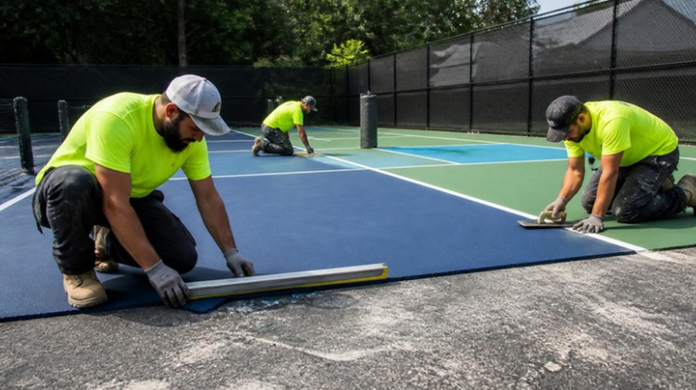

Pickleball has grown faster than almost any recreational sport, and courts are going in across backyards, clubs, schools, and community associations. Planning errors surface repeatedly in projects, and property owners commissioning pickleball court installation in Atlanta can avoid most of them by making a few key decisions before construction begins. Nearly every expensive correction traces back to something settled incorrectly during design rather than during the build. Recognizing those pressure points early keeps a project on budget.
Skipping the Site Evaluation
Ground conditions dictate everything that follows. Soil composition, existing slope, tree root systems, and drainage patterns determine excavation depth and base construction, and none of them can be assessed from a satisfactory site photograph. Courts built on unevaluated ground settle unevenly and crack within a few seasons. A proper evaluation costs very little compared with rebuilding a failed slab two years later. Georgia clay in particular holds water and moves seasonally, which makes base depth and compaction decisions genuinely site-specific rather than standard.
Undersizing the Playing Area
The playing surface measures twenty by forty-four feet, but that figure alone strands many projects. Regulation play requires surrounding run-off space, with a total recommended footprint closer to thirty by sixty feet. Courts squeezed into a smaller area force players to pull up short near fences and walls, raising injury risk and frustrating competitive use. Confirming the full footprint before committing prevents a court nobody wants to play on. Properties without room for full clearance are often better served by a deliberately planned, slightly reduced recreational layout than by a regulation court crammed against a boundary.
Choosing the Wrong Surface System
Post-tensioned concrete with acrylic coating, asphalt with a cushioned overlay, and modular tile each behave differently under Georgia weather. Concrete resists movement and lasts longest with periodic resurfacing, while modular systems add cushioning and drainage over an existing base. Choosing a system based on price alone often results in a surface that doesn’t match how the court will actually be used. Anticipated play frequency, climate exposure, and expected service life should drive the specification together. A court hosting daily organized play answers to different requirements than one used occasionally by a single household.
Ignoring Orientation and Lighting
Courts oriented incorrectly put low sun directly in players’ eyes through the most popular hours of the day. North-to-south alignment resolves that problem and costs nothing when addressed during layout. Lighting deserves the same early attention, since fixture placement and conduit routing are far cheaper before paving than after. Retrofitting light poles into a finished court means cutting and patching a surface that was just completed, at considerable cost. Wind direction and prevailing shade patterns deserve the same consideration during layout.
Underestimating Fencing and Noise
Paddle impact carries a sharp, repetitive sound that travels farther than most owners expect, and neighbor complaints have shut down otherwise successful installations. Fence height, acoustic screening, and setback distance can meaningfully reduce that friction. Association rules and municipal ordinances may also govern fence height, lighting hours, and permitted play times. Confirming those requirements during design avoids expensive modifications later.
Treating Maintenance as Optional
A finished court still needs cleaning, drainage clearing, crack monitoring, and periodic resurfacing on a defined schedule. Debris left standing traps moisture along the same lines each season and accelerates surface breakdown. Owners who plan for those intervals from the beginning spend far less across the life of the court. Deferred attention converts routine upkeep into structural repair surprisingly quickly.
Conclusion
Most failed courts were compromised on paper before a single truck arrived. Site evaluation, adequate footprint, an appropriate surface system, correct orientation, thoughtful fencing, and a realistic maintenance plan address the overwhelming majority of problems that appear later. Working through those decisions with an experienced contractor for a sport court in Atlanta turns a significant investment into a surface that performs for decades. The planning stage remains the least expensive place to solve any of it.